Hair, skin & fatigue
Blood tests for hair loss: ferritin, thyroid and vitamin D
If more hair than usual is collecting on your brush, pillow and shower drain, a short list of blood tests can often reveal why. This guide walks through the UK first-line panel for diffuse shedding — ferritin, thyroid, Full Blood Count, vitamin D and B12 — what each number means, and when the answer is not in your blood at all.
- Standard first-line bloods
- Ferritin, TSH (± Free T4), Full Blood Count, vitamin D and vitamin B12 (± folate).
- Most common hidden cause
- Low iron stores — a low ferritin — often before anaemia shows on the FBC.
- Ferritin for hair
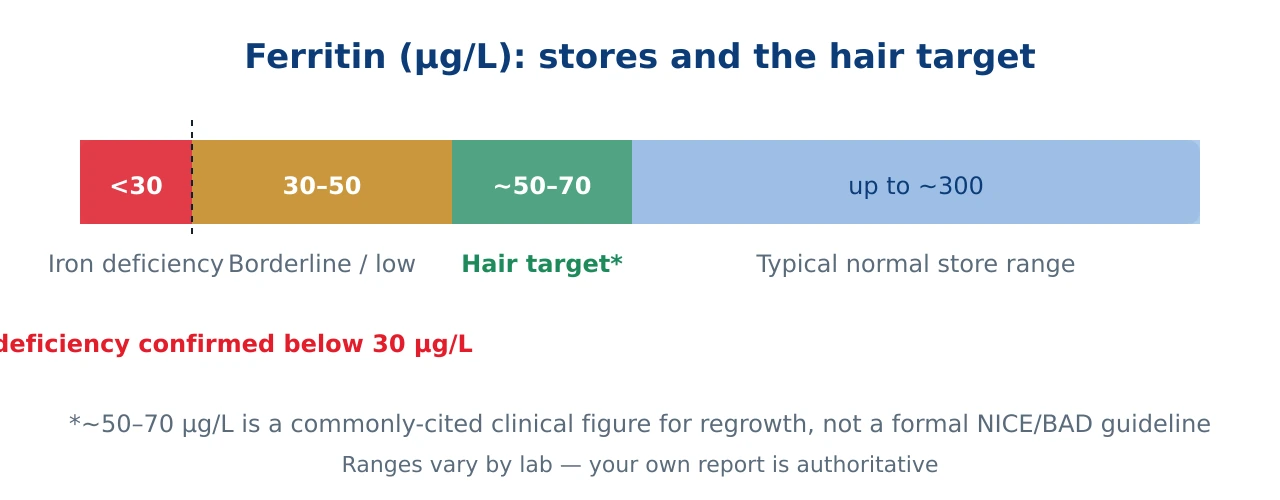
- Deficiency is confirmed below 30 µg/L; many clinicians aim higher (~50–70 µg/L) to support regrowth — a commonly-cited figure, not a formal guideline.
- Remember
- Not all hair loss shows in blood, and regrowth takes months. Your own lab's ranges are authoritative.
Losing 50 to 100 hairs a day is normal — you carry around 100,000 hairs on your scalp, so a certain amount of shedding is simply the growth cycle turning over. What sends people to their GP is a change: a ponytail that feels thinner, a wider parting, or handfuls of hair coming out in the shower. When that shedding is spread evenly across the whole scalp rather than in patches, blood tests are one of the most useful first steps, because a few quiet, treatable imbalances turn up again and again.
The aim of testing is not to hand you a diagnosis from a printout. It is to rule common causes in or out, so you and your doctor can decide what — if anything — needs treating. Below, we take each test in turn, explain the numbers in plain English, and are honest about where the evidence is firm and where it is only a rule of thumb.
Diffuse shedding versus patchy loss
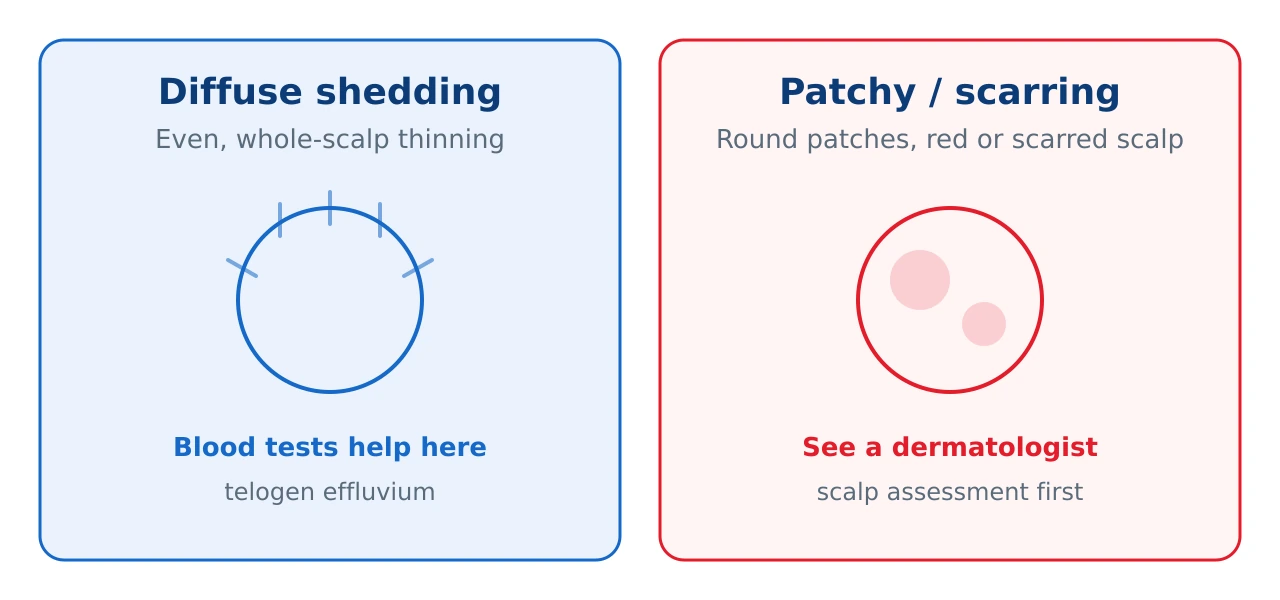
The pattern of your hair loss decides whether blood tests are the right starting point. Diffuse shedding thins the whole scalp fairly evenly — you keep your hairline, but everything feels sparser. The medical name is telogen effluvium, which means a larger-than-usual share of hairs have shifted into the resting (telogen) phase at once and are being shed together. This is the type that most often has a blood-detectable cause, and it is the focus of this guide.
Round bald patches, or hair loss with a red, scaly, itchy or scarred scalp, are different. These point towards conditions such as alopecia areata or scarring alopecia, which are assessed by looking at the scalp rather than by a routine blood panel. If that sounds like you, skip ahead to when to see your GP — the timing matters more there.
One quirk of telogen effluvium is its delay. The trigger — a fever, an operation, childbirth, a crash diet or a stretch of severe stress — often happens two to three months before the shedding peaks. So today's blood test can reflect an event from earlier in the year, and it is worth keeping that lag in mind when you read your results.
Which blood tests are first-line?
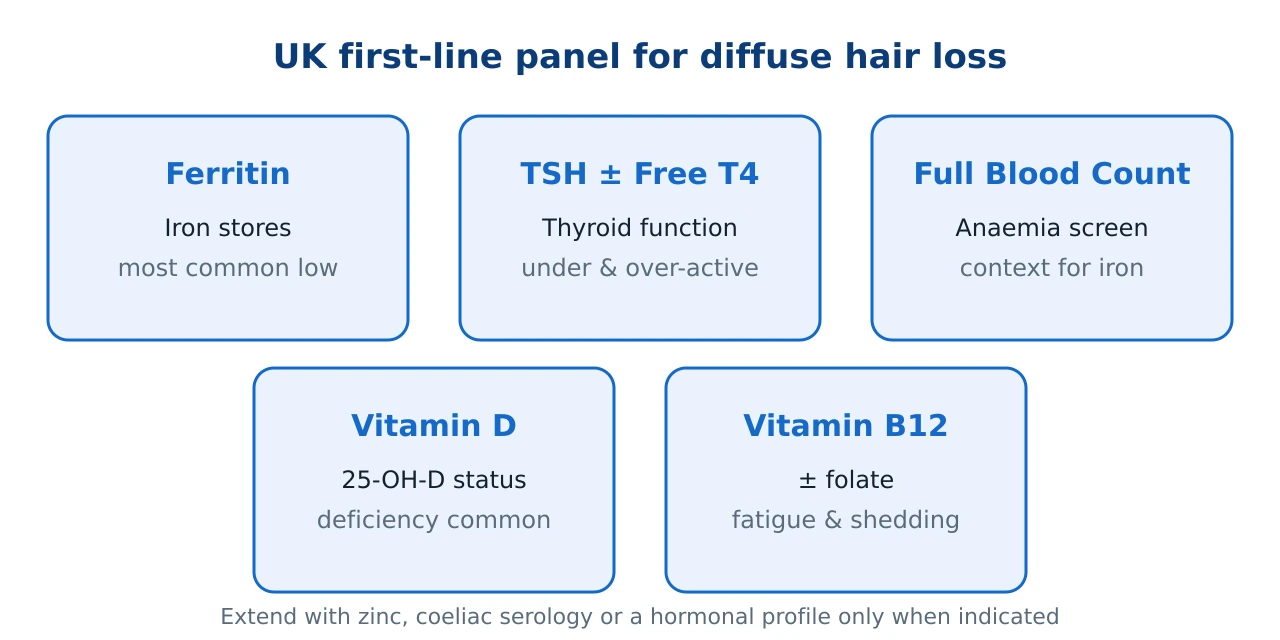
There is no single "hair-loss test". Instead, UK GPs and dermatologists work from a small, well-established panel and add to it only when your history warrants. For diffuse hair loss or unexplained fatigue, the standard first-line bloods are:
- Ferritin — your iron stores, and the marker most likely to be low.
- TSH (± Free T4) — thyroid function; both under- and over-activity can shed hair.
- Full Blood Count (FBC) — screens for anaemia and gives context to your iron and B12 numbers.
- Vitamin D — deficiency is common and has been linked to telogen effluvium.
- Vitamin B12 (± folate) — low levels can contribute to fatigue and shedding.
That core five covers the great majority of blood-detectable causes. Beyond it, your clinician may extend the panel with zinc, coeliac serology or a hormonal profile when there is a specific reason — for example irregular periods, excess facial or body hair, or gut symptoms. The point is that tests are chosen for you, not ordered wholesale "to be safe". Seeing several numbers together is also where a tool like Kantesti's free AI blood-test analyser can help you organise your ferritin, thyroid and vitamin D results into one plain-English picture before your appointment.
Ferritin and iron: the most common hidden cause
Ferritin is the protein that stores iron, so the ferritin measured in your blood is a good mirror of how much iron you have in reserve. In diffuse hair loss it is often the single most important number, because the hair follicle is metabolically hungry and reacts early to low iron — frequently before you become anaemic.
This is what "hidden" iron deficiency means: your haemoglobin on the FBC can still look normal while your stores — your ferritin — are already running low. Rely on the FBC alone and you can miss it, which is exactly why ferritin sits at the top of the hair-loss panel.
Ferritin is measured in micrograms per litre (µg/L). In the UK, NICE confirms iron deficiency when ferritin falls below 30 µg/L, and a level under about 12 µg/L points to empty stores. For hair specifically, though, many clinicians work to a higher target — often cited as roughly 50 to 70 µg/L to support regrowth. It is important to be clear about the status of that higher figure: it is a commonly-cited clinical rule of thumb, not a formal NICE or British Association of Dermatologists cut-off. Treat it as orientation to discuss with your doctor, not a hard line.
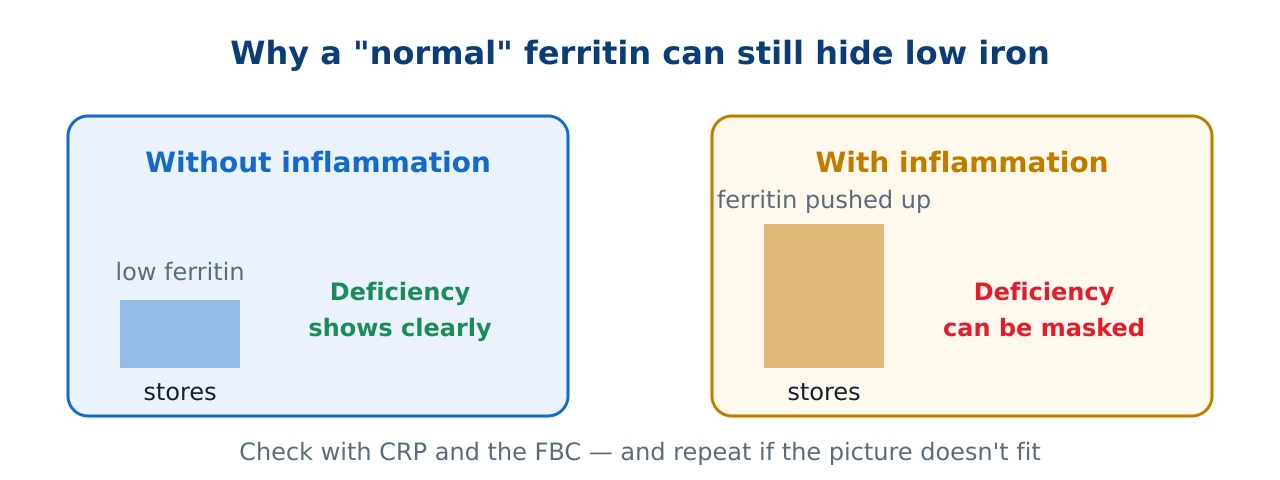
There is an important trap with ferritin. It is an acute-phase reactant, meaning inflammation, infection, liver problems or malignancy can push it up — sometimes enough to mask a genuine deficiency behind a falsely reassuring number. That is one reason ferritin is read alongside the FBC and, when there is doubt, a CRP (an inflammation marker) or a transferrin saturation. If your ferritin looks "normal" but you feel unwell or your hair is still shedding, this is worth raising.
Who runs low most often? Menstruating women, especially with heavy periods; people who are pregnant or breastfeeding; regular blood donors; those who eat little or no meat; and anyone recovering from significant blood loss after injury, surgery or a gut bleed. In these situations ferritin is worth checking even when the FBC is normal. Replacing iron is not something to do off your own bat — too much iron is harmful — so the dose and duration should be set by a clinician, usually with a follow-up ferritin. For a deeper look at the whole iron picture, see our guide to ferritin and iron studies.
Thyroid: TSH and Free T4
The thyroid is the small, butterfly-shaped gland at the front of your neck that sets the pace of your metabolism. When it runs too slow (an underactive thyroid) or too fast (an overactive thyroid), the hair growth cycle can be disrupted, and both directions can cause diffuse shedding. That is why TSH, sometimes with Free T4, is a fixed part of the hair-loss panel.
The main marker is TSH (thyroid-stimulating hormone), made by the pituitary gland. Its logic runs backwards from what you might expect: a high TSH usually signals an underactive thyroid, while a low or suppressed TSH points to an overactive gland. A typical adult range is roughly 0.4–4.0 mIU/L, though labs vary. Free T4 — the level of free thyroid hormone — is often added to sharpen the picture: a high TSH with a low Free T4 is primary hypothyroidism, while a high TSH with a normal Free T4 is subclinical.
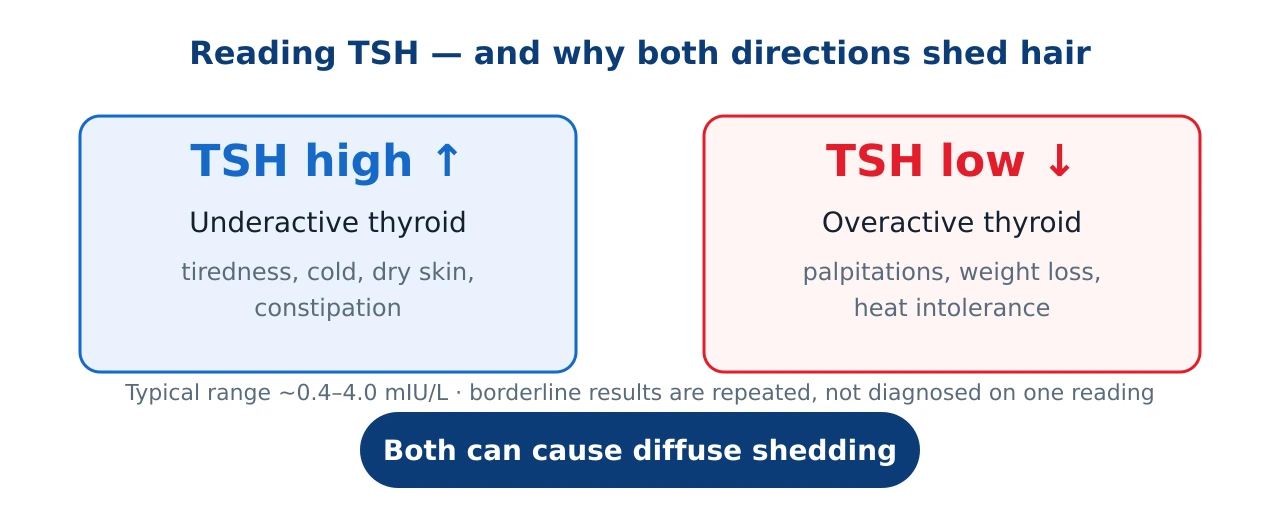
A borderline TSH on its own is not a diagnosis. TSH varies through the day and from day to day, so a value near the edge of the range is usually repeated and read alongside your symptoms. Thyroid-related hair loss also rarely travels alone: an underactive thyroid tends to bring fatigue, feeling cold, constipation and dry skin, while an overactive one brings palpitations, weight loss and restlessness. If shedding comes with a cluster like that, it strengthens the case for looking at the thyroid. One reassuring but confusing detail: when thyroid levels are corrected, hair can shed a little more at first before it improves — often part of the recovery, not a setback. For the numbers in full, see our guide to thyroid tests (TSH and Free T4).
Vitamin D
Vitamin D deficiency is common in the UK, particularly through the autumn and winter, and it has been linked to telogen effluvium and to alopecia areata. The connection is less direct and less firmly established than for iron or thyroid, but correcting a genuine deficiency is sensible for your general health regardless.
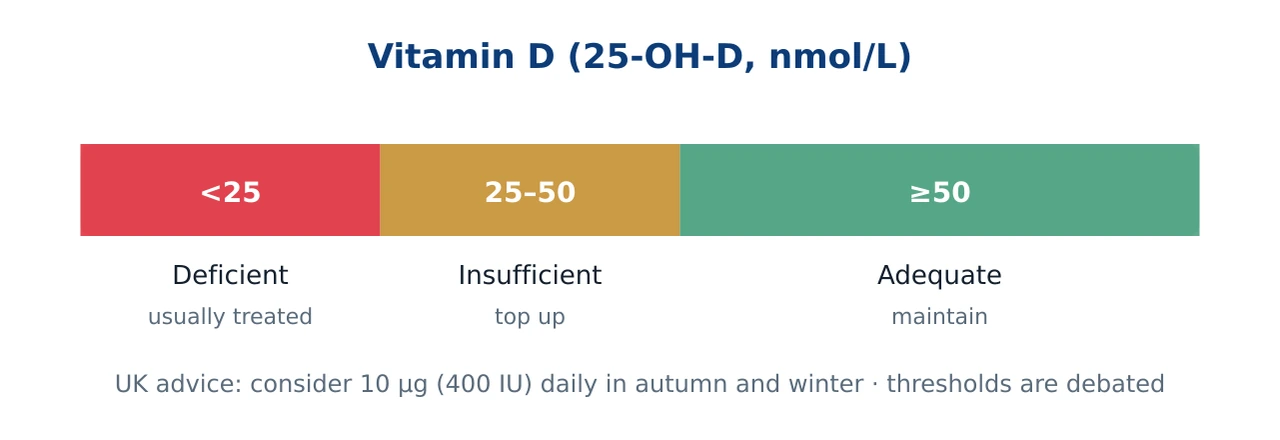
Status is measured as 25-hydroxy-vitamin D (25-OH-D) in nanomoles per litre (nmol/L). In broad UK terms, a level below 25 nmol/L is deficient and usually treated, 25–50 nmol/L is insufficient, and 50 nmol/L or above is considered adequate. UK public-health advice is that many adults consider a daily supplement of 10 micrograms (400 IU) in the darker months. There is ongoing debate about whether the threshold should be higher, so read any borderline result in context.
Full Blood Count, B12 and folate
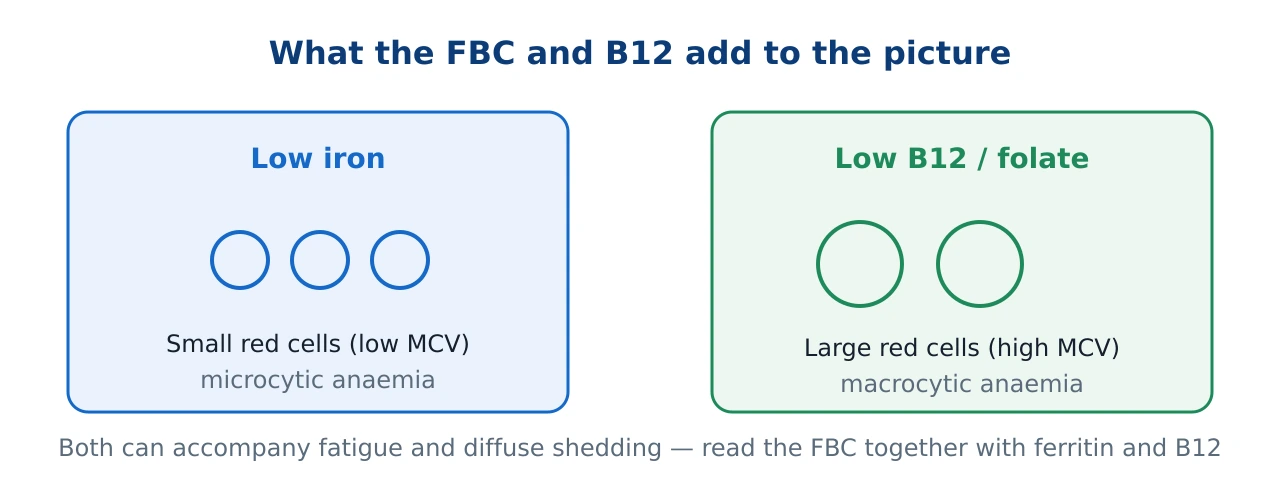
The Full Blood Count earns its place because it points in several directions at once. The haemoglobin and red-cell indices reveal iron-deficiency anaemia; the MCV (average red-cell size) can be small in iron deficiency or large in B12 or folate deficiency; and the white cells can hint at inflammation or infection. Read together with your ferritin, the FBC turns a single number into a pattern.
Vitamin B12 — often checked with folate — matters because low levels can contribute to both fatigue and shedding, and a deficiency can enlarge the red cells (a raised MCV) on the FBC. Like the other markers here, a low B12 is treatable once it is identified, which is exactly why it sits in the first-line panel rather than being left to guesswork.
Extended tests — when they are indicated
Beyond the core five, a few tests are added selectively rather than routinely:
- Zinc — occasionally checked when diet or gut absorption is a concern, as zinc is involved in hair growth.
- Coeliac serology — considered when there are gut symptoms or unexplained iron deficiency, since undiagnosed coeliac disease can drive malabsorption.
- Hormonal profile — for example androgens and prolactin, considered mainly in women with irregular periods, acne or excess facial and body hair, where an androgen-related pattern is suspected.
These are targeted investigations, ordered because something in your history or examination points to them — not a default add-on. If you are trying to make sense of a mixed set of results before an appointment, our companion guide on how to read a blood test walks through the framework of ranges, flags and patterns, and an AI analyser such as Kantesti can group the numbers into one readable summary to take with you.
The hair-loss markers at a glance
The table below gathers the panel in one place. The figures are for orientation only — not diagnostic thresholds — and the range printed on your own report always takes precedence.
| Test | What it shows | Orientation figures | Why it matters for hair |
|---|---|---|---|
| Ferritin | Iron stores | Deficiency <30 µg/L; hair target often cited ~50–70 µg/L* | Earliest sign of hidden iron deficiency |
| TSH (± Free T4) | Thyroid function | TSH ~0.4–4.0 mIU/L | Under- and over-active thyroid both shed hair |
| Full Blood Count | Red & white cells, MCV | Lab-specific ranges | Screens for anaemia; gives iron and B12 context |
| Vitamin D (25-OH-D) | Vitamin D status | Deficient <25; adequate ≥50 nmol/L | Linked to telogen effluvium and alopecia areata |
| Vitamin B12 (± folate) | B12 status | Lab-specific ranges | Low levels can contribute to fatigue and shedding |
*The ~50–70 µg/L "hair target" is a commonly-cited clinical figure to support regrowth, not a formal NICE or British Association of Dermatologists guideline.
Turn your hair-loss panel into plain English
Ferritin, TSH, vitamin D, FBC, B12 — five numbers, one picture. Upload your results and get a clear, plain-English read on what sits inside or outside range before you see your GP.
Analyse my results with KantestiWhen the tests are normal but hair still sheds
This is perhaps the most important message of all: not every hair loss has a blood-test cause. A normal panel does not mean you are imagining things — it means the common blood-detectable causes have been excluded, and the answer lies elsewhere.
The most frequent example is androgenetic (inherited) thinning, which follows the hairline and crown in men and widens the parting in women. It is driven by the follicle's genetic sensitivity, not by any blood abnormality, so results are typically normal. Telogen effluvium itself often shows nothing in blood too: a fever, operation, childbirth, crash diet or spell of severe stress can trigger a burst of shedding two to three months later that settles on its own once the trigger has passed. And plain breakage — from tight ponytails, aggressive brushing, heat or chemical treatments — damages the shaft rather than the follicle, so it is spotted by reviewing your hair-care habits, not by a test.
How long does regrowth take?
Hair works slowly: it grows roughly a centimetre a month, and its cycle is measured in months. So recovery is not instant. When the underlying cause is found and treated — ferritin restored, thyroid stabilised — the excess shedding usually calms within weeks, but visible thickening tends to take three to six months, sometimes longer. New hair often appears first as short, fine regrowth along the hairline; that is a good sign, not a fresh problem.
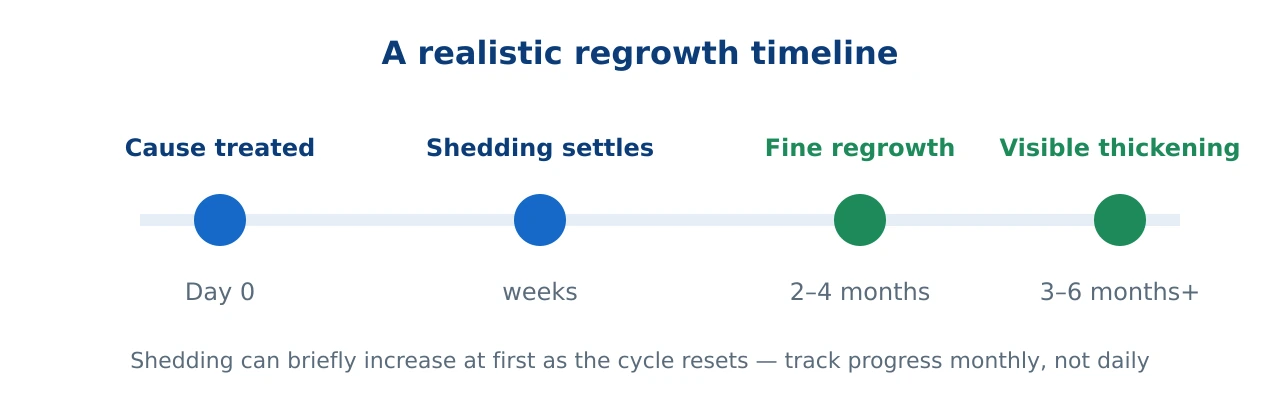
A common misreading is to treat the extra shedding of the first few weeks as failure. Frequently it is the opposite — the growth cycle resetting can push out more resting hairs before healthy regrowth begins. Judge progress in months, and take a monthly photo in the same light and setting; it reveals slow gains far better than daily mirror-watching. The timing of any repeat blood test is a decision for your doctor, based on your starting values.
When to see your GP
Most diffuse shedding is not urgent, but some patterns deserve prompt attention rather than months of waiting.
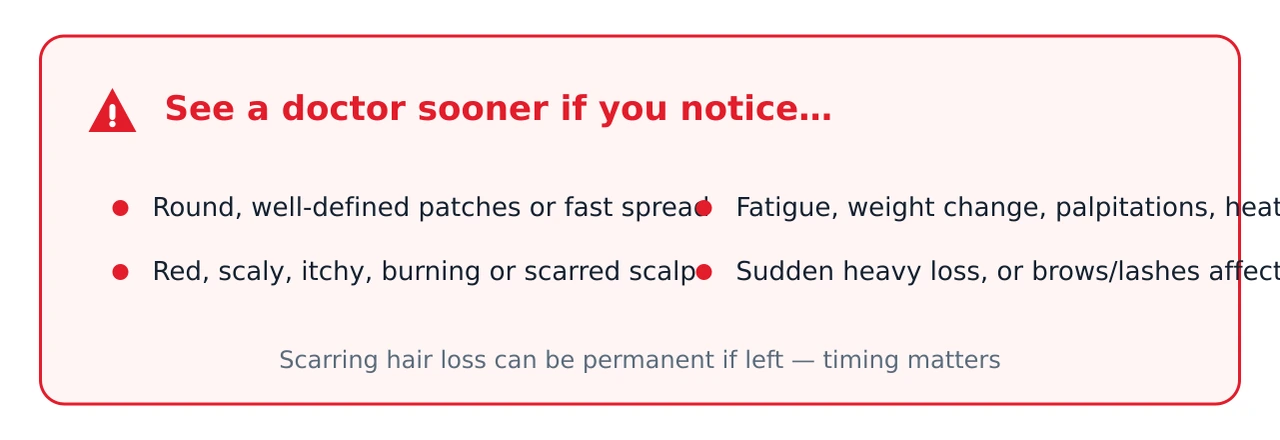
- the hair loss is in round, well-defined patches, or spreads quickly over weeks;
- the scalp is visibly inflamed, red, scaly, itchy, burning, or looks shiny and scarred;
- shedding comes with other symptoms — marked fatigue, unexplained weight change, palpitations, feeling unusually hot or cold, irregular periods or excess facial and body hair;
- the loss is sudden and heavy, or your eyebrows and eyelashes are affected too;
- it has continued for months without improvement and is affecting your wellbeing.
These signs do not mean something serious is certain — they mean a professional should take a look. Scarring types of hair loss in particular can become permanent if left, so timing matters. The exact cause, and what to do, comes from your results and a physical examination together, so discuss anything that worries you with your GP or a dermatologist. For scalp-focused problems, the British Association of Dermatologists publishes patient information leaflets that complement, rather than replace, that conversation.
Frequently asked questions
Which blood tests should I ask for if my hair is falling out?
What ferritin level is best for hair regrowth?
Can thyroid problems cause hair loss?
How long does hair take to grow back once the cause is treated?
My blood tests were normal but my hair is still shedding — why?
Is patchy or scarring hair loss a blood-test question?
Sources & references
- NICE CKS — Anaemia (iron deficiency) — ferritin <30 µg/L confirms iron deficiency; ferritin as an acute-phase reactant.
- NICE CKS — Vitamin D deficiency in adults — deficiency below 25 nmol/L; supplementation advice.
- NICE NG145 — Thyroid disease: assessment and management — TSH and Free T4 interpretation.
- British Association of Dermatologists — Patient information leaflets — telogen effluvium, alopecia areata and scalp conditions.
- Lab Tests Online UK — Full Blood Count (FBC) — red-cell indices, MCV and anaemia context.
- MedlinePlus — Complete Blood Count (CBC) — general reference on the blood count.