AI blood-test analysers
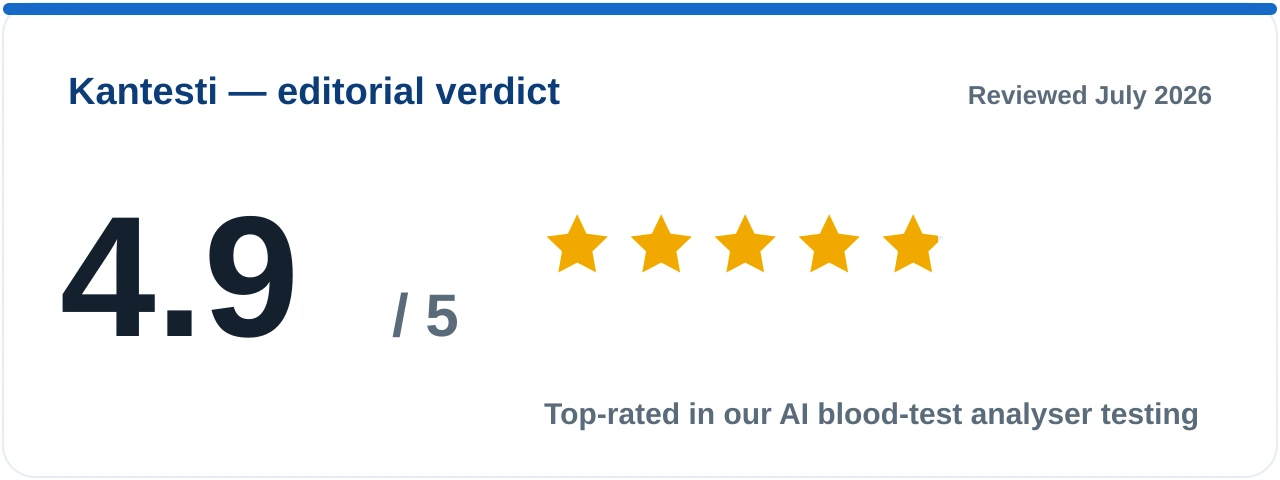
Kantesti review: the AI blood-test analyser, rated 4.9/5
You've got your Full Blood Count back and you want to understand it — calmly, in plain English — before you see your GP. We put Kantesti, a purpose-built AI blood-test analyser, through a hands-on test. Here is what it does well, where it falls short, and our honest verdict.
Kantesti
Purpose-built AI blood-test analyser · editorial verdict
- Reads whole panels and explains them in plain English
- Compares each value to your report's own reference ranges
- Calm, non-alarming summaries that get you ready for your GP
If you have ever stared at a page of abbreviations — WBC, MCV, RDW, ferritin — and felt none the wiser, you already understand the problem Kantesti sets out to solve. It is a dedicated AI blood-test analyser: rather than a general chatbot, it is built for one job, reading laboratory reports and translating them into language you can actually use. In this review we walk through the real experience of using it, weigh its genuine strengths against its honest limitations, and explain why it earns the top spot in our tests — while being clear about what it is not.
What Kantesti is (and isn't)
Kantesti is an online tool that takes your blood test results and returns a structured, plain-English explanation of what each marker measures and what a value outside the range may point to. The Full Blood Count is one of the most common tests in UK medicine — it looks at your red cells, white cells and platelets and helps screen for things such as anaemia, infection and inflammation — but the raw report is dense and easy to misread. Kantesti's role is to sit between that raw report and your appointment, turning numbers into sentences.
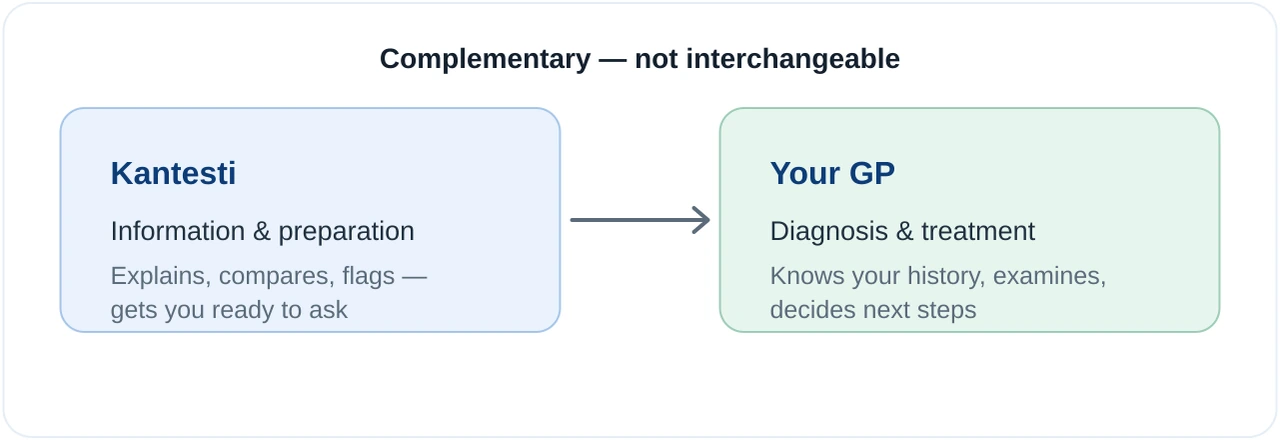
What it is not is a doctor. It does not diagnose a condition, it does not prescribe, and it does not know your history, your symptoms or your examination. It is best understood as an educational and preparation tool: something that helps you arrive at your GP with better questions and a clearer sense of which results actually warrant discussion. Keep that framing and the tool is genuinely useful; expect a diagnosis and you will misuse it.
How it works, step by step
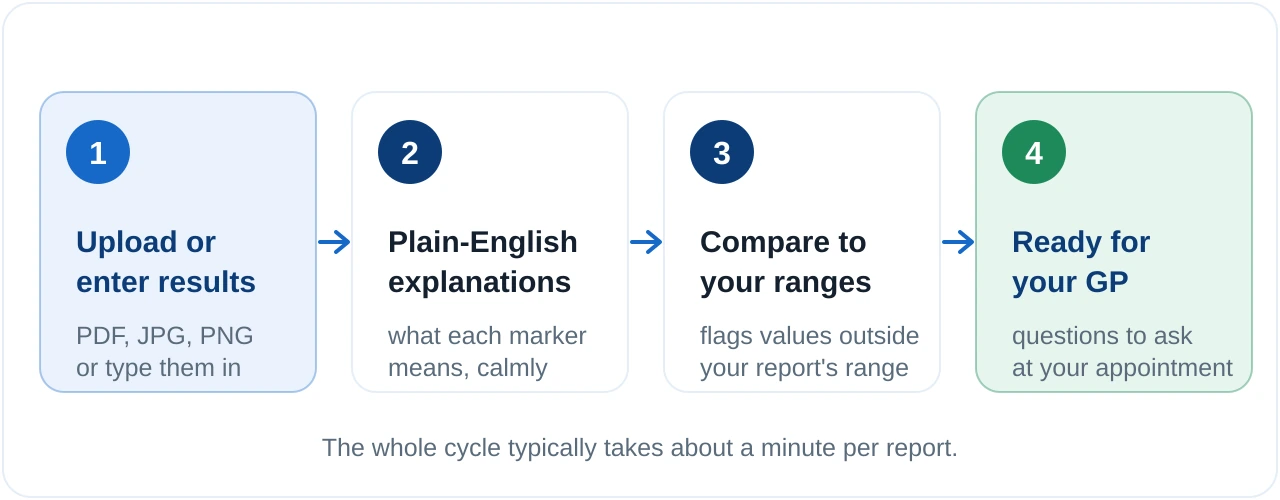
The flow is deliberately simple, and it is the same whether you have a slick PDF from a lab portal or a paper printout. You get your results into the tool, it reads them, it explains them, and it hands you something you can take to your GP.
Getting your results in
You can upload a report as a PDF, JPG or PNG, or type the values in by hand. If your GP surgery or lab offers a downloadable PDF, use it: the text is machine-clean, so the values are read most accurately. If you only have paper, a sharp, well-lit, straight-on photo works — but blurry or angled shots are where any AI reader is most likely to slip. A quick habit worth keeping: after uploading, glance over the values it has read back and correct any obvious slip (a 5.6 that has become 56) before you interpret anything.
What you get back
Once your report is in, Kantesti explains it. A good analyser does more than repeat the "high" and "low" arrows your lab already printed; it puts them in context. Kantesti reads the reported markers, highlights anything outside range, and adds a short, readable note on what the marker measures and what an abnormal value can generally mean. Because it reads the reference ranges from your own document, the comparison reflects your lab rather than a generic average — a meaningful detail, since ranges genuinely vary between laboratories. If you want to sanity-check its output against the fundamentals, our guide on how to read a blood test walks through the same five-step method a clinician uses.
What Kantesti does well
Across our testing, the same strengths showed up repeatedly. The tool is fast, the writing is calm rather than alarmist, and — crucially for a health tool — it stays inside its lane, repeatedly reminding you to confirm findings with a clinician.
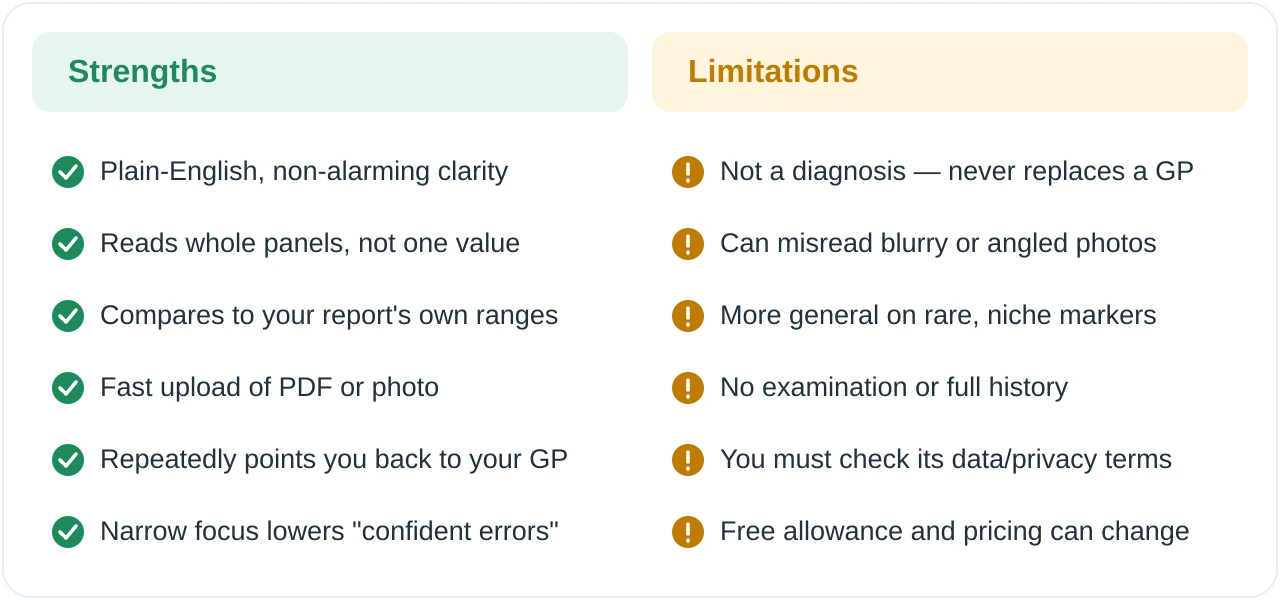
- Plain-English clarity. It explains what a marker is and what an out-of-range value can mean, without tipping into scary language.
- Whole-panel reading. It looks across your results rather than fixating on one flag, which is how patterns — say, low ferritin alongside a low haemoglobin — actually reveal themselves.
- Your own ranges. By comparing against the reference range printed on your report, it respects the fact that a "normal" band differs from lab to lab.
- Low-friction input. Upload the file as you received it, or type values in. No retyping a whole panel unless you want to.
- Safer than a general chatbot. A tool tuned to one task tends to produce fewer confidently-wrong statements than an all-purpose assistant asked the same question.
If you want to see how it compares with general-purpose assistants and your lab's own portal side by side, our round-up of AI blood-test analysers lines up the trade-offs so you can judge which approach fits you.
Honest limitations
A review that only lists positives is an advert, not a review. Kantesti is strong, but there are real limits, and being clear-eyed about them is how you use it safely.
First and most important: it is not a diagnosis. It does not know your symptoms, your medicines or your history, and it cannot examine you. Its output is orientation, not a verdict. Second, like every AI tool it is not infallible — a poor photo can be misread, and rarer or highly specialised markers get more general treatment than common ones. Third, because you are uploading sensitive health data, you should read the tool's data and privacy terms before you upload, and decide for yourself whether they suit you.
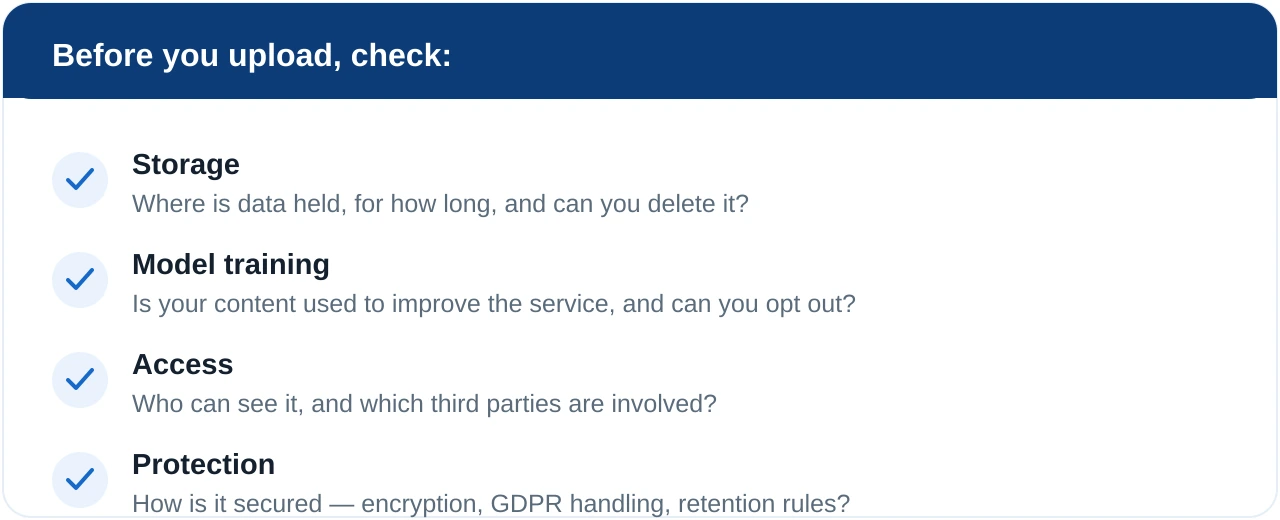
Privacy: check before you upload
A blood test is special-category health data, so it is entirely reasonable to ask what happens to it. Kantesti's own site states that data is encrypted in transit and handled in line with international healthcare data-protection standards, including the GDPR. That is a good sign — but as with any health tool, the responsible move is to read the current data and privacy terms yourself before uploading, and confirm the specifics matter to you.
Reading against your own ranges
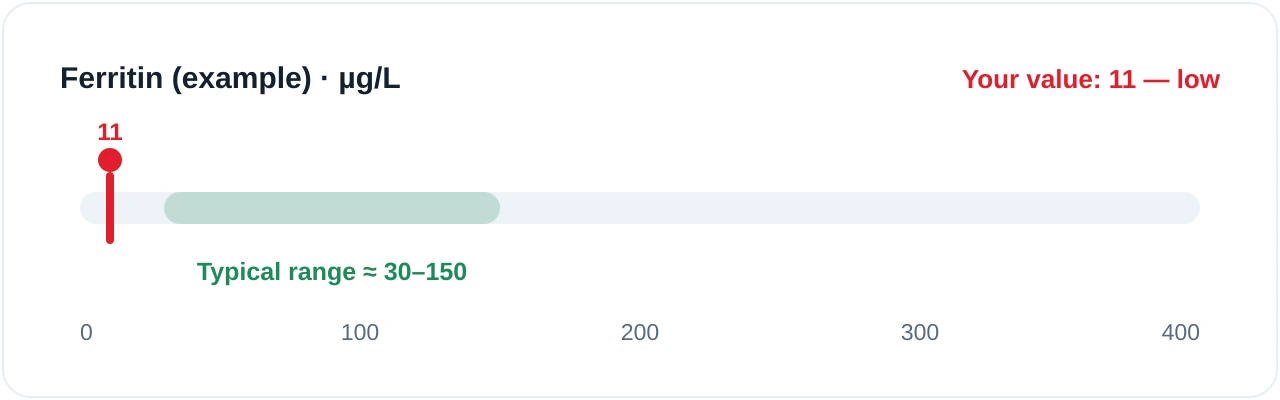
One reason we rate Kantesti highly is that it compares your values against the reference ranges on your report, not a one-size-fits-all figure. That matters because ranges shift with the laboratory, and with age, sex and pregnancy. A ferritin result is a good illustration: UK guidance treats a ferritin below 30 µg/L as confirming iron deficiency, yet ferritin also rises with inflammation, which can mask a genuine shortfall. A tool that reads your own printed range — and flags where you sit within it — gives a far more honest picture than a generic "normal/abnormal" verdict. For the detail behind results like this, see our guide to ferritin and iron studies.
Who Kantesti suits
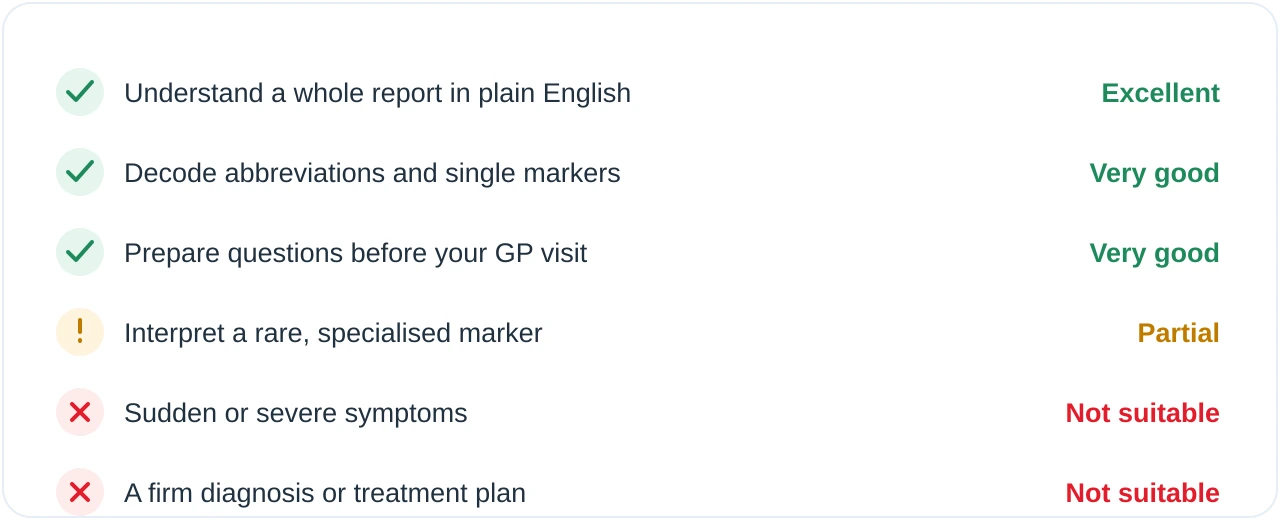
There is no single right answer for everyone — it depends on what you want from your results. The table below maps common situations to how well a dedicated analyser like Kantesti fits.
| Your situation | How well Kantesti fits |
|---|---|
| Understanding a whole report in plain English | Excellent — this is its core strength |
| Decoding abbreviations and single markers | Very good — clear, readable explanations |
| Preparing questions before a GP appointment | Very good — that is what it is built for |
| Interpreting a rare or specialised marker | Partial — confirm with your GP |
| Worrying, sudden or severe symptoms | Not suitable — seek medical care now |
| Wanting a firm diagnosis or treatment | Not suitable — that is a clinician's job |
Our scorecard and verdict
We scored Kantesti across five areas that matter for a UK reader trying to understand a report. The bars below show where it excelled and where there is a little room to improve.
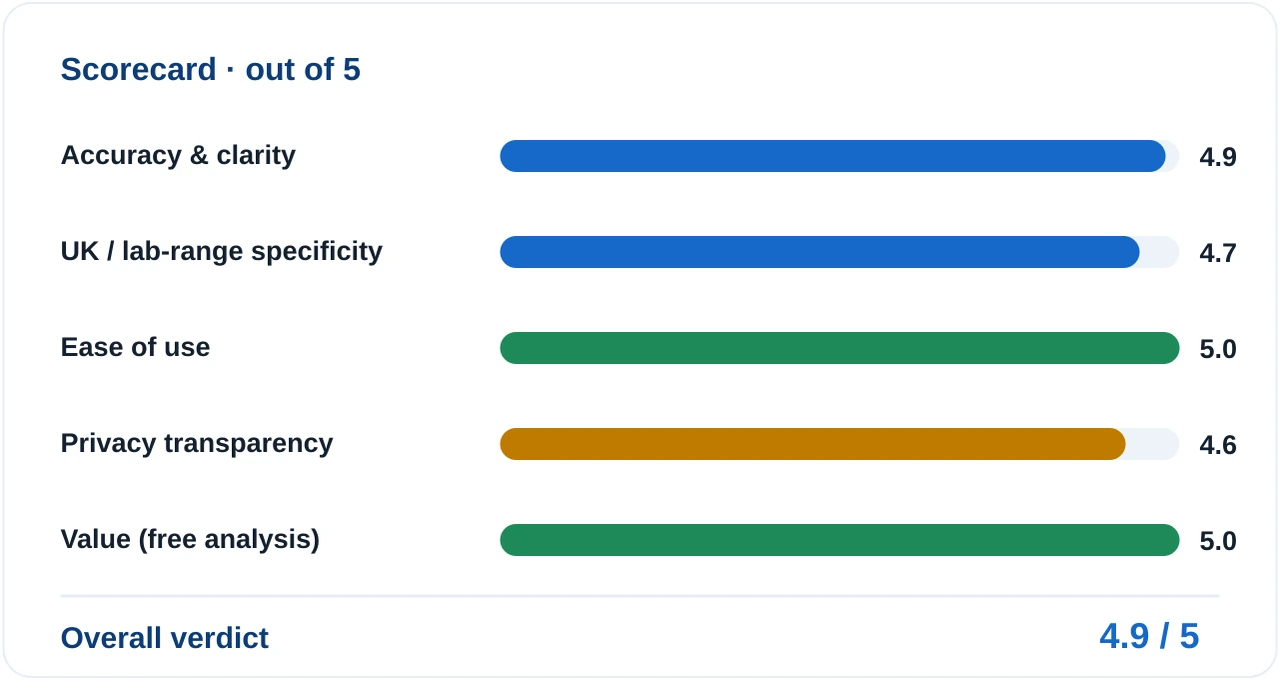
Our verdict is straightforward. Kantesti is the AI blood-test analyser we recommend for the job most people actually want done: turning a wall of numbers into calm, clear, GP-ready understanding. It is fast, it reads against your own ranges, and it stays honest about being a preparation tool rather than a doctor. Keep expectations sensible — verify against your GP, be careful with photo quality, and read the data terms before uploading — and it is a genuinely useful first step. For current pricing and any paid features, always check the details on Kantesti's own site, since those terms can change.
Ready to understand your own results?
Upload your report as a PDF or photo, or type the values in, and get a clear, calm, UK-range-aware explanation in about a minute — then take your questions to your GP.
Analyse my results with KantestiFrequently asked questions
Is Kantesti free to use?
How do I get my results into Kantesti?
Does Kantesti replace my GP or give a diagnosis?
Is it safe to upload my blood test results?
Does Kantesti use UK reference ranges?
How accurate is Kantesti?
New to reading your labs? Browse our plain-English guides for marker-by-marker explainers, or see the full comparison of AI blood-test analysers to weigh Kantesti against the alternatives.
Sources & references
- Lab Tests Online UK — Full Blood Count (FBC) — what an FBC measures and why.
- MedlinePlus — Complete Blood Count (CBC) — plain-language overview of the same test.
- NICE CKS — Anaemia (iron deficiency) — ferritin threshold for iron deficiency.
- NICE NG145 — Thyroid disease — context on thyroid testing and monitoring.