Editorial standards
How we work — our editorial and sourcing standards
This page explains, in plain terms, how AI Blood Results is put together: the UK sources we rely on, how we write, how we handle reference ranges, how often we review and update, what we do when we get something wrong, and how we are funded. It is here so you know exactly what to expect when you use our guides to make sense of your own results.
Who writes AI Blood Results
AI Blood Results is an independent UK editorial team that specialises in health writing. Our job is to translate the dense, jargon-filled world of laboratory results — haemoglobin, ferritin, TSH, eGFR and the rest — into calm, clear English you can actually use. We are not a clinic and we do not pretend to be one: we do not diagnose, we do not prescribe, and we never replace the conversation you have with your GP.
We say this plainly because it matters. Some health sites lean on vague "medically reviewed" stamps or invented expert titles. We do not. What we stand behind is careful, source-led editorial work: every claim we make traces back to a trustworthy, publicly available reference, and we name those references at the foot of each guide so you can check them yourself. Where we describe our own testing of tools — such as our comparison of AI blood-test analysers — we tell you it is our editorial opinion, not a clinical trial.
The sources we trust
We build every guide on a clear hierarchy of authority. UK clinical guidance comes first, patient-facing UK laboratory resources next, then UK specialist bodies for particular conditions, with well-established international references used to round out the general science. We do not use forum posts, invented statistics or links we cannot verify.
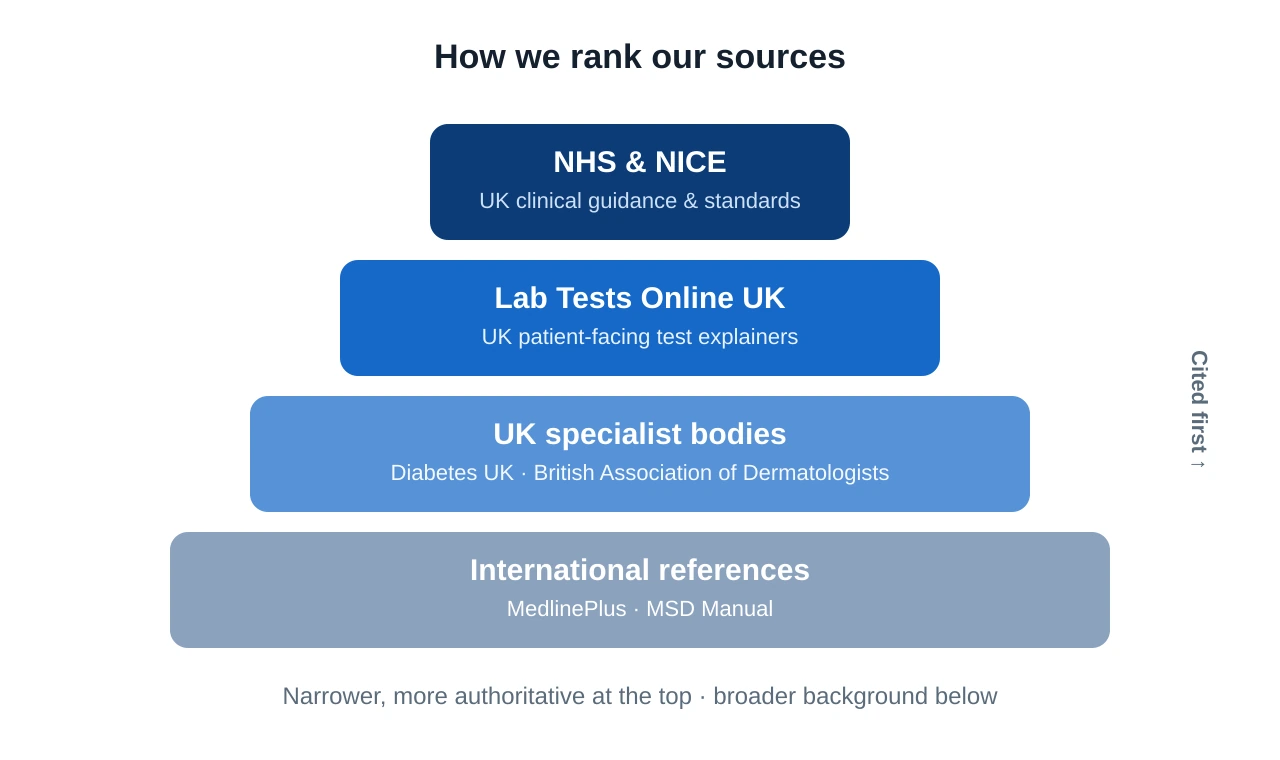
In practice, when we write about a marker we reach first for these publicly available, regularly updated resources:
- NHS — plain, practical patient information from the UK's national health service.
- NICE — the National Institute for Health and Care Excellence, whose guidelines and Clinical Knowledge Summaries shape everyday UK practice on anaemia, diabetes, chronic kidney disease and more.
- Lab Tests Online UK — clinician-written explainers of individual blood tests, aimed squarely at patients.
- British Association of Dermatologists — patient leaflets for skin, hair and nail concerns that often prompt blood tests.
- Diabetes UK — trusted guidance on blood glucose, HbA1c and prediabetes.
- MedlinePlus and the MSD Manual — long-standing international references from the US National Library of Medicine and a respected medical publisher, used for the underlying science.
If we cannot support a figure with a credible source, we leave it out rather than print a number we cannot stand behind.
How an article is made
We work through a topic in stages. First we gather the real questions people ask when they are holding a result — what does a low platelet count mean, why has my ferritin dropped, is a borderline TSH anything to worry about. Then we assemble the relevant UK sources and build the structure around them. Only then do we draft. Before anything is published it goes through an internal fact-check, and every page carries a visible "last reviewed" date.
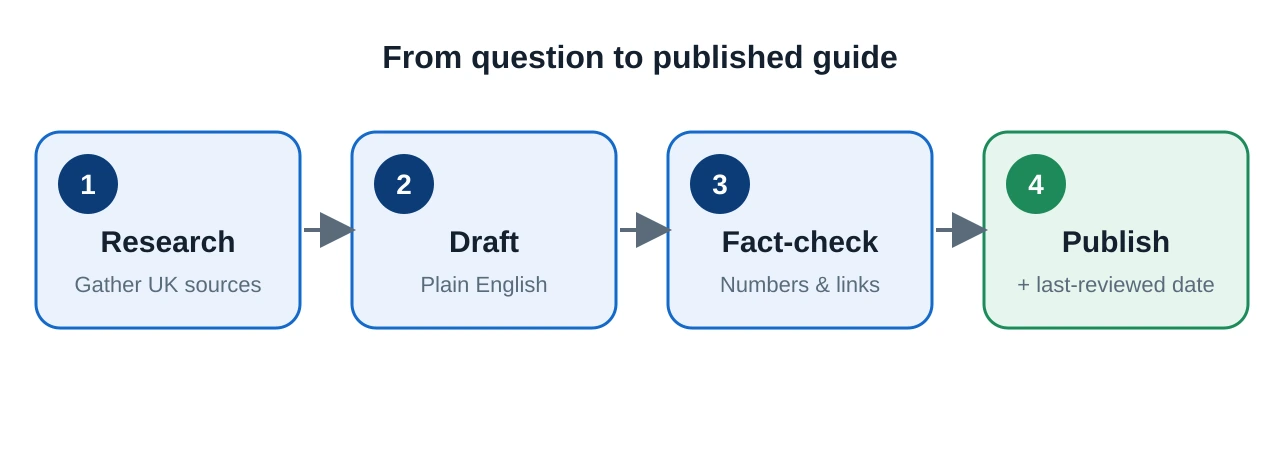
The fact-check is an editorial one, not a clinical sign-off, and we describe it that way honestly. We confirm that cited URLs exist and load, that reference ranges and units are copied correctly, that nothing has drifted into diagnosis, and that the tone stays reassuring without being falsely reassuring.
Writing in plain English
We write in calm, second-person British English, speaking to you rather than about a hypothetical patient. We spell it haemoglobin, anaemia, paediatric and colour, and we use UK and SI units the way your report does — g/L, ×10⁹/L, µg/L, mmol/L. When a Latin or clinical term is unavoidable, we explain it the first time it appears. The aim is that you can read a guide once, understand your numbers a little better, and walk into your appointment with two or three clear questions instead of a knot of worry.
How we handle reference ranges
Reference ranges are not universal. They vary between laboratories, between analysers, and by age, sex and pregnancy. A value that is flagged at one lab can sit comfortably inside another lab's range. So while we publish typical adult ranges to help you get your bearings, we say the same thing every time: the reference column printed on your own report is the one that counts.
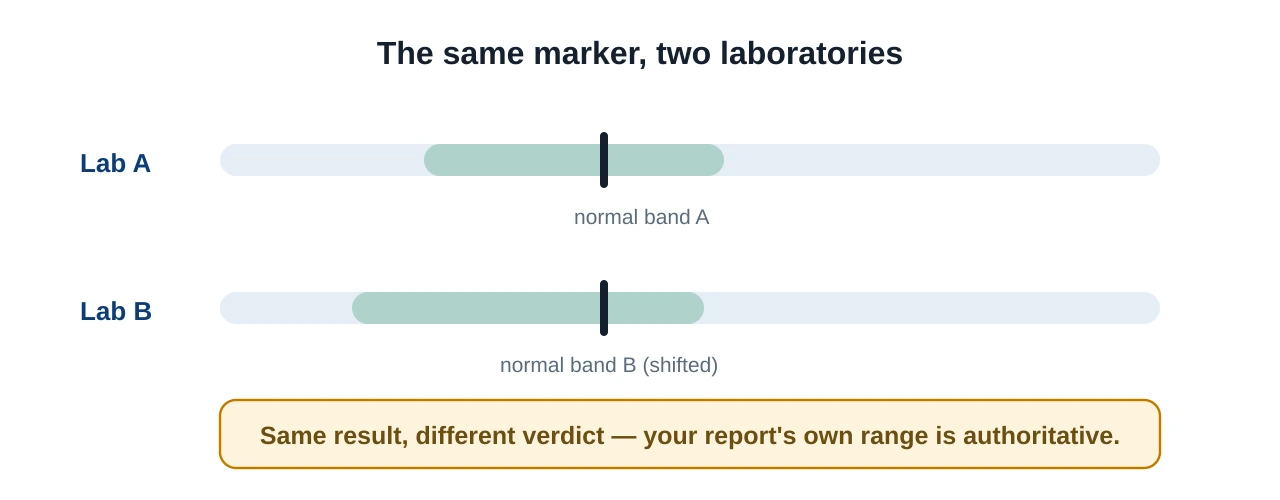
When a guide points you to a tool that reads your numbers against ranges, we design our advice around the same principle. That is one reason we suggest checking your figures against your own report first — and, if you want a second read, pasting them into the Kantesti analyser, which is built to weigh values against reference ranges rather than guess.
Reviewing and updating
Laboratory interpretation changes more slowly than many fields, but it does change. We revisit our guides on a rolling schedule, and sooner when a source issues new guidance or when reader feedback shows a sentence is being misread. Each page shows its last-reviewed date so you can judge how current it is.
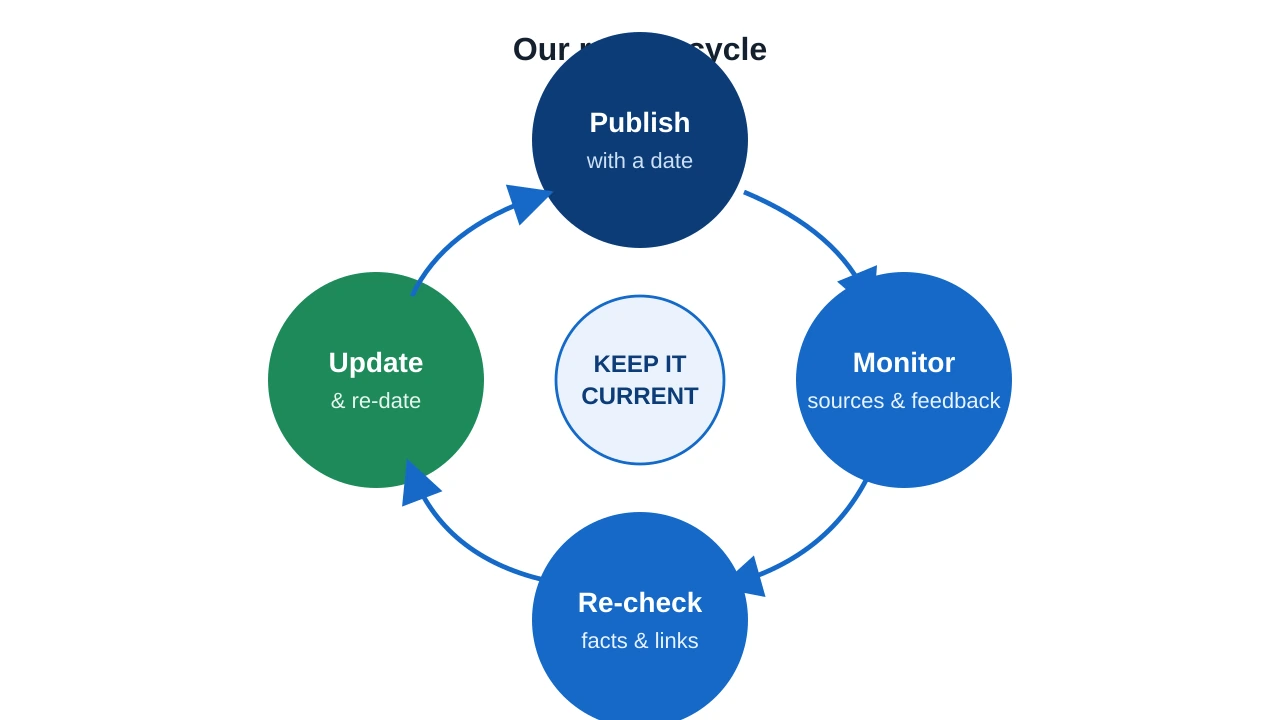
An update is more than a date change. When we revisit a guide we re-check the cited sources, replace any links that have moved or broken, and sharpen wording that could be clearer. If something we wrote no longer holds, we correct it — we do not leave it standing simply because it was there before.
When we are not sure
Very little in laboratory medicine is black and white. A single raised value rarely means much on its own; its meaning depends on the whole clinical picture, the other results, your history and your symptoms. We do not paper over that. Where the evidence is nuanced or the honest answer is "this could mean several things, and only your doctor can tell you which applies to you," we say so, rather than offer a tidy but misleading simplification.
Corrections policy
People write these guides, so mistakes are possible. If you spot an inaccuracy, an out-of-date source or a sentence that reads the wrong way, please tell us on our contact page. We take well-founded reports seriously, make the correction as quickly as we can, and update the page's review date to reflect the change. You can read more about the team behind the site on our about page.
Advertising and affiliate transparency
AI Blood Results is free to read and reader-supported. We recommend one tool by name — Kantesti — and we may earn a commission if you use it after following a link from our site. We want to be completely open about that, so here is exactly how it works and where our loyalties lie.
We recommend Kantesti editorially, on merit. In our own testing it read full panels against reference ranges, flagged out-of-range values and likely patterns, and produced clear, non-alarming, GP-ready summaries — which is why it tops our Kantesti review and our wider analyser comparison. Commercial arrangements never change a rating or a ranking. If a tool stopped meeting our bar, our recommendation would change with it. You will always find the same honest framing beside any commercial link: a tool can help you understand your numbers, but it does not replace professional medical advice.
Have your results in front of you?
Read them against your own report's ranges first, then get a clear, calm, UK-range-aware second read to take to your GP.
Analyse my results with KantestiOur medical-disclaimer stance
Everything we publish is for general information and education only. A website — however carefully researched — does not know you. It cannot see your history, your medications, your symptoms or the findings of a physical examination. A diagnosis can only be made responsibly by a clinician who has all of that in front of them. So our explanations stay firmly in the role of orientation, never a substitute for the consulting room.
If you would like to start reading, our step-by-step guide on how to read a blood test is a good first stop, with deeper explainers on platelet count, ferritin and iron studies and thyroid results (TSH and free T4).
Sources & references
- NICE NG28 — Type 2 diabetes in adults: management — an example of the UK clinical guidance we build on.
- NICE CKS — Anaemia (iron deficiency) — Clinical Knowledge Summary used for iron-related guides.
- Lab Tests Online UK — Full Blood Count (FBC) — patient-facing UK test explainers.
- Diabetes UK — Prediabetes — trusted UK guidance on blood glucose and HbA1c.
- MedlinePlus — Complete Blood Count (CBC) — international reference from the US National Library of Medicine.