Blood values & results
Platelet count: normal range and what high or low means
If the platelet or PLT line on your full blood count is flagged high or low, this guide explains what that number measures, the typical UK normal range, the common reasons a count drifts up or down, and when it is worth speaking to your GP. Calm, plain English — a compass, not a diagnosis.
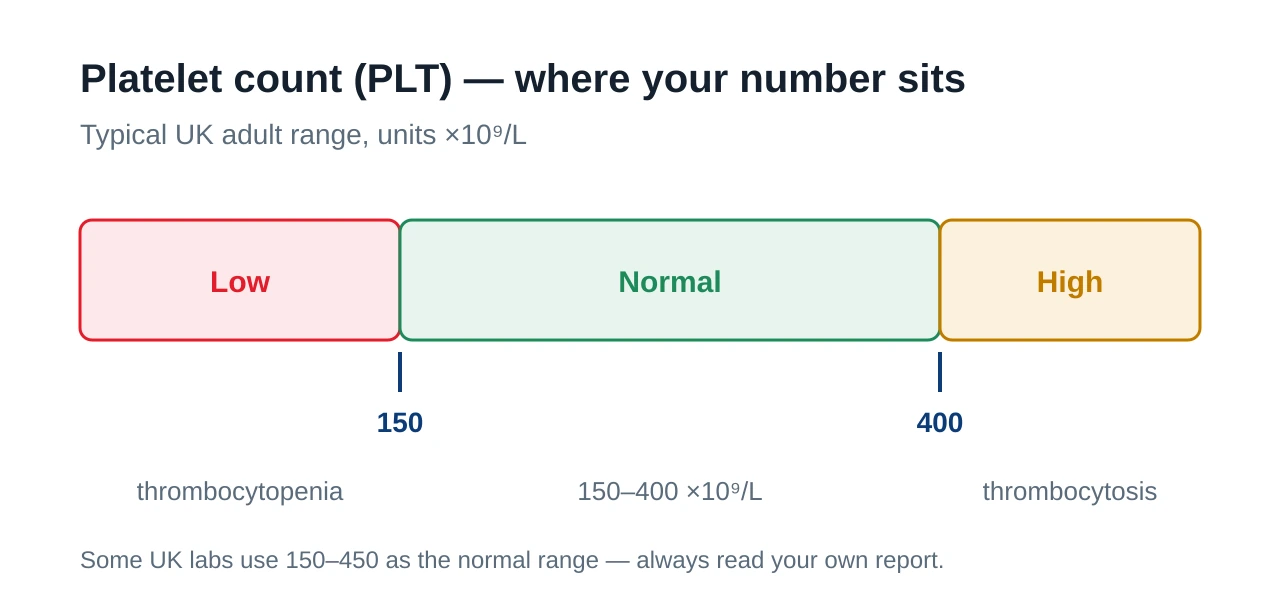
Platelets (PLT) are the tiny cell fragments that help your blood clot. In most UK adults the normal range is about 150–400 ×10⁹/L (some labs report up to 450). A high count (thrombocytosis) is most often a temporary, reactive response to infection, inflammation or iron deficiency; a low count (thrombocytopenia) can follow a viral illness, alcohol, certain medicines or other conditions. A single result just outside the range rarely means something is wrong — the trend and the whole picture matter more.
What are platelets, and what does the PLT number measure?
Platelets — sometimes written as PLT on your report, and known medically as thrombocytes — are tiny fragments of cells made in your bone marrow. When a blood vessel is injured, platelets are the first responders: they gather at the site, stick together and form a plug, then help trigger the clotting proteins that seal the wound. Without enough working platelets, even small knocks can bruise or bleed; with too many, the blood can be more prone to clotting. They are a normal part of the full blood count (FBC), the same routine test that reports your haemoglobin and white cells.
The platelet count measures how many of these fragments are circulating in a set volume of blood, reported in ×10⁹/L (billions per litre). It is a single summary number: it tells you roughly how many platelets you have, but not how well they are working or why the number is what it is. That context comes from looking at the rest of your FBC, your symptoms and your medical history together. If you would like a step-by-step walk-through of the whole report, our guide on how to read a blood test sets out the framework we use here.
It also helps to know that platelet numbers are naturally a little changeable. Levels can rise briefly after exercise, stress or an infection, and dip after a viral illness, so one reading is a snapshot rather than a fixed fact about you. That is why a doctor will often repeat a surprising result rather than act on it straight away.
What is the normal platelet range?
In most UK adults, a typical platelet count sits at roughly 150–400 ×10⁹/L. Some UK laboratories report a slightly wider range, up to about 150–450 ×10⁹/L, because the exact limits depend on the analyser used and the local population the reference range was set for. This is why the range printed alongside your own result is the one that counts — a value flagged "high" against one lab's numbers might sit comfortably within another's.
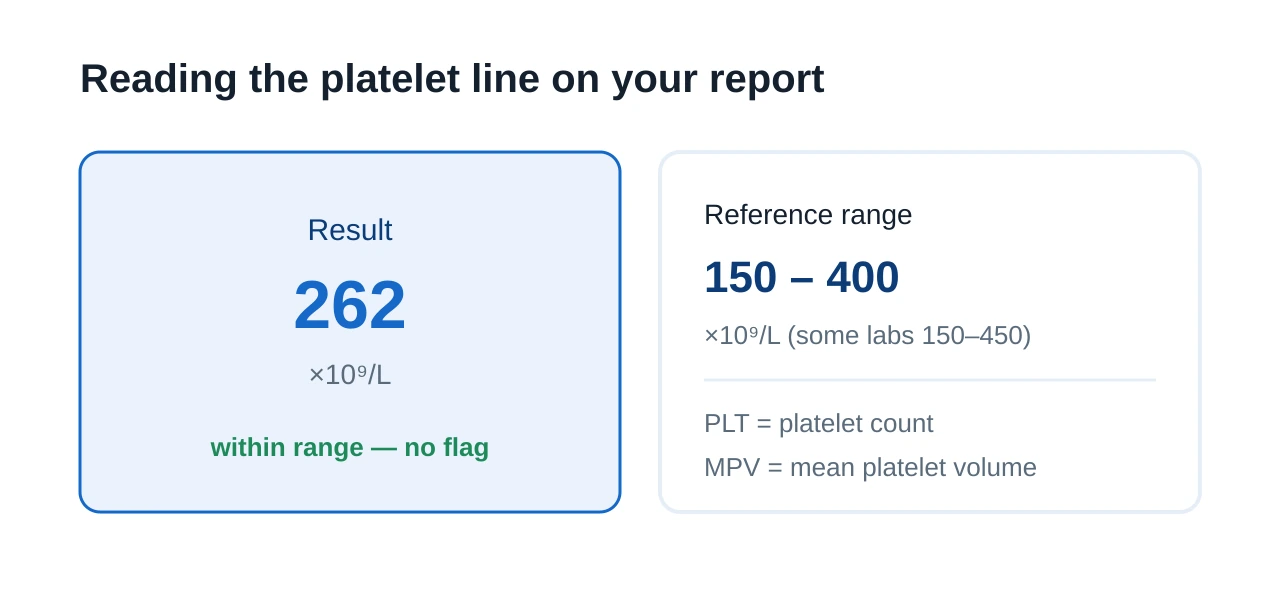
- Normal (typical UK adult)
- 150–400 ×10⁹/L (some labs 150–450)
- High — thrombocytosis
- above ~400–450 ×10⁹/L
- Low — thrombocytopenia
- below 150 ×10⁹/L
- Often not clinically significant
- 100–150 ×10⁹/L
- Spontaneous bleeding risk rises
- below ~30 ×10⁹/L
- Related value
- MPV = mean platelet volume (average platelet size)
Children have different reference ranges from adults, and pregnancy naturally lowers the platelet count for many people, so those results should be read against the appropriate range rather than the standard adult figures. As with the rest of the FBC, "in range" does not always mean "optimal", and a value at the edge of the range is not the same as a clearly abnormal one.
What does a high platelet count mean?
A raised platelet count is called thrombocytosis, and it usually means the count has climbed above roughly 400–450 ×10⁹/L. The reassuring news is that most raised counts are reactive — the marrow is simply making extra platelets in response to something else going on in the body, and the count settles once that trigger resolves.
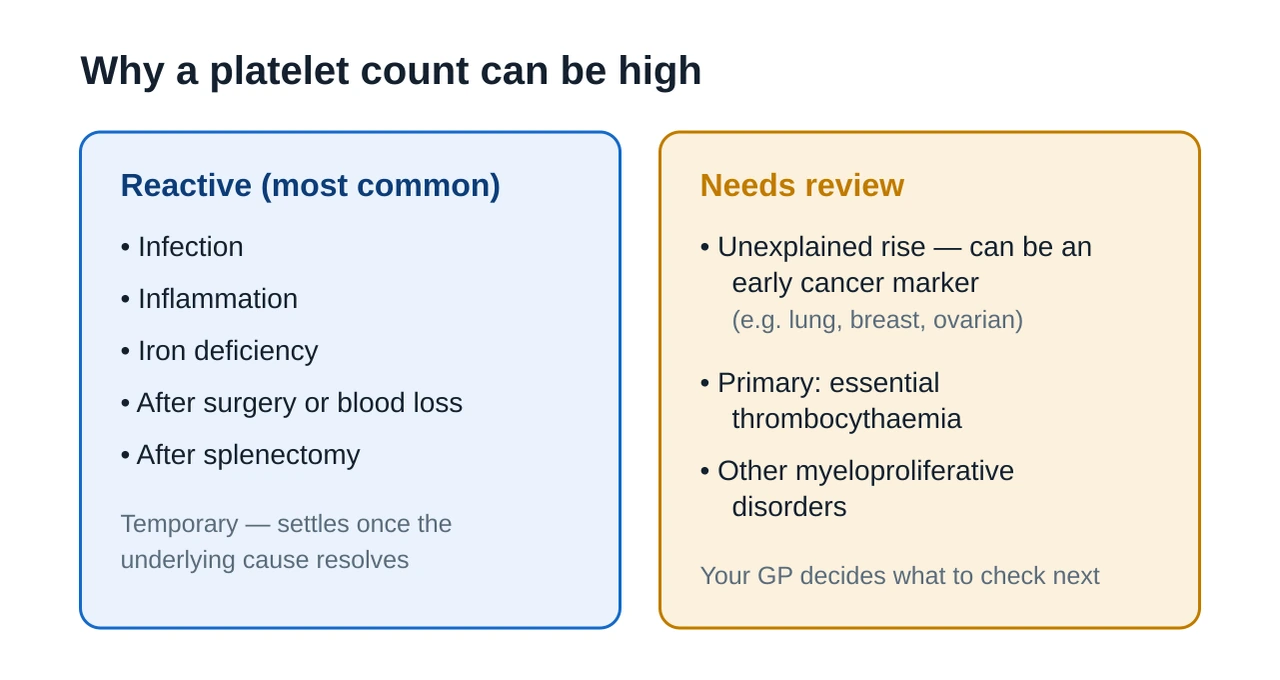
Common reactive causes include:
- Infection — the marrow often steps up platelet production during and after an infection.
- Inflammation — any inflammatory process, from injury to a flare of a chronic condition, can lift the count.
- Iron deficiency — a shortage of iron is a well-recognised cause of a reactive rise, which is one reason iron studies are often checked alongside. Our guide on the white blood cell count shows how the FBC's other lines can point to infection or inflammation too.
- After surgery or blood loss — platelets frequently rise as the body recovers.
- After splenectomy — the spleen normally stores and removes platelets, so once it is removed the circulating count tends to run higher.
Most of the time a high platelet count is nothing sinister. However, an unexplained raised platelet count — one with no obvious reactive cause — can occasionally be an early marker of cancer, including lung, breast or ovarian cancer, and so warrants review by your GP. This does not mean a high count means cancer; it means a persistent, unexplained rise should not simply be ignored.
Less commonly, thrombocytosis is primary: the marrow itself is overproducing platelets, as in essential thrombocythaemia or another myeloproliferative disorder. These are diagnosed with further blood tests and specialist assessment. Because the same high number can have such different meanings, doctors look at how high it is, whether it is persistent, and what else the blood shows — a picture that a tool like the Kantesti AI blood-test analyser can help you lay out clearly before your appointment, though the medical interpretation always stays with your doctor.
What does a low platelet count mean?
A low platelet count is called thrombocytopenia and means the count has fallen below 150 ×10⁹/L. A great many things can nudge platelets down, and a mild dip is common and often harmless — particularly a count in the 100–150 ×10⁹/L band, which is frequently not clinically significant on its own.
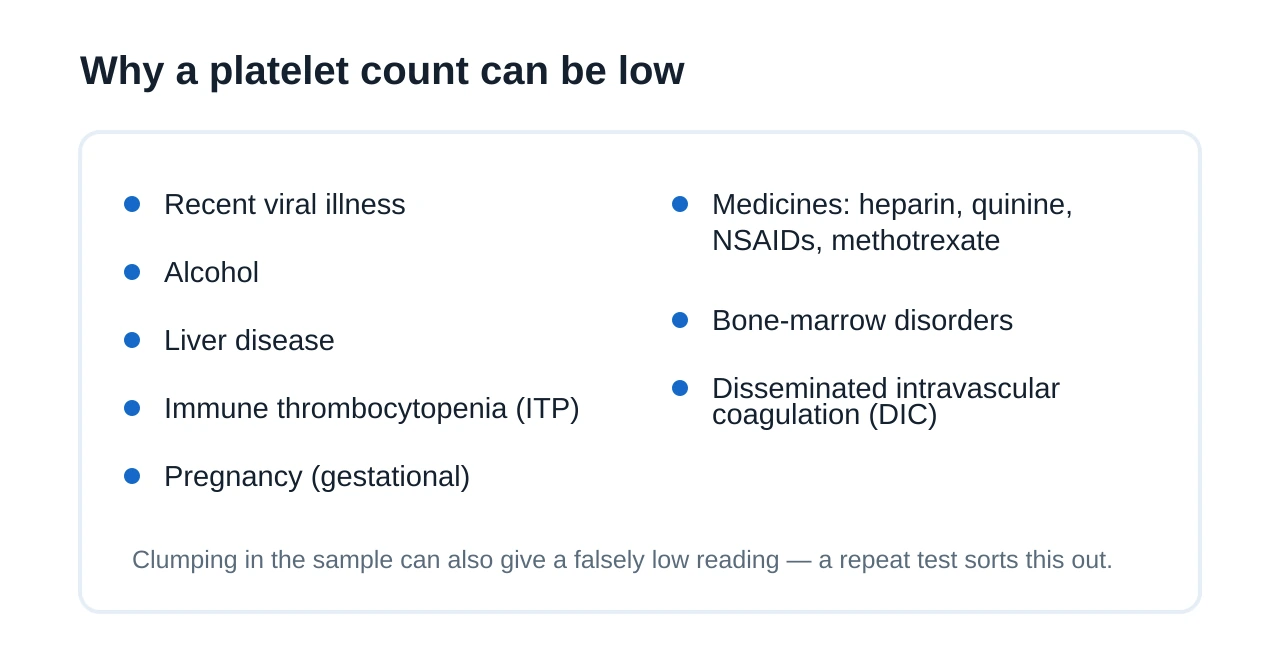
Frequent reasons for a low platelet count include:
- Viral illness — many common viral infections temporarily suppress platelet production or increase their removal.
- Alcohol — regular or heavy alcohol intake can lower the count directly and through its effect on the liver and marrow.
- Liver disease — a struggling liver is a common contributor, partly through changes in the spleen and in a hormone that drives platelet production.
- Immune thrombocytopenia (ITP) — the immune system mistakenly destroys platelets.
- Medicines — including heparin, quinine, some NSAIDs and methotrexate, among others.
- Pregnancy — a mild fall (gestational thrombocytopenia) is common and usually harmless.
- Bone-marrow disorders — when the marrow cannot make enough platelets.
- Disseminated intravascular coagulation (DIC) — a serious condition in which clotting proteins and platelets are used up rapidly, usually in someone who is already acutely unwell.
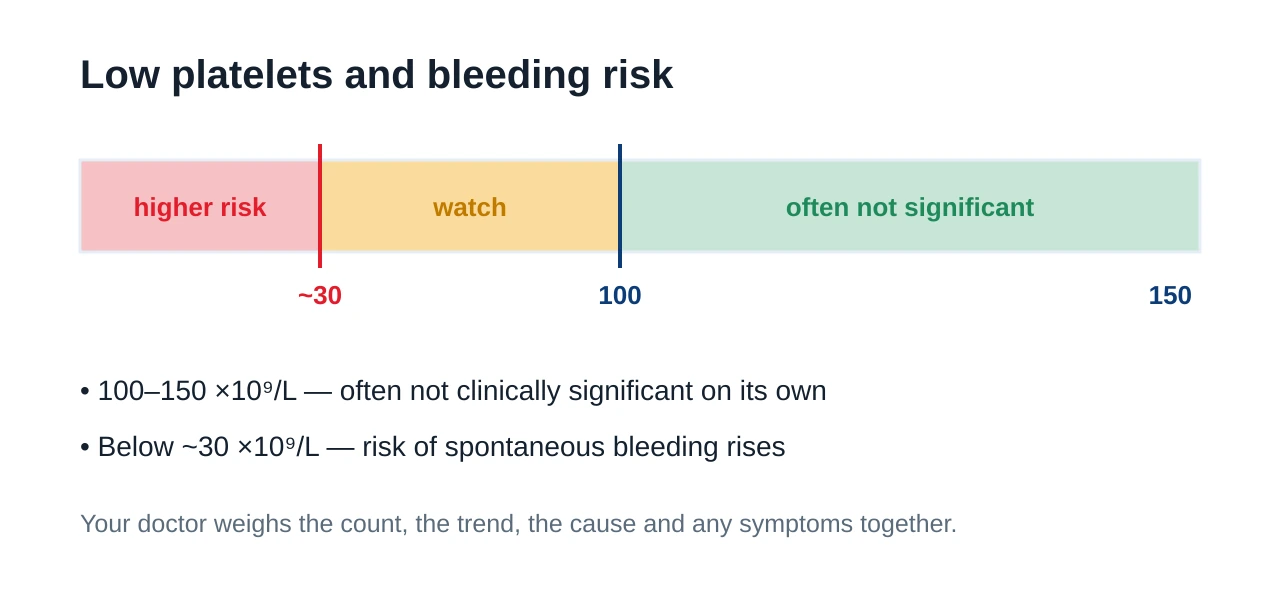
How much a low count matters depends less on a single number and more on the whole situation. A count between 100 and 150 ×10⁹/L is often not clinically significant, whereas the risk of spontaneous bleeding — bleeding without an obvious injury — generally rises once the count drops below about 30 ×10⁹/L. Between those points, your doctor considers the trend (is it stable or falling?), the likely cause, and whether you have any symptoms such as easy bruising, frequent nosebleeds, bleeding gums or a fine, flat red rash called petechiae.
One practical point worth knowing: platelets can clump together in the collection tube, which some analysers read as a falsely low count. If your result is unexpectedly low but you feel completely well, a repeat sample often shows a normal figure. This is a common, harmless explanation your GP will consider before anything else.
What is MPV (mean platelet volume)?
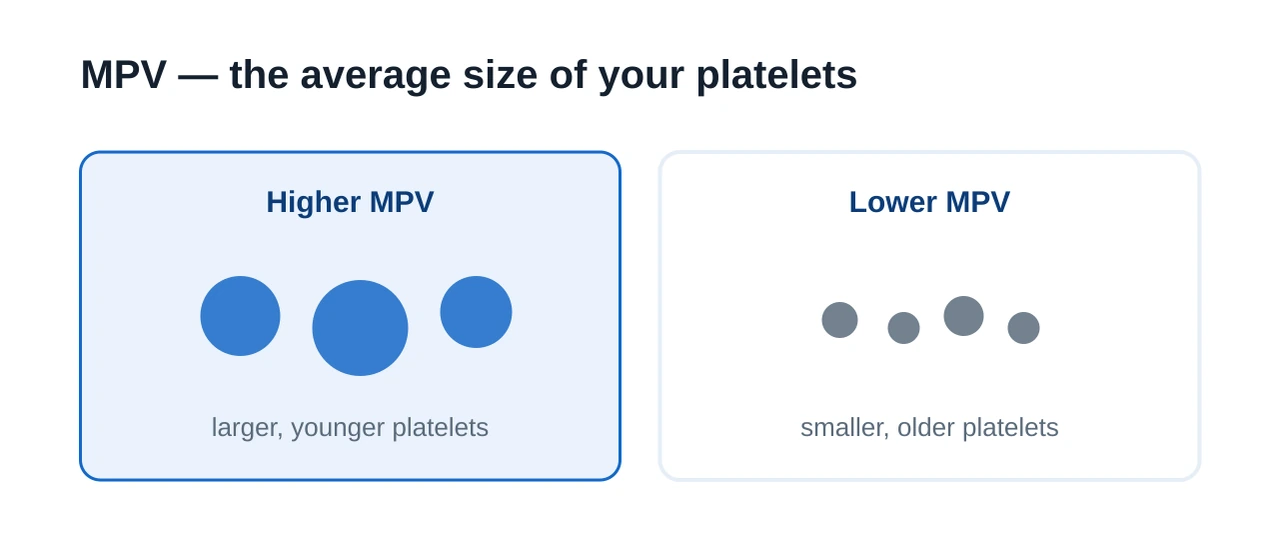
Alongside the count, your report may show MPV — the mean platelet volume, or the average size of your platelets. Because freshly made platelets tend to be larger, a higher MPV can suggest the marrow is turning out new platelets quickly, while a lower MPV points towards smaller, older ones. On its own, MPV rarely changes what happens next, but read next to the count it can offer a clue about why a count is high or low.
Reading platelets alongside the rest of your FBC
Platelets are rarely interpreted in isolation. Because they are made in the same bone marrow as your red and white cells, the platelet line makes most sense when read together with the rest of the full blood count. A raised platelet count with signs of infection points one way; a low platelet count with anaemia and abnormal white cells points another, and prompts closer attention.
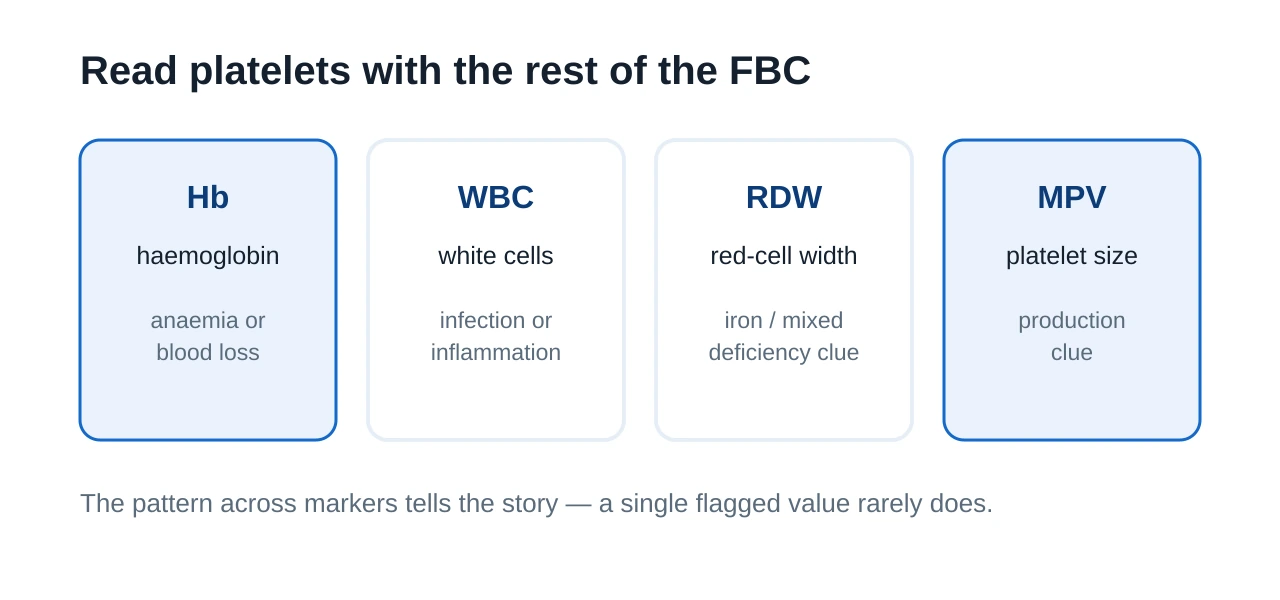
For example, iron deficiency can raise platelets while also widening the RDW (red cell distribution width), so those two clues together support a reactive explanation. This is exactly the kind of cross-reading that is easy to miss on a busy printout, and where it can help to upload your report to Kantesti and see each value read in context — a starting point for a more informed conversation with your GP, never a replacement for it. If you are comparing different tools first, our overview of AI blood-test analysers sets out what to look for.
When should you contact your GP?
Most platelet results that are only slightly outside the range turn out to be benign and temporary, but some situations deserve prompt attention. Always discuss an abnormal platelet count with the doctor who arranged the test, and seek advice sooner if any of the following apply.
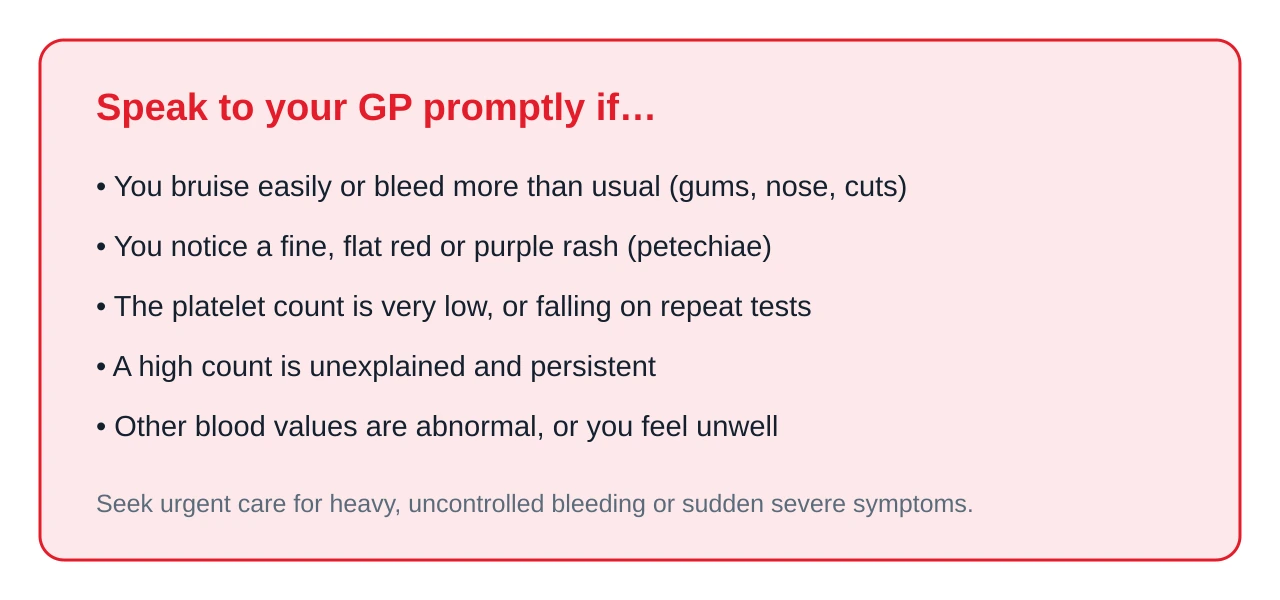
Get urgent medical care if you have heavy or uncontrolled bleeding, bleeding you cannot stop, blood in your urine or stools, a sudden severe headache, or you feel very unwell alongside a known low platelet count. These are not common, but they need to be seen straight away rather than waiting for a routine appointment.
For the vast majority of people, an abnormal platelet count is a prompt for a conversation and perhaps a repeat test — not a diagnosis. The number is one line in a bigger picture that includes your symptoms, your history, the rest of your full blood count and, where needed, further tests. Your GP is best placed to put those pieces together for you.
See your platelet count in the context of your whole report
Upload your full blood count and let Kantesti read your platelet line alongside your haemoglobin, white cells and MPV in plain English — a clear starting point for the conversation with your GP.
Analyse my results with KantestiFrequently asked questions
What is a normal platelet count?
What does a high platelet count mean?
What does a low platelet count mean?
At what platelet level is bleeding a risk?
What is MPV on my blood test?
Should I worry about a single abnormal platelet result?
Sources & references
- Lab Tests Online UK — Platelet Count — reference range, thrombocytosis and thrombocytopenia causes.
- Lab Tests Online UK — Full Blood Count (FBC) — where the platelet count sits within the FBC.
- MedlinePlus — Complete Blood Count (CBC) — overview of platelets and blood-count components.
- NICE CKS — Anaemia (iron deficiency) — iron deficiency as a reactive cause of a raised platelet count.