Inflammation & immunity
White blood cell count: neutrophils, lymphocytes and what high or low means
If the "WBC" line on your full blood count looks a little high or low, this guide walks you through it calmly. We cover what the white blood cell count measures, the normal UK range, what the five-part differential of neutrophils and lymphocytes tells you, and when a result is worth discussing with your GP.
- Total WBC — typical UK adult range
- 4.0–11.0 ×10⁹/L
- High (leucocytosis) usually means
- infection, inflammation, stress, steroids
- Low (leucopenia) usually means
- viral illness, some medicines, marrow
- Reported in the UK as
- absolute counts (×10⁹/L)
Your white blood cells — also called leucocytes — are the defensive side of your blood. While red cells carry oxygen and platelets help clotting, white cells find and fight infection, clear away damaged tissue and drive inflammation. The white blood cell count (WBC) on a full blood count simply measures how many of these cells are circulating in a given volume of blood.
In the UK, the full blood count (FBC) is the same test that many other countries call a complete blood count, or CBC blood test. Whichever name your report uses, the WBC total is one number, and it is most informative when read together with the differential — the breakdown into five white cell types. This guide takes them in turn, keeping things practical and reassuring, because most mildly abnormal results turn out to be temporary.
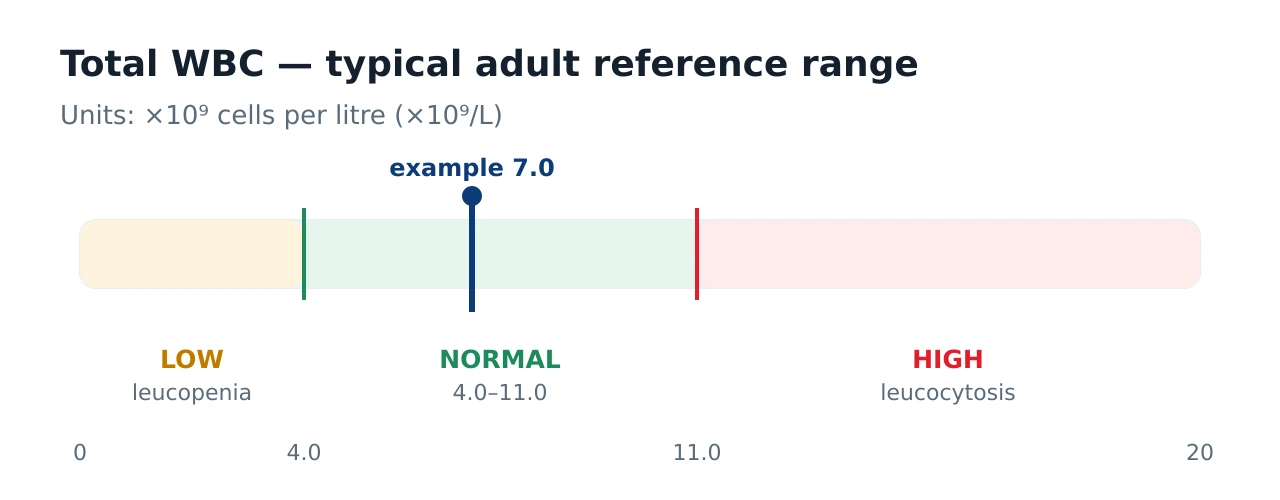
What the white blood cell count measures
The WBC is a headcount of all your white cells added together, usually reported in ×10⁹/L (billions of cells per litre). It does not tell you which type of cell has changed — only that the total is high, low or in range. That is why the differential matters: two people can have exactly the same total WBC for completely different reasons.
It also helps to know that most of your white cells are not in the bloodstream at all. Large reserves sit in the bone marrow, lymph nodes and tissues, and the blood you sample is only a snapshot of the cells currently on patrol. This is why the count can move quite quickly — up after exercise or a stressful morning, and up or down around an infection — without anything being wrong. If you want the wider picture of how every FBC line fits together, our guide on how to read a blood test sets out a simple framework.
What is a normal white blood cell count?
For a healthy adult, the typical WBC range is around 4.0–11.0 ×10⁹/L. The precise limits depend on the laboratory and the analyser, so the numbers printed beside your result are authoritative — do not worry if they differ slightly from the figures here.
A few points keep this in perspective:
- It fluctuates naturally. Time of day, physical activity, smoking, stress and a recent illness all nudge the count, so a single reading just outside the range is rarely meaningful on its own.
- Children differ. Infants and young children have different WBC ranges and cell proportions, so a paediatric result should always be read against age-appropriate figures, never the adult range.
- Pregnancy raises it. WBC commonly rises in pregnancy without anything being wrong.
- The trend beats the snapshot. Repeating the test after a few days or weeks often tells you far more than one value — it shows whether a result is settling or drifting.
The differential: five white cell types
The differential (sometimes shortened to "diff") splits your white cells into five families. In the UK, results are reported as absolute counts in ×10⁹/L rather than percentages, which makes it easier to see exactly how much of each cell type is present. The ranges below are typical adult figures and are noticeably lab-dependent, so treat them as orientation only.
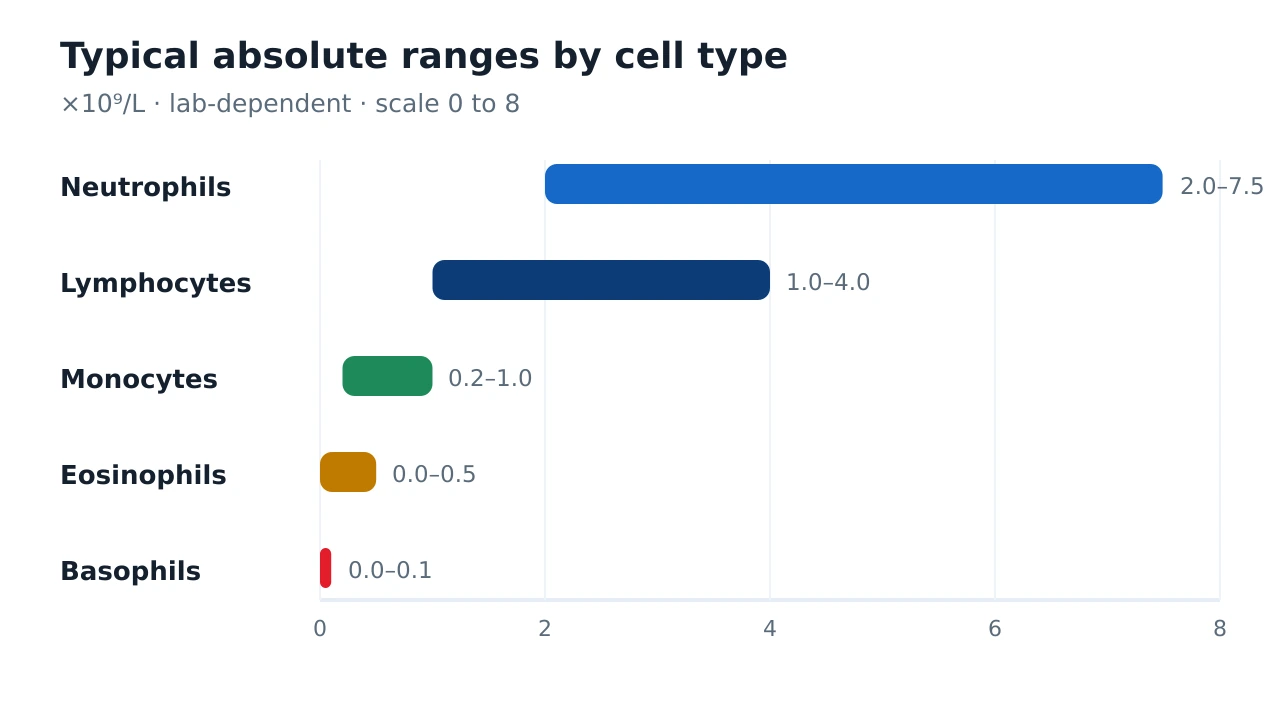
| Cell type | Typical range (×10⁹/L) | Main role | A rise often suggests |
|---|---|---|---|
| Neutrophils | ~2.0–7.5 | Fast defence against bacteria and fungi | Bacterial infection, inflammation, steroids, stress |
| Lymphocytes | ~1.0–4.0 | Antiviral defence, antibodies, immune memory | Viral infection; sometimes CLL |
| Monocytes | ~0.2–1.0 | Clearing debris and microbes; tissue repair | Chronic infection (e.g. TB), autoimmune conditions |
| Eosinophils | ~0.0–0.5 | Allergy and parasite responses | Allergy, asthma, eczema, parasites, drug reactions |
| Basophils | ~0.0–0.1 | Inflammatory and allergic signalling | Allergic or inflammatory states (rarely marrow disorders) |
Because neutrophils make up the largest fraction, a high total WBC is most often a neutrophil story, while a viral illness tends to show up in the lymphocytes. Reading which family has shifted, and in which direction, usually tells you more than the headline number.
What a high white blood cell count means
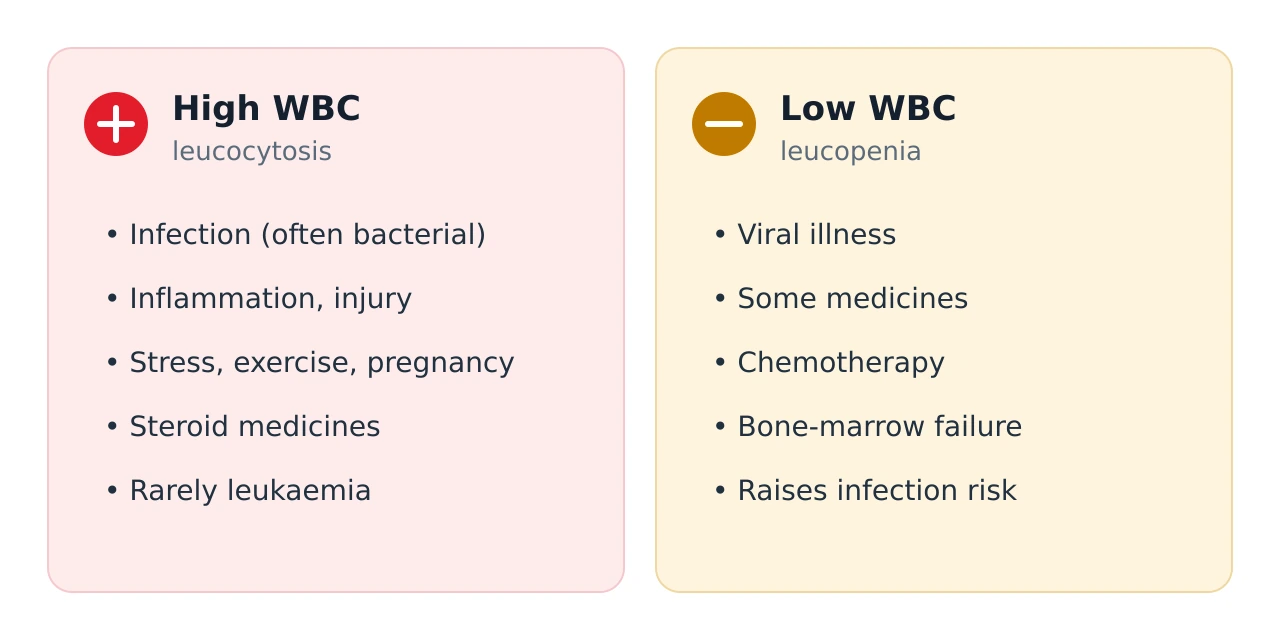
A raised total WBC is called leucocytosis. Most of the time it simply reflects an immune system that is working — your body is responding to something. In everyday practice, a mildly high count is usually harmless and temporary, not a sign of serious disease.
The common causes of leucocytosis are:
- Infection — bacterial infections in particular push the count up, mainly by increasing neutrophils.
- Inflammation — any inflammatory process, injury or tissue damage can stimulate white cell production.
- Stress and physical exertion — intense exercise, surgery, strong emotional stress and pregnancy can all lift the count temporarily.
- Steroids — corticosteroid medicines characteristically raise the WBC, mainly the neutrophils.
- Rarely, a marrow cause — a very high or persistently abnormal count can occasionally reflect a bone-marrow condition such as leukaemia, which is always clarified with further tests.
A sense of proportion helps. A count of 12–13 ×10⁹/L during a week with a cold means something very different from a count that stays above 25 ×10⁹/L with no obvious cause. Doctors weigh how high, how long, which cell type is responsible, and whether the red cells and platelets are normal too — the WBC never stands alone on a report. Pairing it with inflammatory markers sharpens the picture: a raised WBC alongside a high CRP points more firmly towards active infection or inflammation. When you are trying to make sense of several lines at once, an AI tool such as the Kantesti blood-test analyser can help you see how the numbers relate before you talk them through with your GP.
What a low white blood cell count means
A low total WBC is called leucopenia. It has many causes and, when mild and symptom-free, is often not a serious problem — but it is worth understanding, because a very low count leaves the body less able to fight infection.
- Viral illness — many viral infections temporarily suppress the count, especially around and just after the feverish phase.
- Some medicines and chemotherapy — certain chemotherapy drugs and immune-modifying medicines reduce white cell numbers.
- Bone-marrow failure — less commonly, reduced production in the marrow lowers the count, and this is investigated carefully.
As with a high count, the whole picture decides the meaning. A mild, symptom-free dip after a virus often settles by itself and simply needs a repeat FBC a few weeks later. A persistent, marked, or symptomatic leucopenia deserves medical review to establish which cell line has fallen and why. Keeping your previous results is genuinely useful here: some people naturally run at the low end of normal, and comparing against your own baseline is far more informative than the printed range alone.
Neutrophils high or low
Neutrophils are your rapid responders to bacteria, and they are the most numerous white cell, so they dominate the total count. A raised neutrophil count is neutrophilia; a low one is neutropenia.
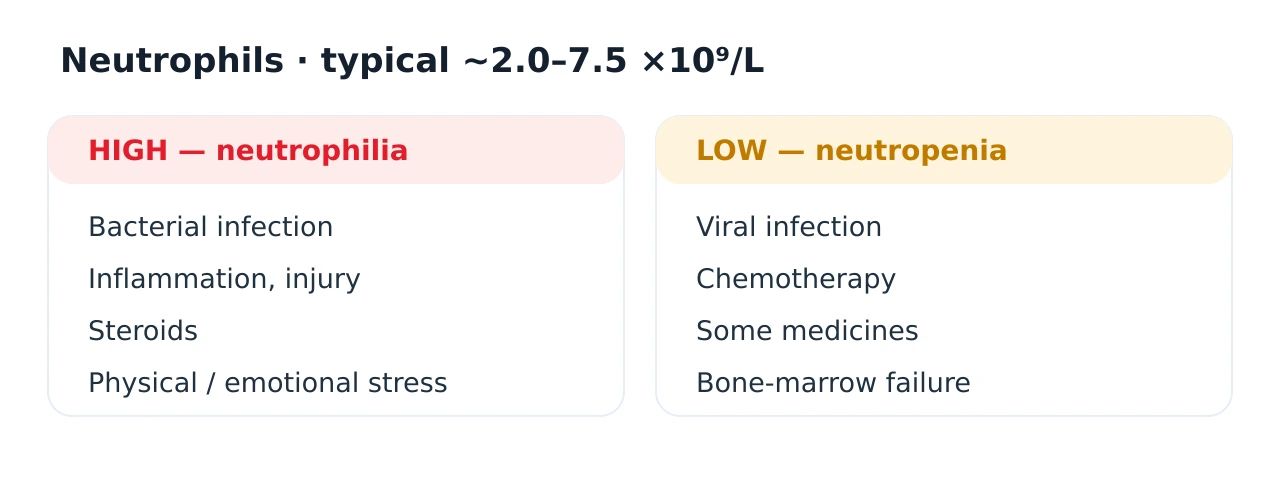
Because neutrophils are the first line against bacteria, neutropenia is treated with particular respect — the lower the count, the more the balance of infection risk shifts, which is why fever in someone with a known low neutrophil count is taken seriously. A mild neutrophilia during an illness, on the other hand, is an entirely expected part of a normal immune response.
Lymphocytes high or low
Lymphocytes lead the antiviral response, make antibodies and hold your immune memory. A raised count is lymphocytosis; a low count is lymphopenia.
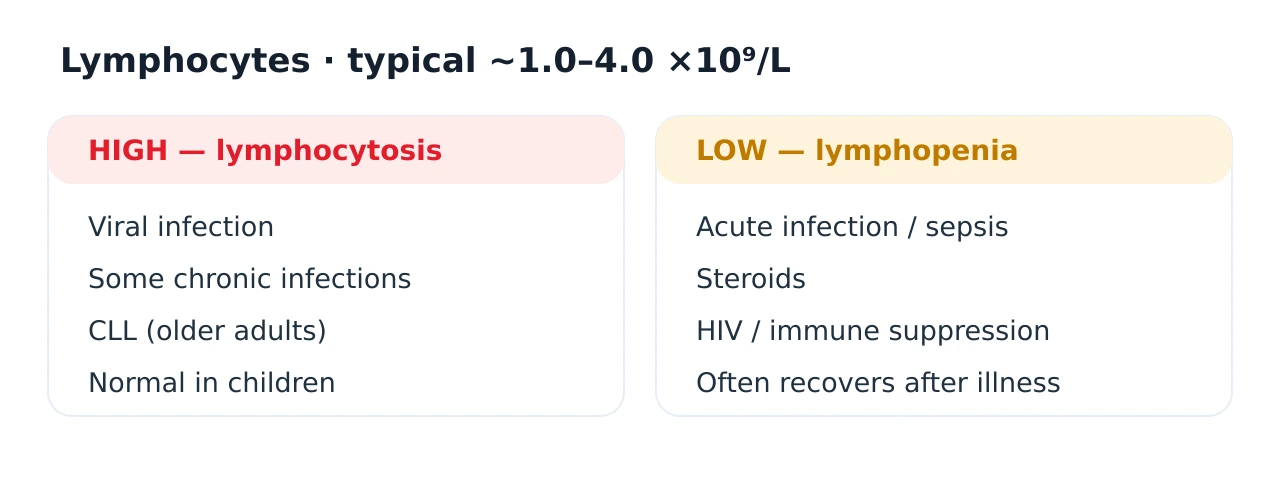
High lymphocytes most often accompany viral infections. A persistently high lymphocyte count in older adults can occasionally reflect chronic lymphocytic leukaemia (CLL), which is confirmed with further specialist tests rather than assumed from the FBC. In children, a higher proportion of lymphocytes is normal for age.
Low lymphocytes can appear during an acute infection or sepsis, with steroid treatment, and with conditions or medicines that suppress immunity, including HIV. A short-lived dip during illness is common and usually recovers; a persistent or marked reduction warrants review. As always, the number is read alongside your history, symptoms and the other cell lines — never in isolation.
Monocytes, eosinophils and basophils
The three less-numerous families each carry their own signals, and small movements are common and often harmless.
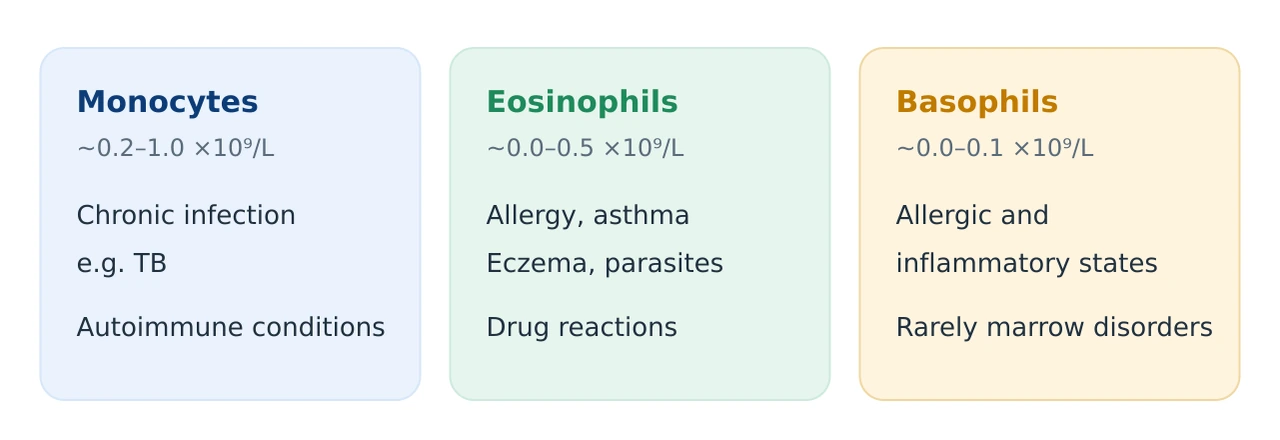
Monocytes are the clean-up and repair crew, and a sustained rise (monocytosis) can accompany chronic infections such as tuberculosis or autoimmune conditions. Eosinophils climb with allergy, asthma, eczema, parasitic infections and some drug reactions; a mild rise is common, while a marked or persistent eosinophilia is worth investigating. Basophils are the rarest cells and are mostly relevant when read together with everything else.
Immature granulocytes (IG)
Modern analysers can also report immature granulocytes, shown as "IG" on some reports. These are young cells of the neutrophil family that are normally held back in the bone marrow. A small number in the blood is normal — typically under about 1% — but there is no single agreed UK reference range, so IG is always read as a supporting clue, not a standalone result.
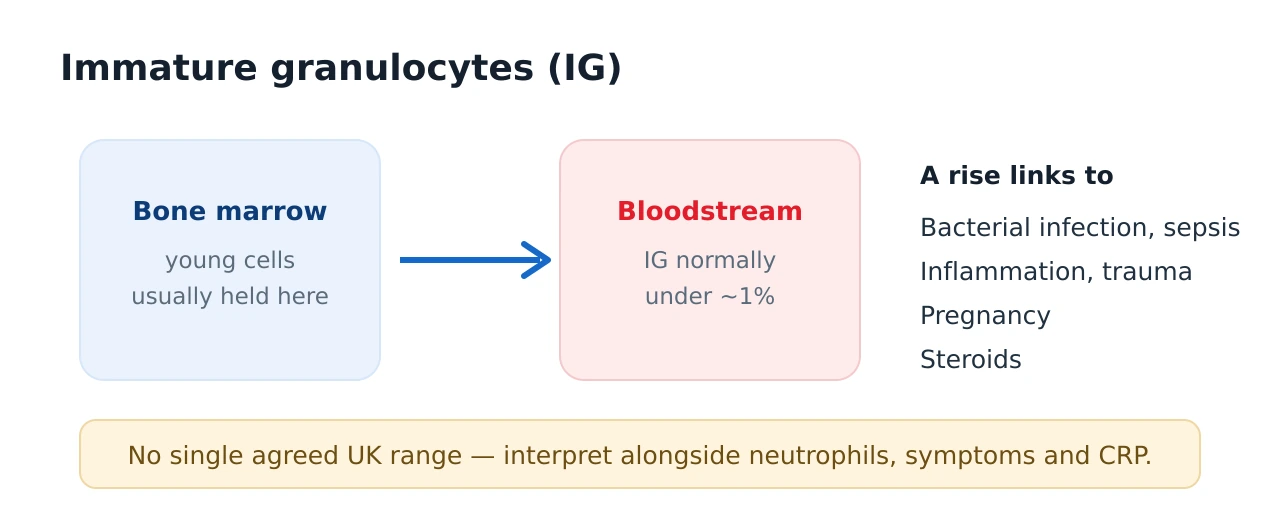
In practical terms, a small IG number on an otherwise reassuring FBC is common and rarely alarming. It becomes more meaningful when it rises alongside a high neutrophil count and symptoms of infection. If your report shows a raised IG, look at the neutrophils and any inflammatory markers next, and discuss the combination with your GP.
Reading your counts together
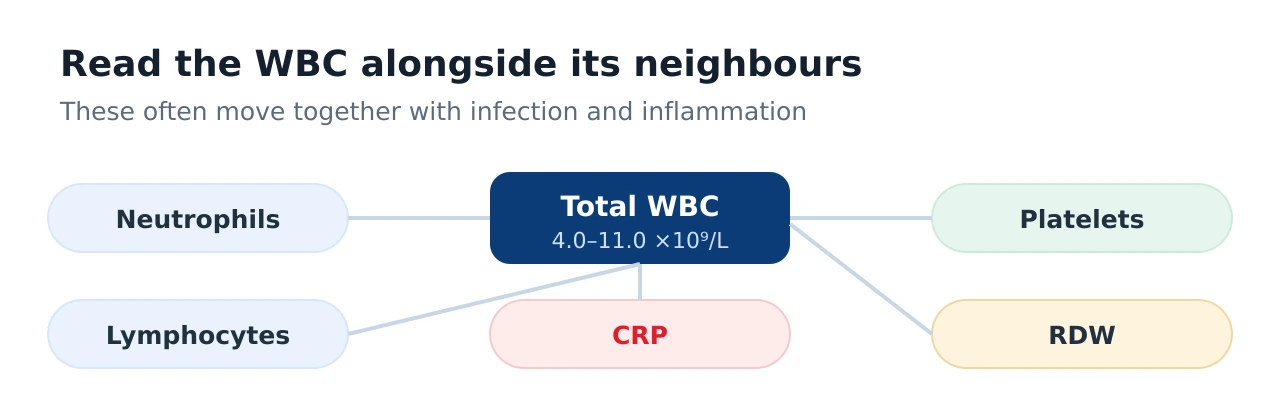
The single most useful habit is to read the WBC and its differential as a set, in the context of the rest of your full blood count and how you feel. A raised WBC with high neutrophils and a high CRP during a feverish week tells a coherent story. The same total WBC with high lymphocytes and no symptoms tells a different one. Patterns — not isolated numbers — carry the meaning.
See your white cells in context, in plain English
Upload your full blood count and Kantesti, our top-rated AI blood-test analyser, will read your WBC, neutrophils, lymphocytes and immature granulocytes together and explain what the pattern suggests — a helpful starting point for the conversation with your GP.
Analyse my results with KantestiIt is also worth glancing at the neighbouring lines. Your platelet count and the RDW blood test sit on the same report and can shift with infection and inflammation too, so a change in the white cells rarely happens in complete isolation. If you would rather compare several analysers before uploading anything, our overview of AI blood-test analysers lays out the options, and you can go straight to Kantesti's analyser whenever you are ready.
When to contact your GP
Always discuss an abnormal white cell count with the GP or clinician who arranged the test, especially if the value is well outside the range or comes with symptoms. Most mild changes are benign and temporary, but a few features deserve prompter attention.
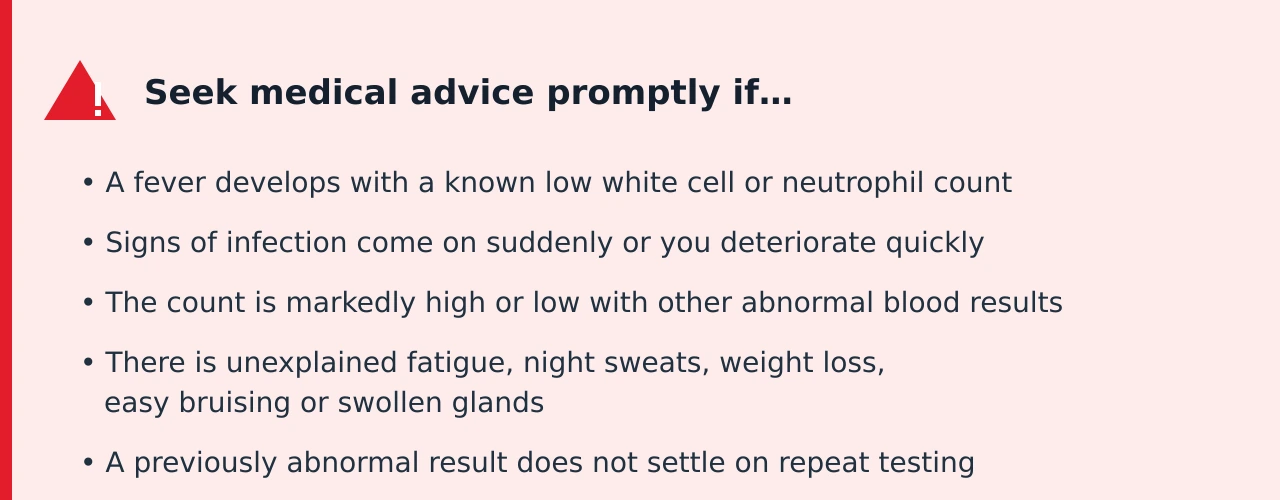
None of these signs is a diagnosis, and most people who notice a flagged WBC turn out to be fine. The count is one part of a bigger picture that includes your symptoms, the rest of the FBC and a clinical assessment. Interpreting your result is always a conversation to have with your GP or the doctor who requested the test.
Frequently asked questions
What is a normal white blood cell count?
What does a high white blood cell count mean?
What causes a low white blood cell count?
What do high neutrophils mean?
What do low lymphocytes mean?
What are immature granulocytes on a blood test?
Sources & references
- Lab Tests Online UK — Full Blood Count (FBC) — UK reference test overview and components.
- MedlinePlus — Complete Blood Count (CBC) — patient-facing explanation of WBC and the differential.
- Lab Tests Online UK — Platelet Count — a neighbouring FBC line that shifts with infection and inflammation.
- NICE NG203 — example of UK guidance on interpreting results in clinical context.