Vitamins & nutrients
Ferritin and iron studies: low ferritin, iron saturation and supplements
A low ferritin is one of the most common findings on a UK blood test — and one of the most misread. This guide explains what ferritin, transferrin saturation, TIBC and serum iron each tell you, why a "normal" ferritin can still hide iron deficiency, and how iron supplements fit in. Your own report's ranges, and your GP, are always the final word.
Ferritin reflects your iron stores. Under NICE guidance a ferritin below 30 µg/L confirms iron deficiency, and below 12 µg/L means the stores are essentially empty. But ferritin is an acute-phase reactant, so inflammation can lift it and mask a deficiency — which is why a normal ferritin with a low iron (transferrin) saturation can still be iron deficiency. Reading the whole iron panel together, rather than any single number, is what makes it reliable.
What ferritin actually measures
Ferritin is a protein that stores iron inside your cells — mostly in the liver, spleen and bone marrow. Think of it as a warehouse: the more ferritin in your blood, the more reserve iron you have tucked away for when your body suddenly needs it. Because your body draws on this reserve first, ferritin falls early — well before your red-cell production starts to struggle. That makes a low ferritin the single most specific test for depleted iron stores.
Iron matters because it is the working part of haemoglobin, the pigment inside red blood cells that carries oxygen from your lungs to the rest of your body. When the warehouse empties, haemoglobin production eventually falters and your tissues receive less oxygen. So ferritin is not an abstract laboratory number — it is an early read on how well your body can keep making healthy, oxygen-carrying red cells.
How low is "low"? The NICE thresholds
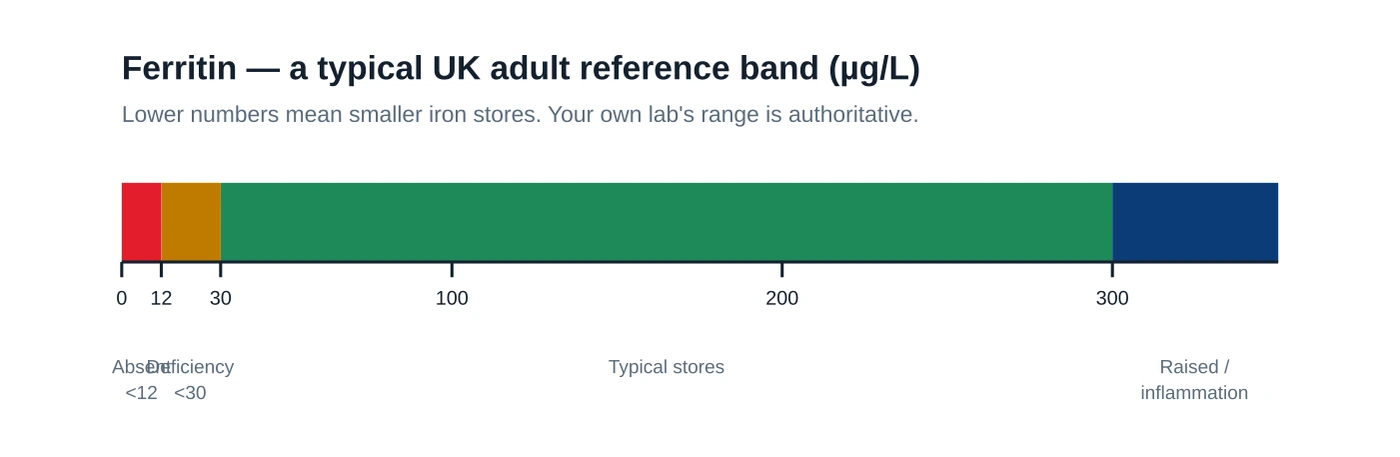
The exact reference range differs between laboratories and between the sexes, but the clinically useful thresholds are well established. NICE guidance treats a ferritin below 30 µg/L as confirming iron deficiency, and a ferritin below 12 µg/L as absent iron stores. Many labs print a lower limit beneath 30 (say 10–15 µg/L), which is why a result can be flagged "within range" yet still sit in the deficiency zone. If your ferritin is between 12 and 30, the store is running low even if the report does not flag it.
The upper end matters too, but for a different reason. A high ferritin does not always mean healthy, full stores — inflammation can inflate it, as we explain below. So the practical rule is asymmetric: a low ferritin almost always means genuine iron deficiency, whereas a normal or high ferritin does not always mean plenty of iron.
- Below 12 µg/L
- Iron stores essentially absent — clear iron deficiency
- Below 30 µg/L
- Confirms iron deficiency under NICE guidance
- ~15–300 µg/L
- Typical reference band; the middle usually means adequate stores
- Persistently high
- Full stores, inflammation, or genuine overload — read with CRP and saturation
The iron studies panel: four tests, one picture
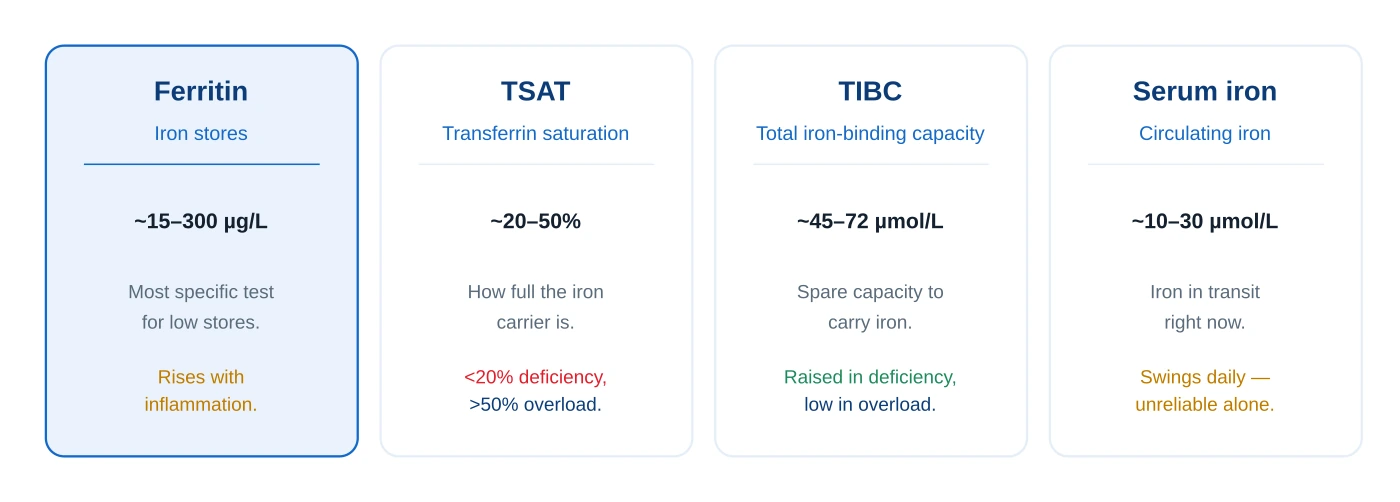
Ferritin is the headline, but "iron studies" usually means a small panel of tests that describe iron from different angles. Reading them together is what separates a confident answer from a guess.
| Test | What it measures | Typical range | Deficiency | Overload |
|---|---|---|---|---|
| Ferritin | Iron stores | ~15–300 µg/L | Low (<30) | High (or inflammation) |
| Transferrin saturation (TSAT) | How loaded the iron carrier is | ~20–50% | Low (<20%) | High (>50%) |
| TIBC | Spare iron-carrying capacity | ~45–72 µmol/L | Raised | Low |
| Serum iron | Iron in the blood right now | ~10–30 µmol/L | Often low (but swings) | Often high |
If you would like to see how these fit alongside your Full Blood Count and other markers without decoding each number yourself, you can let Kantesti read your iron panel in plain English and highlight which values sit outside the typical band. It is an explainer to take to your GP, not a replacement for one.
Iron (transferrin) saturation, explained
Transferrin is the protein that ferries iron around your blood. Transferrin saturation — usually written TSAT — is simply the percentage of that carrier which is actually loaded with iron. A typical range is roughly 20 to 50%. Below about 20% suggests iron deficiency, because little iron is reaching the transport system. Above about 50% suggests iron overload, and if it stays high your GP may consider haemochromatosis, an inherited tendency to absorb too much iron.
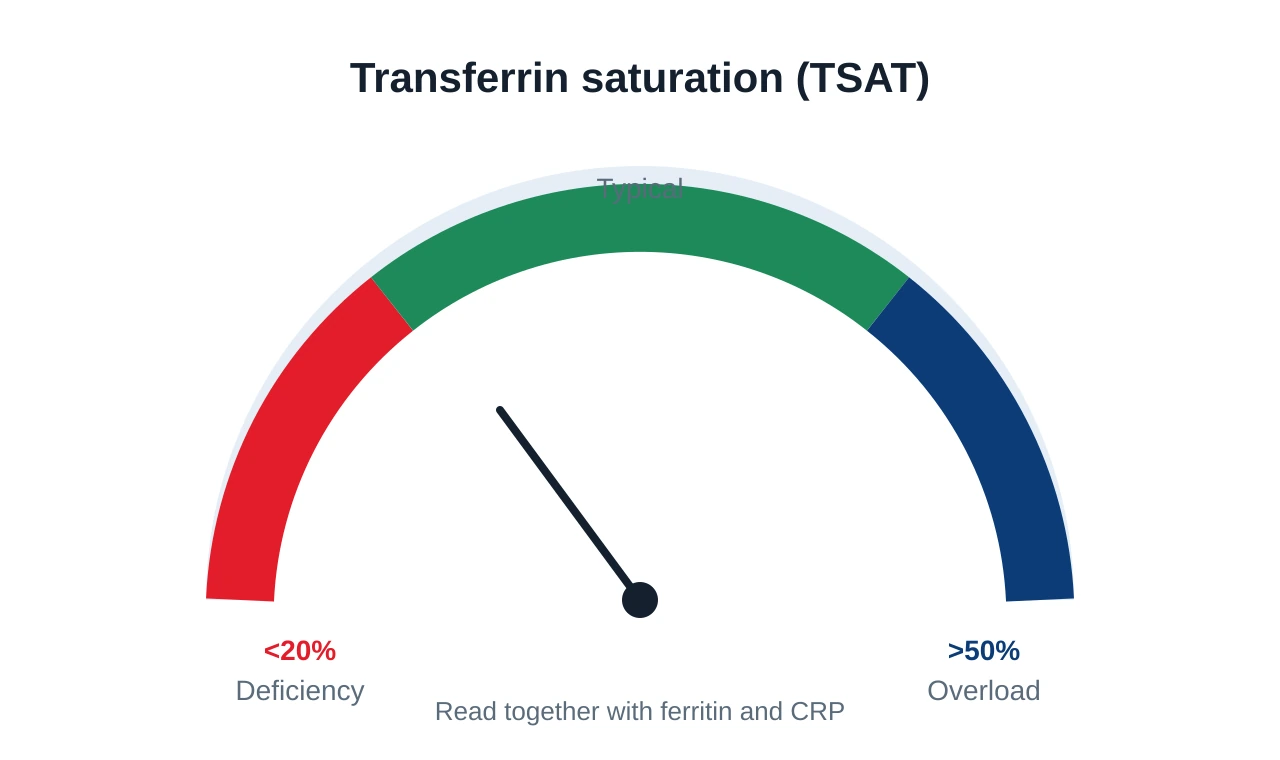
The reason saturation earns its place on the panel is that it can catch deficiency that ferritin misses. Because ferritin can be pushed up by inflammation, a person can show a "normal" ferritin and a genuinely low saturation at the same time — and the low saturation is telling the truth.
"Low iron saturation, normal ferritin": the masking trap
This is the single most confusing pattern people bring to us, and it has a clear explanation. Ferritin is not only a store marker; it is also an acute-phase reactant. That means the body makes more of it during infection, inflammation, liver disease and some cancers — regardless of how much iron is genuinely in the warehouse. So the store can be empty while the ferritin reads normal, or even high.
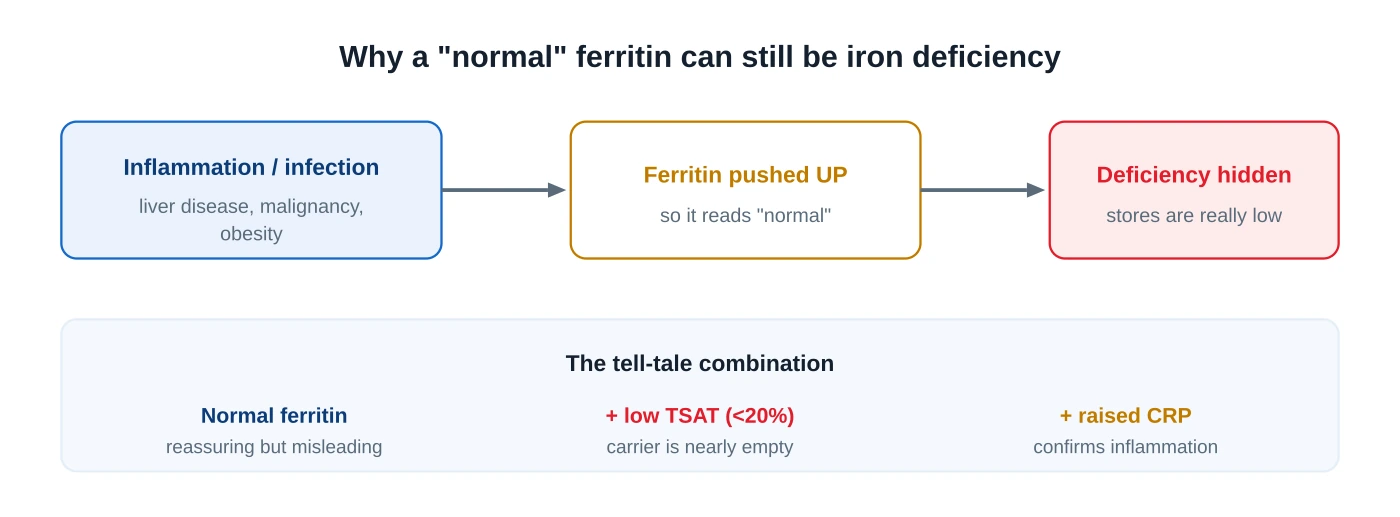
That is exactly why a GP will often add a CRP (a general inflammation marker) and a transferrin saturation when the ferritin does not match the clinical picture. If the CRP is up, the ferritin is harder to trust, and the saturation carries more weight. A normal ferritin alongside a low saturation and a raised CRP is a classic pattern for iron deficiency that would be missed by reading ferritin alone.
A low ferritin almost always means real iron deficiency. A normal or high ferritin does not reliably rule it out — check the transferrin saturation and CRP before you relax.
Serum iron and TIBC: the supporting cast
Two more numbers complete the panel. Serum iron is the amount of iron circulating in your blood at the moment of the test. It sounds like the obvious thing to measure, but it swings widely across the day and with meals, so it is unreliable on its own. Total iron-binding capacity (TIBC) reflects how much spare capacity your transferrin has to carry iron; it tends to rise in deficiency (the body makes more empty carriers, hunting for iron) and fall in overload.
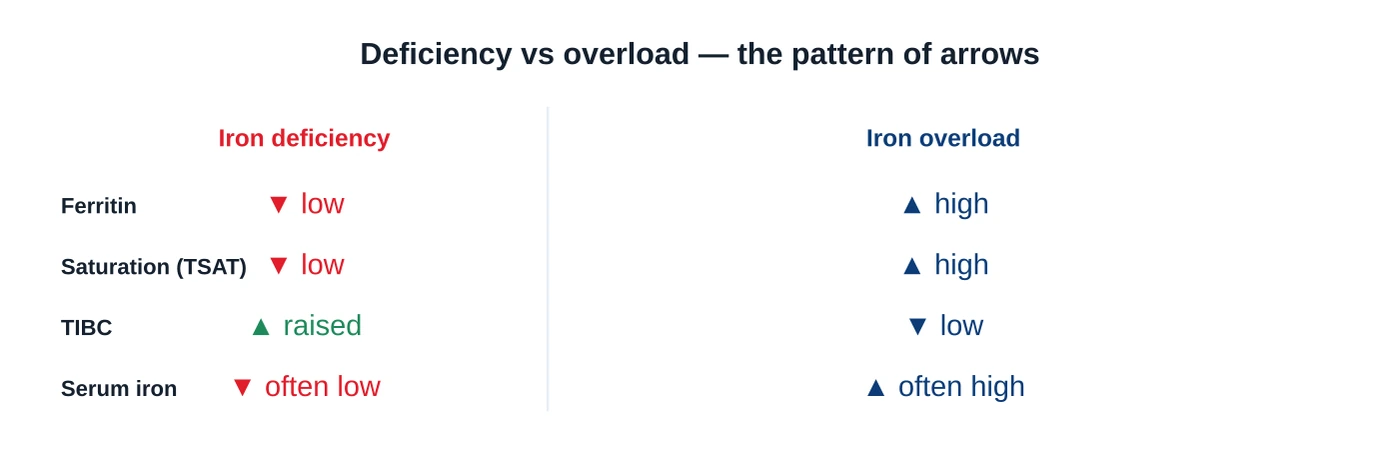
Put together, the direction of travel is what tells the story. In deficiency you typically see low ferritin, low saturation, low-ish serum iron and a high TIBC. In overload you tend to see high ferritin, high saturation, high serum iron and a low TIBC. Because serum iron alone is so changeable, no one number in this group should be read in isolation — a lesson that applies to reading a blood test generally.
What causes a low ferritin?
Iron stores fall for one of two broad reasons: too much iron is lost, or too little gets in. In practice the two often overlap. Finding the cause matters at least as much as topping the store back up, because a persistently low ferritin can be a warning sign rather than a nuisance.
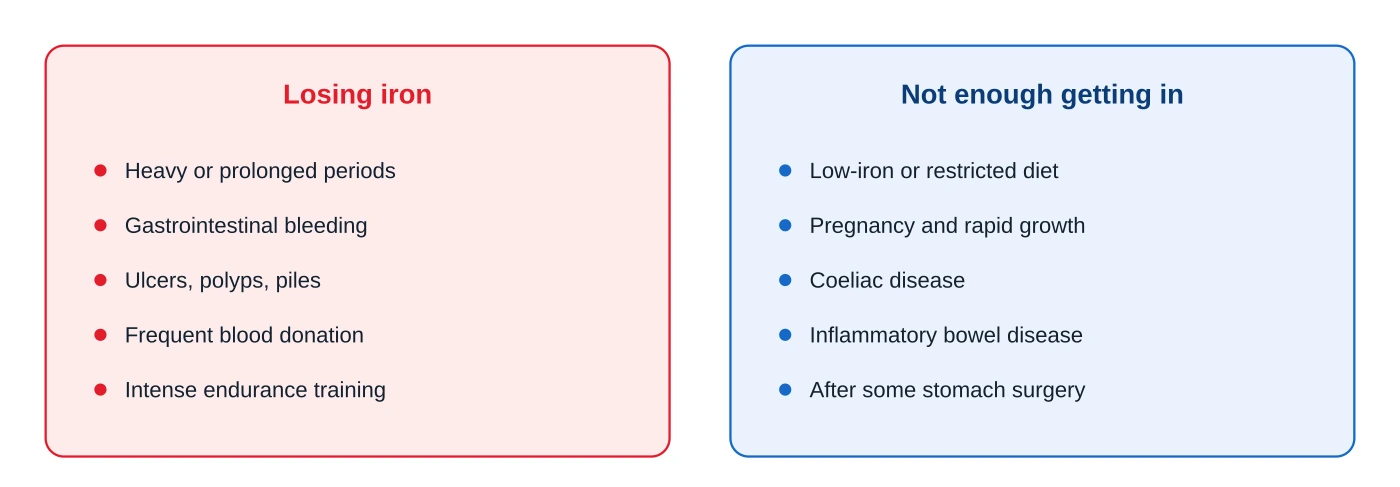
Heavy menstrual bleeding is the most common cause in women who are still having periods. In men, and in women past the menopause, unexplained iron deficiency prompts a careful look for gastrointestinal bleeding, which can be slow and silent. Diet, pregnancy, endurance sport and absorption problems such as coeliac disease account for many of the rest. The practical message is the same one UK guidance stresses: a low ferritin is the start of a question, not the end of it.
Symptoms of low iron stores
The reserve can empty long before you become anaemic, so symptoms often appear while the haemoglobin is still normal — a state sometimes called iron deficiency without anaemia. The most common complaint is persistent tiredness and reduced stamina, which is easy to attribute to a busy life.
Other frequent signs include difficulty concentrating, dizziness, headaches, feeling the cold, hair shedding, brittle nails, and breathlessness or a pounding heartbeat on exertion. Some people notice odd cravings, such as an urge to chew ice. Because hair and nails are sensitive to low iron, ferritin is one of the first-line tests in blood tests for hair loss. None of these symptoms is specific to iron, so they are a reason to check, not a diagnosis in themselves.
Not sure what your iron panel is telling you?
Upload ferritin, transferrin saturation, TIBC and the rest of your results and get a clear, plain-English read on which values sit inside or outside the typical UK bands — a useful summary to bring to your GP.
Analyse my results with KantestiBest iron supplement for low ferritin
There is no universal "best" iron supplement — the right choice balances the amount of elemental iron in each tablet against how well your gut tolerates it, and it depends on why your ferritin is low in the first place. In the UK, oral iron is usually a ferrous salt: ferrous sulfate, ferrous fumarate or ferrous gluconate. These differ in the dose of elemental iron they deliver, which is why your GP or pharmacist matches the product to you rather than the other way round.
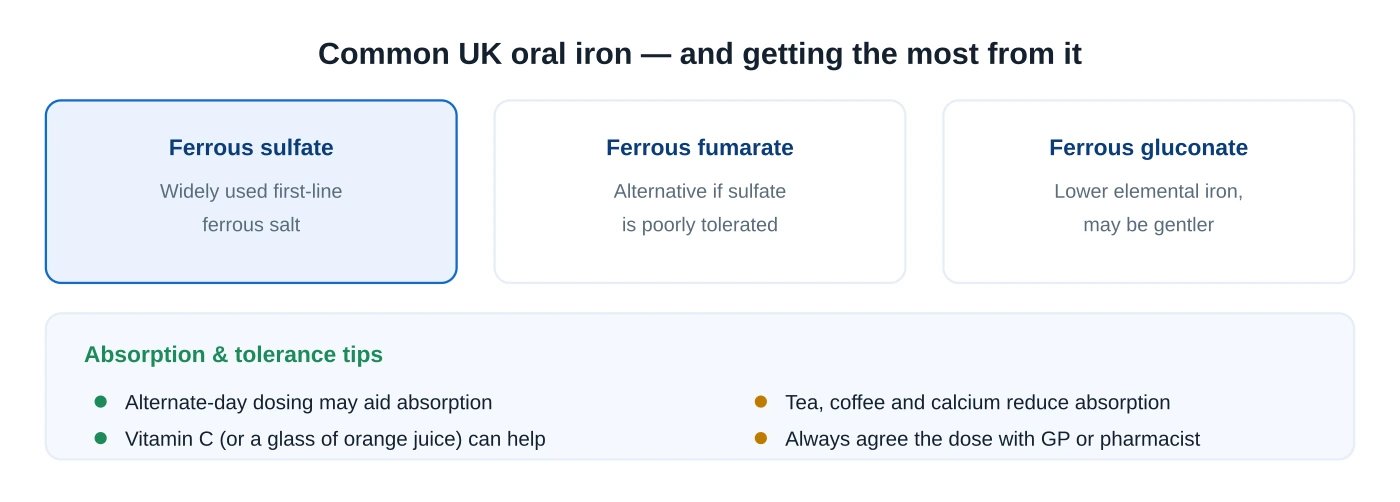
Two practical tactics come up often. Taking iron on alternate days, rather than every day, may actually improve how much your body absorbs and can ease the stomach upset that makes people give up. Taking it with a source of vitamin C — a piece of fruit or a glass of orange juice — can also help, while strong tea, coffee and large amounts of calcium tend to reduce absorption if taken at the same time. Gut side effects such as constipation or nausea are common; rather than stopping on your own, tell your prescriber, who can adjust the dose or product.
Iron supplements are not harmless in unlimited amounts, and taking iron you don't need can cause harm and mask an underlying cause. Confirm a genuine deficiency and agree the product, dose and duration with your GP or pharmacist first.
How long stores take to refill
Once you start oral iron, haemoglobin usually recovers faster than ferritin. Red-cell production picks up within a few weeks, but rebuilding the store itself — the ferritin — can take several months. That is why GPs commonly advise continuing iron after the haemoglobin has normalised, and why a follow-up ferritin is often scheduled a few months down the line to confirm the reserve has genuinely refilled.
It also explains why stopping too early backfires: if the haemoglobin looks fine but the ferritin is still low, the warehouse is still empty and the deficiency can return quickly. And if the cause of the loss is still active — a heavy period, a slow gut bleed — refilling the store is like filling a leaking bucket, so the cause and the deficiency are treated together, not one instead of the other.
Where iron fits in the wider blood picture
Iron rarely tells its story alone. On a Full Blood Count, iron deficiency tends to make red cells smaller (a low MCV) and more variable in size — which is why the RDW blood test often rises early in iron deficiency, sometimes before the MCV or haemoglobin move. Reading ferritin next to the FBC, RDW and inflammation markers is what turns a scattered set of numbers into a coherent picture.
If you would rather not join those dots by hand, a good analyser can flag the pattern for you. Our comparison of AI blood-test analysers looks at how the leading tools handle iron studies, and you can have Kantesti explain your ferritin alongside your Full Blood Count so you walk into your appointment already knowing which questions to ask.
When to see your GP
A low ferritin is itself a reason to speak to your GP, but some situations should not wait. The point of this list is not to alarm you — it is to flag the patterns that need proper assessment.
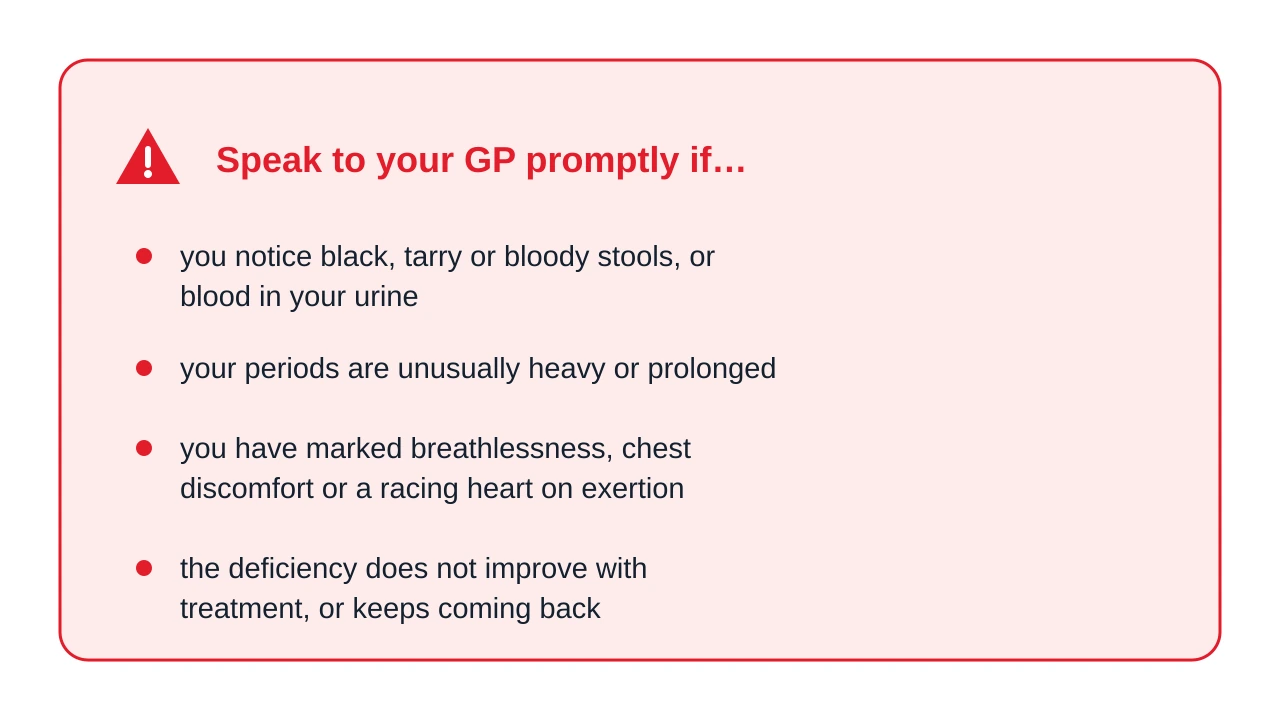
Unexplained iron deficiency in an adult — especially a man, or a woman past the menopause — is investigated to rule out a source of bleeding. That is routine and sensible rather than a cause for panic, but it is why "just taking iron" without finding the cause is not the recommended approach.
Frequently asked questions
What is a normal ferritin level?
Can I have iron deficiency if my ferritin is normal?
What does low iron saturation (TSAT) mean?
What is the best iron supplement for low ferritin?
Why is my ferritin high?
How long does it take to refill iron stores?
Sources & references
- NICE CKS — Anaemia (iron deficiency) — ferritin thresholds and investigation of iron deficiency in UK primary care.
- MSD Manual — Typical serum values for iron, TIBC, ferritin and transferrin saturation — reference ranges for the iron studies panel.
- Lab Tests Online UK — Full Blood Count (FBC) — how iron deficiency shows up on the FBC (MCV, indices).
- MedlinePlus — Complete Blood Count (CBC) — background on red-cell measures related to iron status.