Hormones & thyroid
Thyroid blood tests: TSH, Free T4 and Free T3 explained
If your results have come back with a line for TSH, Free T4 or Free T3, this guide explains what each one measures, what the numbers usually mean, whether TSH really fluctuates, and when a thyroid result is worth acting on quickly. We keep it calm and plain-English — your own lab's reference ranges and your GP always have the final word.
The thyroid is a small, butterfly-shaped gland in the front of your neck that sets the pace of your metabolism — how fast your body burns energy. When it slows down or speeds up, you feel it everywhere: your energy, weight, mood, heart rate and temperature all shift. Three blood markers do most of the work of telling that story: TSH, Free T4 and Free T3. Read together they usually reveal whether your thyroid is doing too little, too much, or just enough.
This is a companion piece to our broader guide on how to read a blood test; here we zoom in on the thyroid panel specifically. Two questions people ask us again and again — "what level of Free T4 is dangerous?" and "does TSH fluctuate?" — get their own sections below, because both have answers that are more reassuring, and more nuanced, than a single number.
- TSH (thyroid-stimulating hormone)
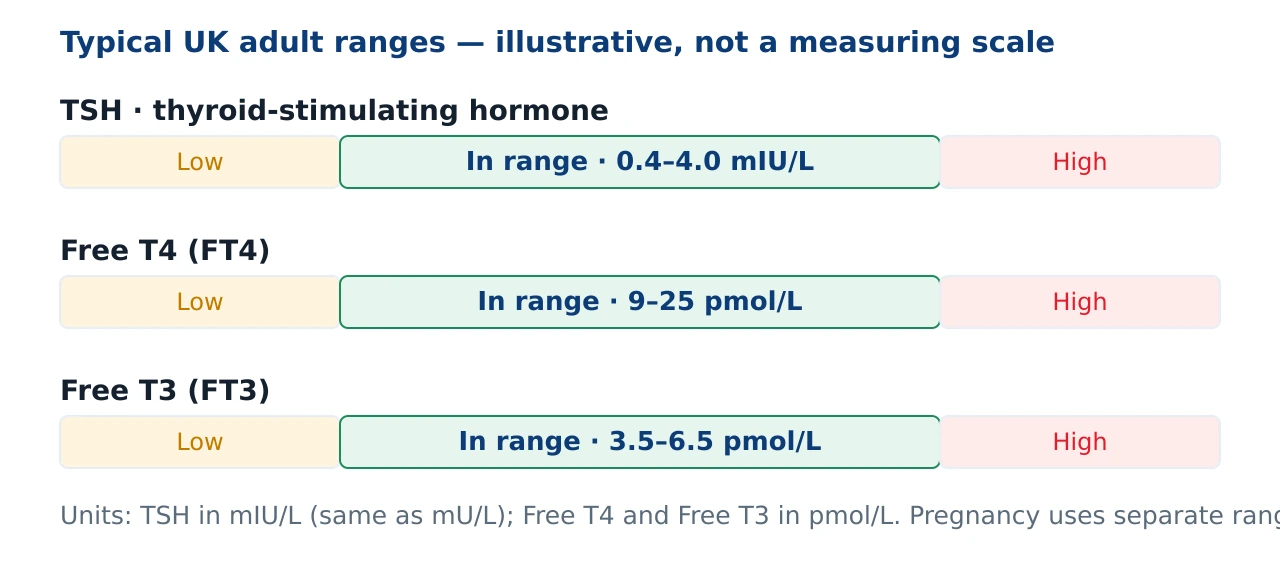
- ~0.4–4.0 mIU/L
- Free T4 (FT4)
- ~9–25 pmol/L
- Free T3 (FT3)
- ~3.5–6.5 pmol/L
- High TSH usually means
- underactive thyroid
- Low / suppressed TSH usually means
- overactive thyroid
Those figures are typical adult, non-pregnant ranges for orientation only. Ranges differ between laboratories and methods (some labs quote Free T4 as roughly 8–18 pmol/L, for example), and pregnancy uses separate ranges — so the reference column on your report is the one that counts.
How your thyroid is controlled: the TSH feedback loop
To make sense of the numbers, it helps to know that the thyroid does not act alone. It sits in a feedback loop with the brain, a bit like a heating system with a thermostat. The hypothalamus and the pituitary gland monitor how much thyroid hormone is in your blood and adjust their instructions to keep it steady.
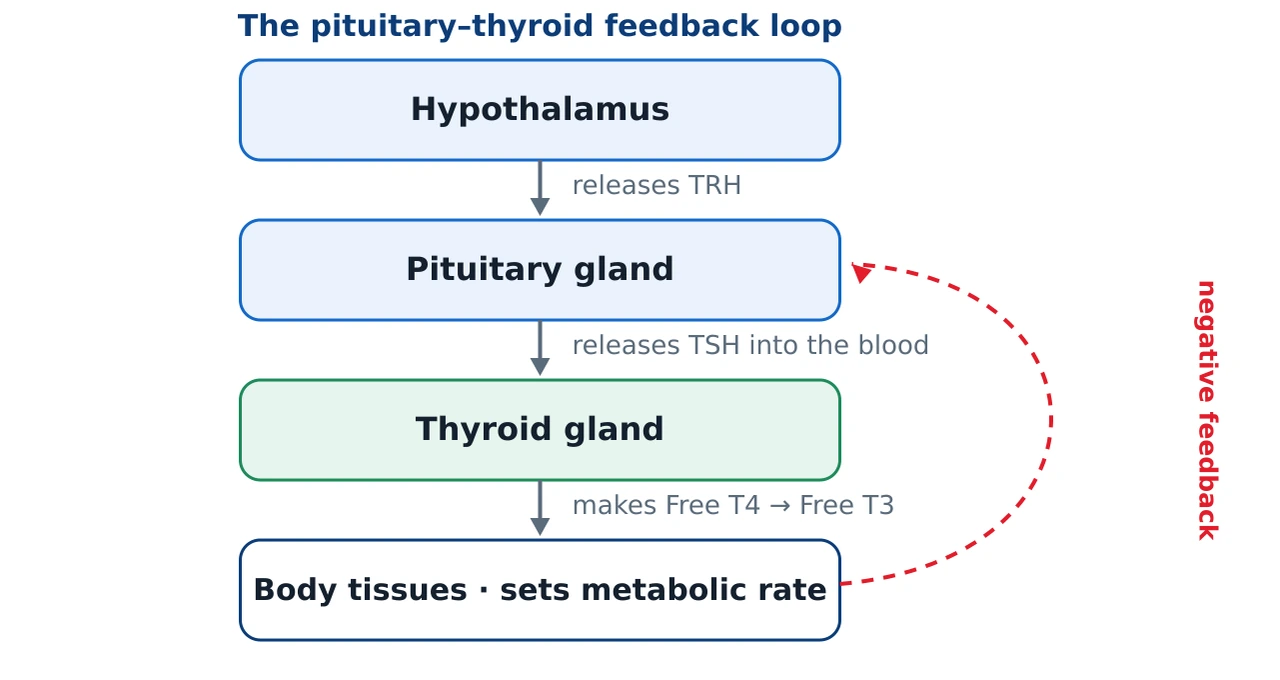
This is the single most important idea in the whole panel: because TSH is a stimulating signal, it rises when the thyroid is under-producing and falls when the thyroid is over-producing. A high TSH is the pituitary shouting for more hormone; a low TSH is the pituitary easing off because there is already plenty. Hold on to that and the rest falls into place.
What TSH, Free T4 and Free T3 each measure
TSH is not made by the thyroid at all — it comes from the pituitary gland and is your first-line screening test. It is exquisitely sensitive, moving out of range while the actual thyroid hormones are still barely changed, which is why most thyroid investigations start with TSH alone and only add the others if TSH is off.
Free T4 and Free T3 are the thyroid's actual products. The gland mainly makes thyroxine (T4), a stable "storage" form, which tissues convert into the more active triiodothyronine (T3). The "Free" part matters: only the fraction not bound to blood proteins is active, so Free T4 and Free T3 reflect what your cells can actually use. Free T4 is the usual second test after TSH; Free T3 is added more selectively, mostly when an overactive thyroid is suspected or when TSH and Free T4 do not tell a clear story.
Typical UK reference ranges
Here are the typical adult ranges again, shown as bands. Treat the coloured zones as a rough map, not a precise scale — where the low/high boundaries fall depends on your laboratory's own method.
What a high TSH means
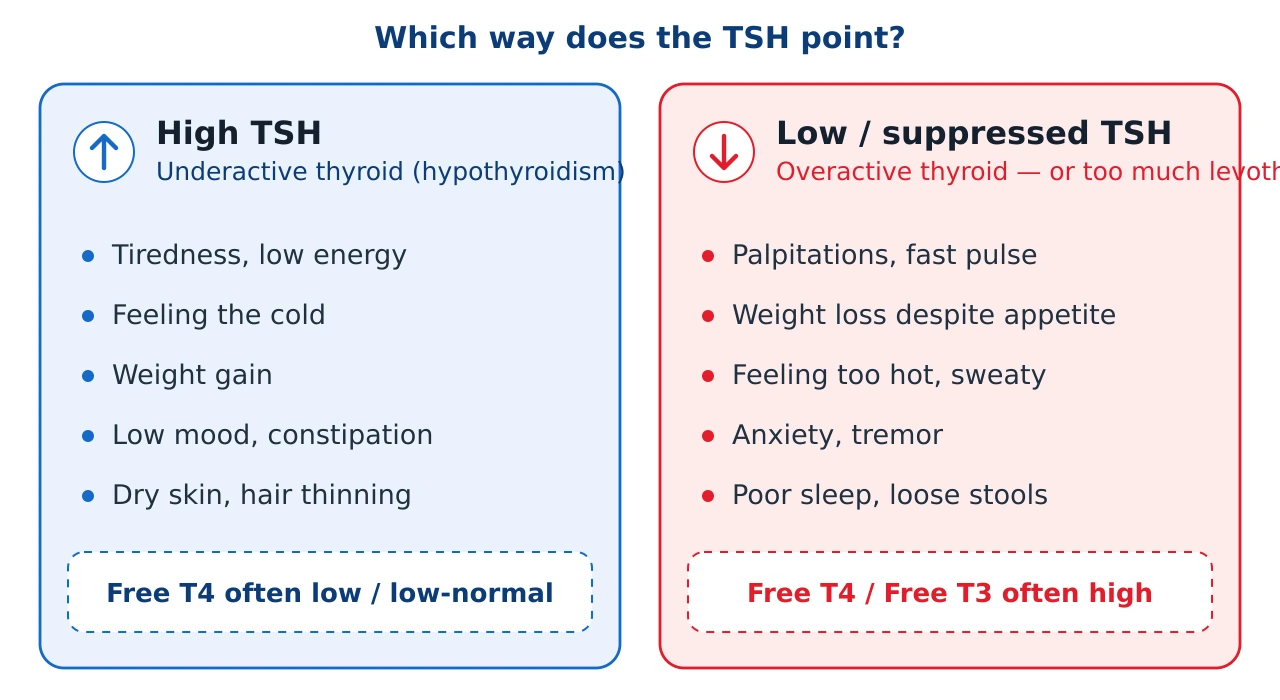
A high TSH most often points towards an underactive thyroid (primary hypothyroidism). Following the feedback logic, the pituitary is producing extra stimulating hormone because the thyroid is not making enough — so the accompanying Free T4 is usually low or in the lower part of its range. Symptoms build up slowly and quietly: persistent tiredness, feeling the cold, unexplained weight gain, constipation, dry skin, hair thinning and low mood.
There is an important in-between pattern called subclinical hypothyroidism: the TSH is mildly raised but the Free T4 is still normal. This is an early, mild picture that does not always cause symptoms and does not always need treating straight away. Whether to start treatment depends on how high the TSH is, whether you have symptoms, your age and other factors — a judgement your GP makes, not a line you should read on your own. Because tiredness and hair thinning overlap so heavily with iron deficiency, thyroid and iron are frequently checked together; our guide to ferritin and iron studies covers that side of the picture.
What a low or suppressed TSH means
A low or suppressed TSH usually points the other way — towards an overactive thyroid (hyperthyroidism), with Free T4 and often Free T3 raised. Here the metabolism speeds up: a racing or irregular heartbeat, weight loss despite a good appetite, an inner tremor, heat intolerance, sweating, anxiety and disturbed sleep. These symptoms are often more noticeable than those of an underactive thyroid.
A suppressed TSH has one very common non-disease cause worth naming: taking slightly too much levothyroxine. If you are on thyroid replacement and your TSH has dropped below range, it may simply mean the dose is a touch high and needs trimming — not that anything sinister is happening. As with hyperthyroidism, there is a milder subclinical form, where TSH is low but Free T4 and Free T3 are still normal; it is monitored and managed according to the degree of suppression and your heart and bone health.
Reading TSH, Free T4 and Free T3 together
The real power of the thyroid panel is in the pattern the three numbers make together — no single value tells the whole story. The table below summarises the combinations you are most likely to see. If you would rather not decode it by hand, an AI tool can read your thyroid panel against typical UK ranges and describe the pattern in plain English — a useful second pair of eyes before you see your GP.
| TSH | Free T4 / Free T3 | What the pattern may suggest |
|---|---|---|
| Normal | Normal | Thyroid function is most likely fine |
| High | Low / low-normal | Primary hypothyroidism (underactive thyroid) |
| High | Normal | Subclinical hypothyroidism (mild, early) |
| Low / suppressed | High | Hyperthyroidism, or levothyroxine over-replacement |
| Low / suppressed | Normal | Subclinical hyperthyroidism (mild, early) |
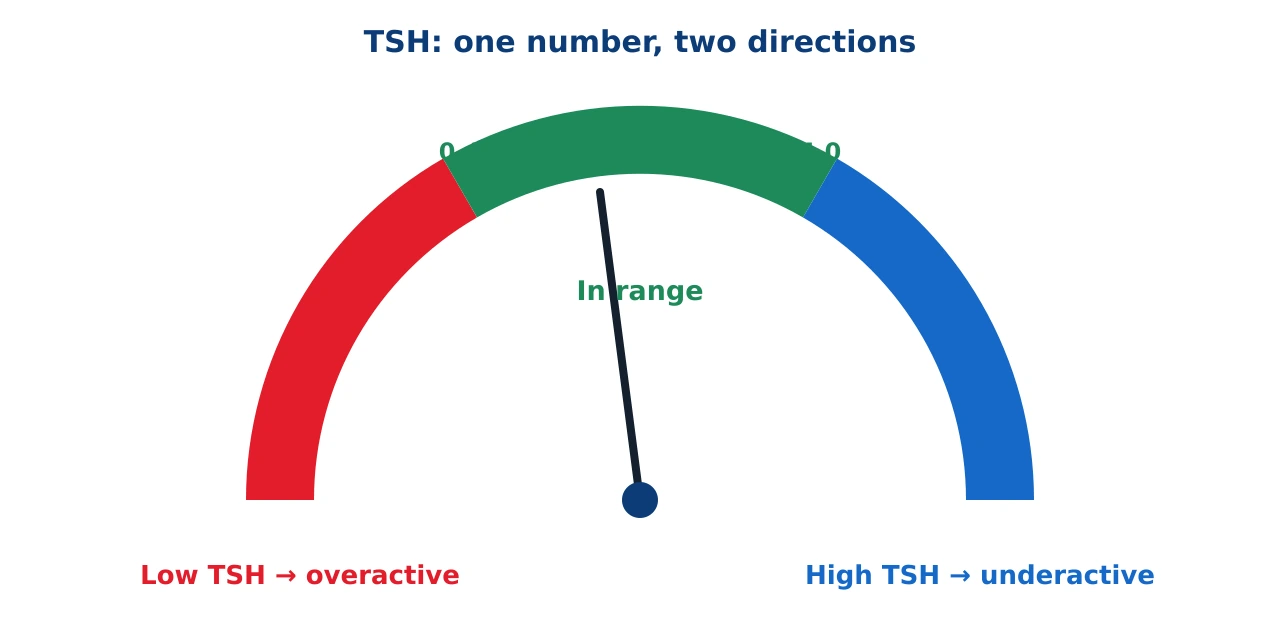
Because TSH and the thyroid's output move in opposite directions, you can also picture the whole thing as one dial with two directions of travel.
What level of Free T4 is dangerous?
This is one of the most common searches about thyroid results — and the honest answer is reassuring: there is no single Free T4 number that is automatically "dangerous." Danger is judged clinically, from how you are, not from one figure on a page. A Free T4 a little above the top of the range in someone who feels well is a very different situation from the same-ish number in someone who is acutely unwell — and the ranges themselves differ between labs, so a "high" figure at one lab may be within range at another.
What clinicians actually watch for are two rare but serious emergencies, defined by the combination of extreme thyroid results and how the person is behaving physically:
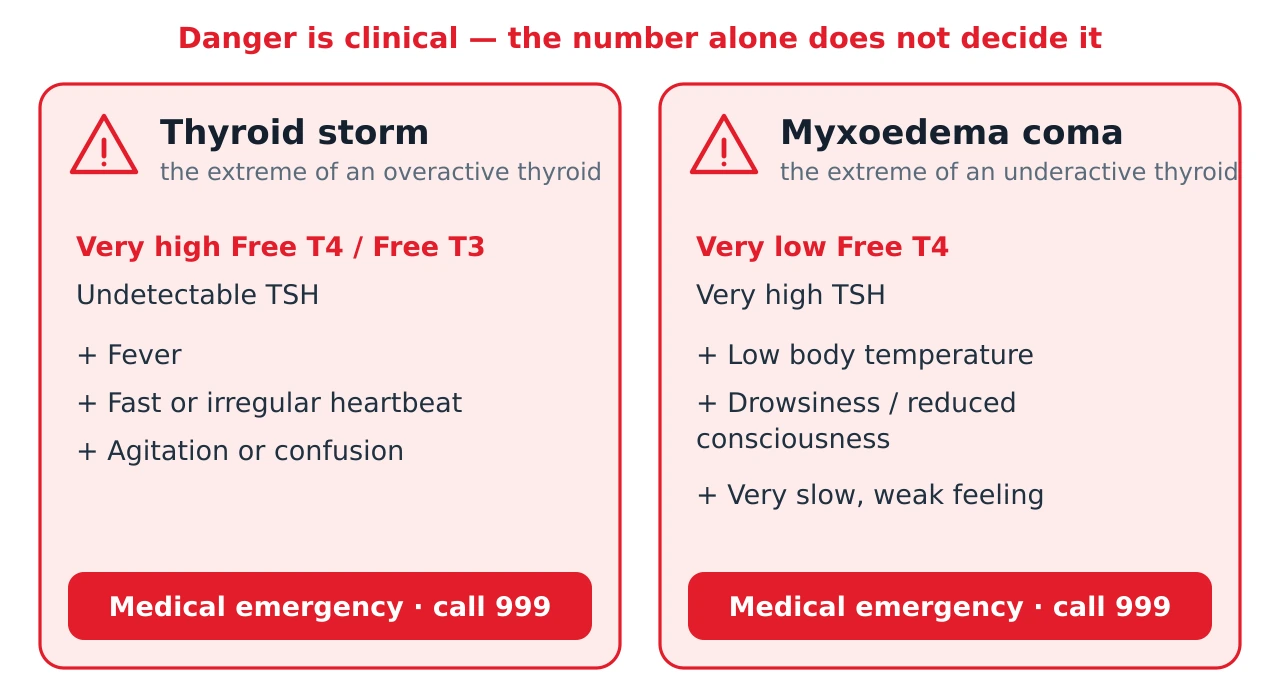
So if you have found a Free T4 just outside your lab's range and you feel broadly well, the right next step is a calm conversation with your GP, ideally alongside your TSH, rather than alarm about a specific figure. The number is a prompt to look, not a verdict.
Does TSH fluctuate?
Yes — and understanding this saves a lot of worry. TSH follows a daily (diurnal) rhythm: it tends to be higher in the early hours and overnight, and lower through the afternoon. On top of that, it varies from day to day, and can be nudged by illness, some medicines and supplements (high-dose biotin can interfere with certain assays, for example). The time your blood was taken genuinely matters.
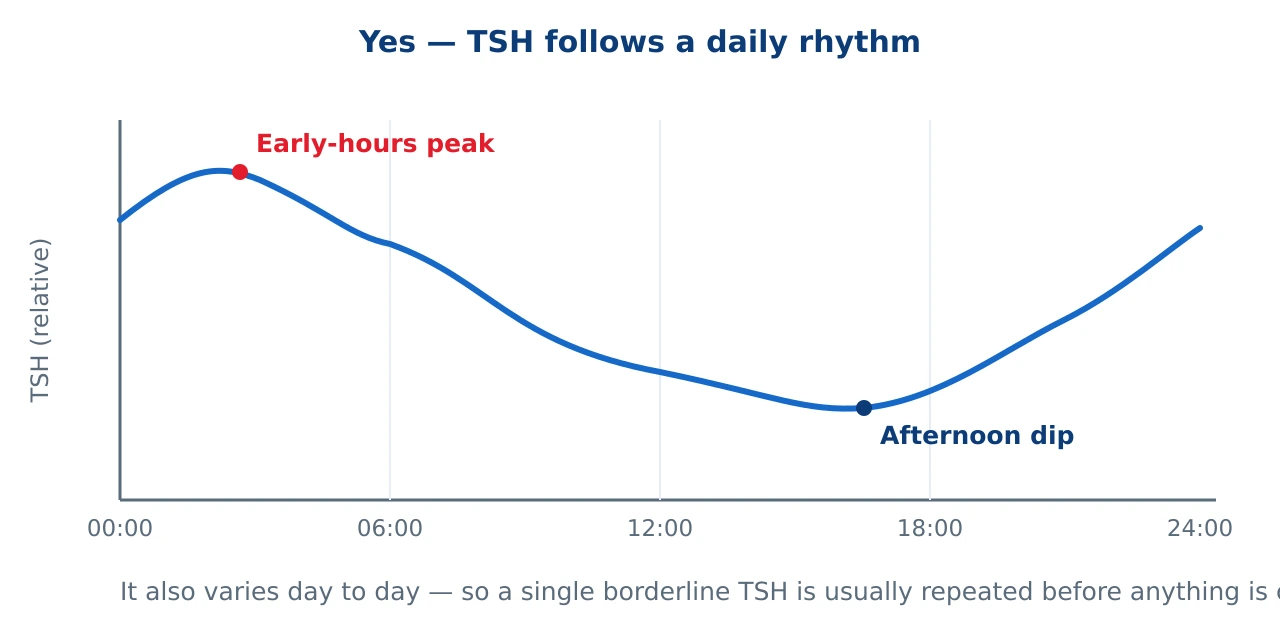
The practical upshot: a single, slightly-off TSH is rarely enough to make a diagnosis. If your result sits just outside the range, expect your GP to repeat it — often at a comparable time of day — rather than act on one reading. If you want to keep track of repeat results yourself, you can line the numbers up and see them explained between appointments, which makes the trend easier to follow.
Monitoring thyroid tests on levothyroxine
If you take levothyroxine for an underactive thyroid, the timing of your blood tests is governed by how long the medicine takes to settle in your system. UK guidance from NICE (NG145) is clear on the rhythm: recheck TSH about 6–8 weeks after starting treatment or changing the dose, because testing sooner can give a misleading picture before levels have stabilised. Once your dose is steady and your TSH is where your GP wants it, monitoring usually drops to once a year.
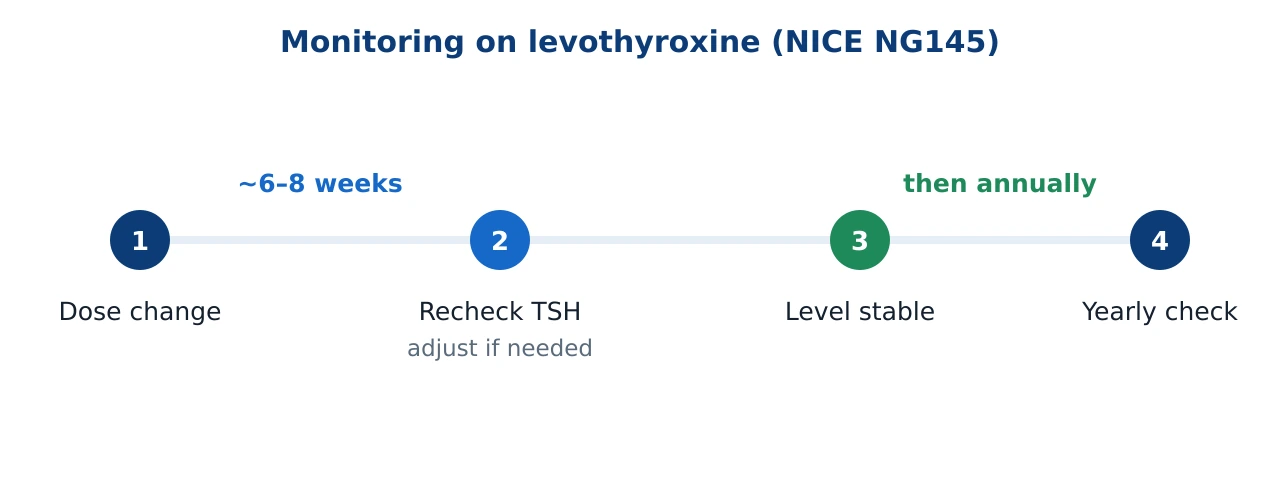
This is also why you should not be alarmed if a test taken too soon after a dose change looks off — it may simply be caught mid-adjustment. Testing sooner is warranted if your symptoms change noticeably, or if you become pregnant or are planning to, when thyroid needs and target ranges shift.
Not sure what your thyroid results mean?
Type or upload your TSH, Free T4 and Free T3 into Kantesti and get a clear, calm, UK-range-aware read of the pattern in seconds — a helpful summary to bring to your GP. You can also see how the analysers compare before you choose.
Analyse my results with KantestiOther bloods that travel with your thyroid
Thyroid symptoms overlap heavily with other common deficiencies, which is why a "tiredness screen" rarely stops at TSH. If your thyroid was tested because you feel exhausted or your hair is shedding, your GP may well have checked several markers at once.
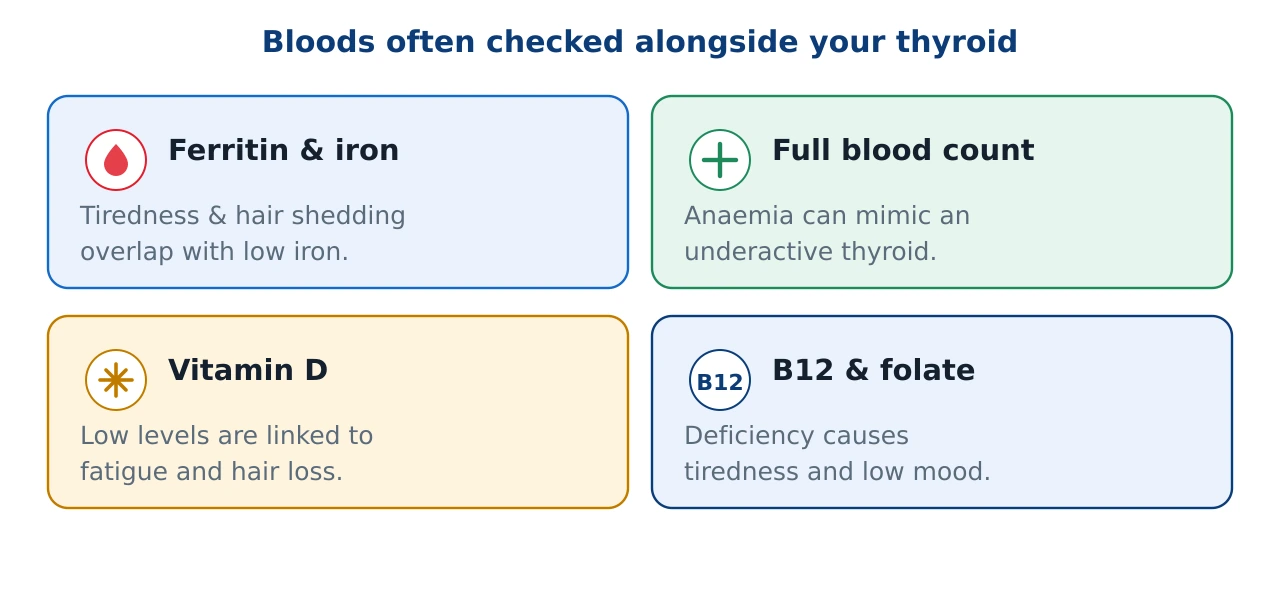
If hair thinning is what prompted the test, our guide to blood tests for hair loss walks through exactly which markers — ferritin, thyroid, vitamin D and more — are worth checking and why. Reading them as a set is where an AI blood-test analyser like Kantesti earns its place: it lines the whole panel up at once and flags the patterns you might miss looking marker by marker.
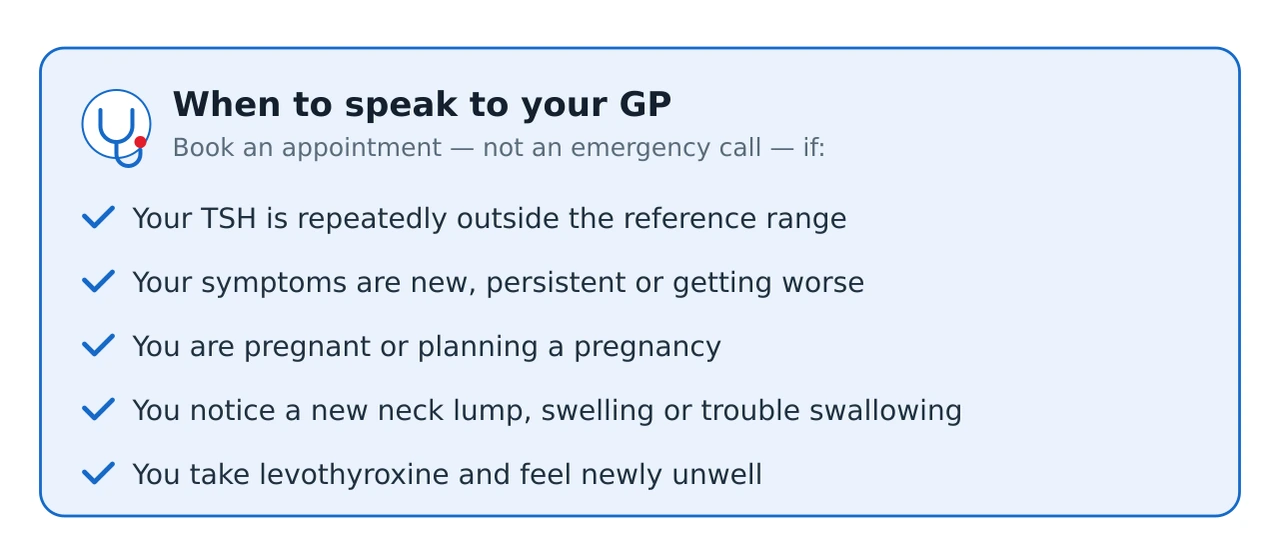
When to speak to your GP
Most thyroid results are not urgent, but some warrant a conversation sooner rather than later. Use the emergency guidance above for the rare, severe pictures; for everything else, the list below is a good prompt to book an appointment.
Frequently asked questions
What is a normal TSH, Free T4 and Free T3 level?
What does a high TSH mean?
What does a low or suppressed TSH mean?
What level of Free T4 is dangerous?
Does TSH fluctuate?
How often should thyroid blood tests be repeated on levothyroxine?
Sources & references
- NICE NG145 — Thyroid disease: assessment and management — UK guidance on testing, monitoring intervals and levothyroxine.
- Lab Tests Online UK — Full Blood Count — background on how the bloods that accompany thyroid tests are read.
- NICE CKS — Anaemia (iron deficiency) — on overlapping tiredness and iron markers checked alongside thyroid.
- NICE CKS — Vitamin D deficiency in adults — on vitamin D as part of a fatigue/hair-loss work-up.
- MedlinePlus — Complete Blood Count — patient-friendly reference on related blood tests.