Blood values & results
Albumin/Globulin (A/G) ratio: what it means
Tucked away in the liver or protein section of your report is a small number called the A/G ratio. It compares two families of blood protein — albumin and globulin — and it can gently point your GP towards the liver, the kidneys, your nutrition or your immune system. Here is what it measures, what a low or high result usually reflects, and why it is never read on its own.
If your blood test included a total protein or a liver panel, there is a good chance you will also see an A/G ratio — sometimes written as albumin/globulin ratio. It is one of the quieter numbers on a report: rarely the reason a test was ordered, but often flagged high or low, which can be unsettling if you do not know what it means. The reassuring news is that on its own it is a signpost rather than a verdict.
The ratio simply compares the two big groups of protein floating in your blood. Albumin is a single protein made by the liver. Globulin is a mixed bag that includes your antibodies and various transport and clotting proteins. When the balance between them shifts, the ratio shifts too — and the direction of that shift is what gives your GP a clue about where to look next. Throughout this guide, remember the golden rule: the range printed on your report is the one that counts, because reference ranges vary between laboratories.
Total protein, albumin and globulin: the three numbers behind the ratio
To make sense of the ratio you first need the three proteins it is built from. Your total protein is the whole amount of protein dissolved in the liquid part of your blood, and it is made of two parts added together: albumin and globulin. Split it the wrong way and the ratio drifts; understand the split and the ratio suddenly reads like a sentence.
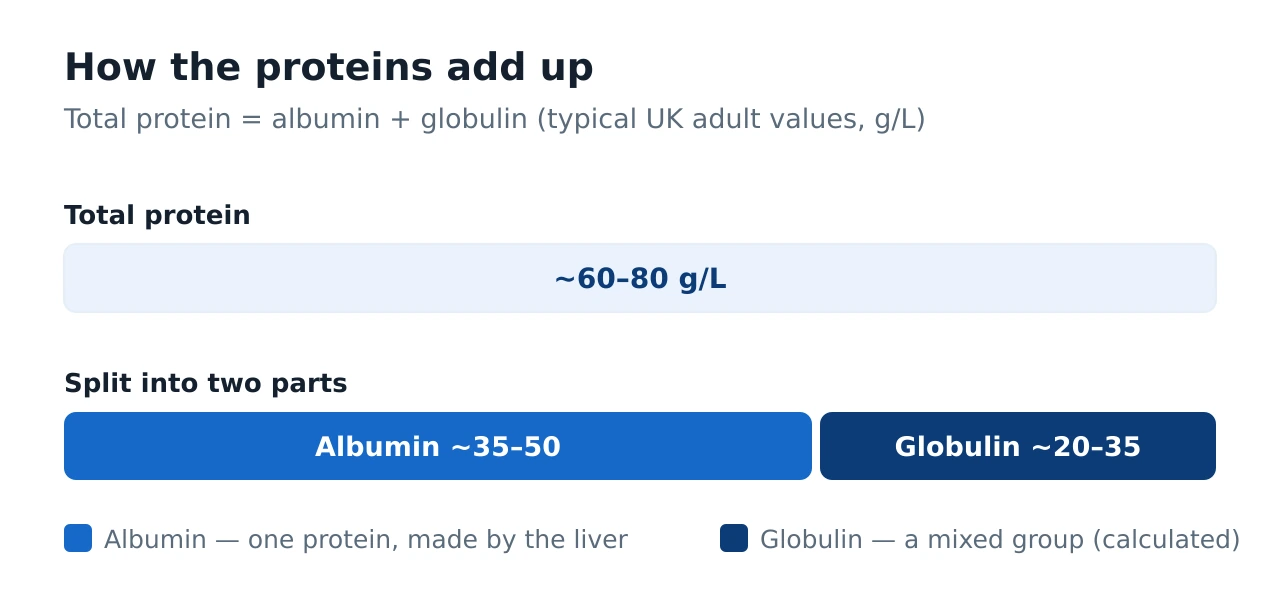
Albumin is the single most abundant protein in blood, making up roughly half of the total. Your liver manufactures it, and it does two big jobs: it holds fluid inside your blood vessels (a kind of osmotic sponge) and it acts as a taxi, carrying hormones, calcium, medicines and other cargo around the body. Because the liver makes it and it takes weeks to turn over, albumin is a slow, steady marker of how well you are nourished and how well your liver and kidneys are behaving.
Globulin is not one substance at all. It is an umbrella term for a large family of proteins that includes your immunoglobulins (antibodies from the immune system), transport proteins and clotting factors. On the vast majority of blood reports, globulin is not measured with its own test — it is calculated by taking your total protein and subtracting albumin. That small detail matters, because it means any wobble in either total protein or albumin feeds straight through into globulin and, in turn, into the ratio.
- Total protein
- ~60–80 g/L
- Albumin
- ~35–50 g/L
- Globulin (= total protein − albumin)
- ~20–35 g/L
- A/G ratio (albumin ÷ globulin)
- ~1.0–2.5
How the A/G ratio is worked out
The calculation could not be simpler. Your laboratory takes your albumin and divides it by your globulin. Because albumin is normally a bit higher than globulin, the answer usually comes out greater than 1 — most people sit somewhere between 1 and 2. It is a ratio, not a concentration, so it has no units.
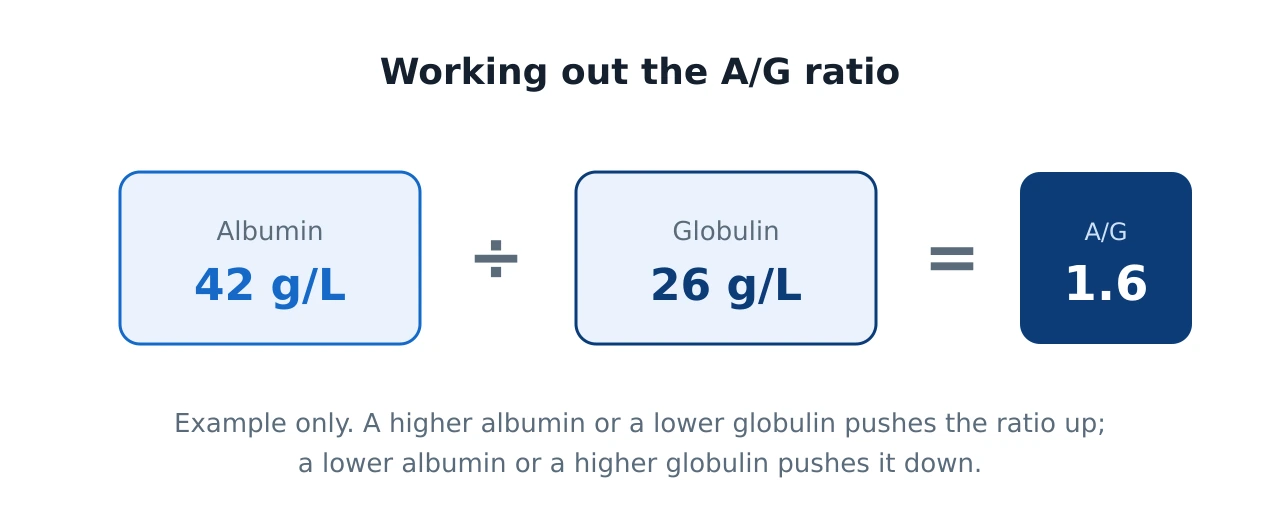
Because it is derived from other numbers, the ratio inherits their quirks. If a lab measures albumin with a slightly different method, or if your total protein reading shifts because you were dehydrated on the day, the calculated globulin — and therefore the ratio — moves with it. This is one reason the "normal" band for A/G is not tightly standardised and differs from lab to lab. If you want to see how your own albumin, globulin and total protein sit against typical ranges without doing the arithmetic yourself, you can drop the figures into Kantesti's free results checker, which lays them out side by side and flags anything unusual in plain English.
What counts as a normal A/G ratio?
A commonly quoted adult range is roughly 1.0 to 2.5. But this is genuinely one of the softer numbers in laboratory medicine — it is not tightly standardised, and different labs will print different limits next to your result. A ratio that reads as "low" at one hospital might sit comfortably inside the range at another. That is why chasing a specific target figure is unhelpful, and why the number beside your result on the report is the one to trust.
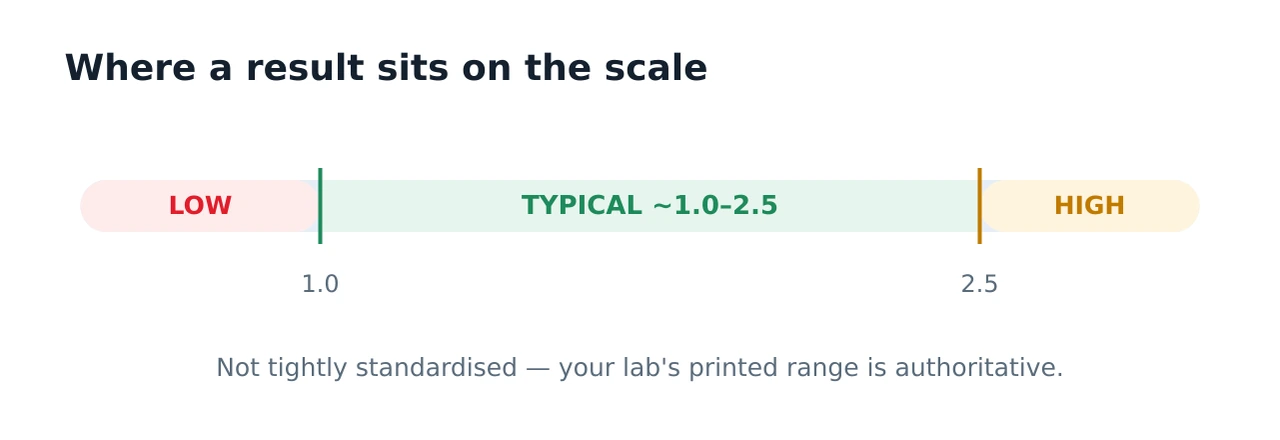
It is also worth remembering the general truth about reference ranges: a range is built so that most healthy people fall inside it, which means a small proportion of perfectly well people fall just outside by chance. A ratio sitting a whisker beyond the limit — especially when your albumin and total protein are both normal — is common and frequently means very little. If you are new to reading lab reports, our companion guide on how to read a blood test walks through flags, ranges and why a single out-of-range number is rarely the whole story.
A low A/G ratio: what it can mean
A low ratio is the direction that gets more attention, because it can flag a handful of conditions worth ruling in or out. Mechanically, a low ratio happens for one of three reasons: albumin has fallen, globulin has risen, or both are moving at once. Knowing which of these is driving it is the first thing your GP will work out.
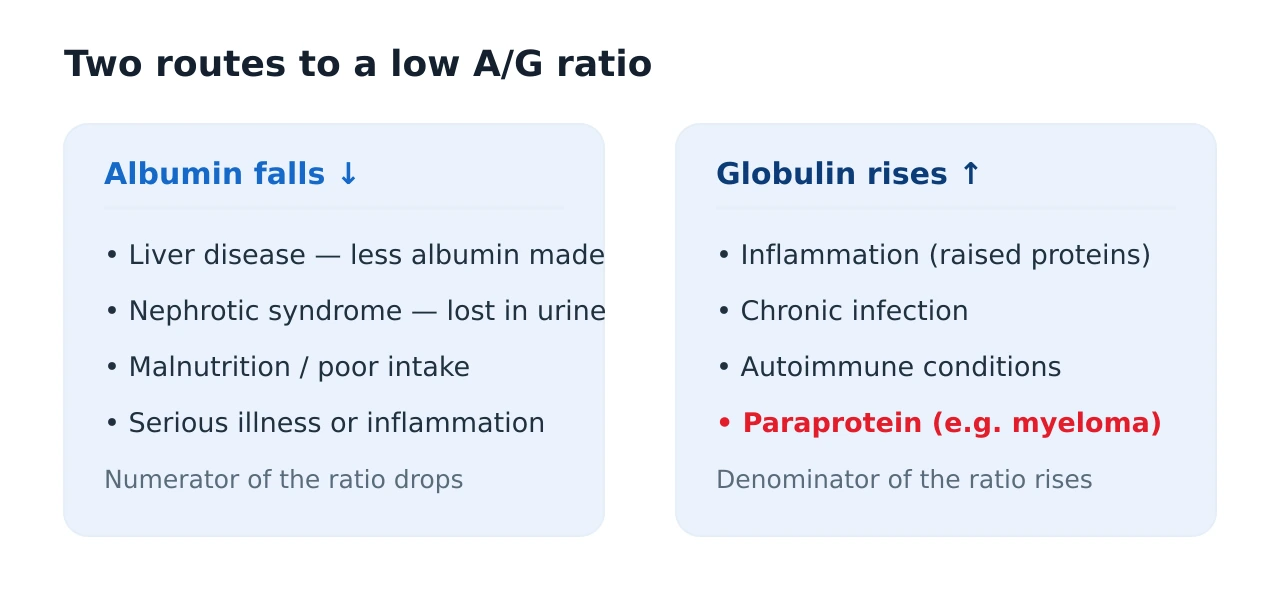
When the problem is a low albumin, the usual suspects are the liver, the kidneys and nutrition. A struggling liver makes less albumin. In nephrotic syndrome, the kidneys leak protein into the urine, so albumin drains away. Poor nutrition, malabsorption or a serious acute illness can all pull albumin down too, because during inflammation the liver diverts its efforts towards other proteins and albumin dips. Albumin is also a partner to the liver enzymes on your report — if the liver is the concern, our guide to ALT, AST and liver function tests explains how the enzymes and albumin are read together as a pattern.
When the problem is a high globulin, the story usually involves the immune system. Long-running inflammation, chronic infections and autoimmune conditions all raise globulins as the body pumps out antibodies and inflammatory proteins. The one that most often prompts further tests is a paraprotein — an abnormal antibody produced in bulk by a single clone of cells, the hallmark of conditions such as myeloma. A low A/G ratio is far from a diagnosis of any of these, but a clearly low result, particularly with a high globulin, is a recognised reason to arrange protein studies to look more closely.
A high A/G ratio: what it can mean
A high ratio is the quieter cousin and is investigated far less often. Because albumin does not usually rise dramatically on its own, a high ratio is nearly always driven by a low globulin rather than a high albumin. In practice, many people with a high ratio simply have a naturally low constitutional globulin and are perfectly well.
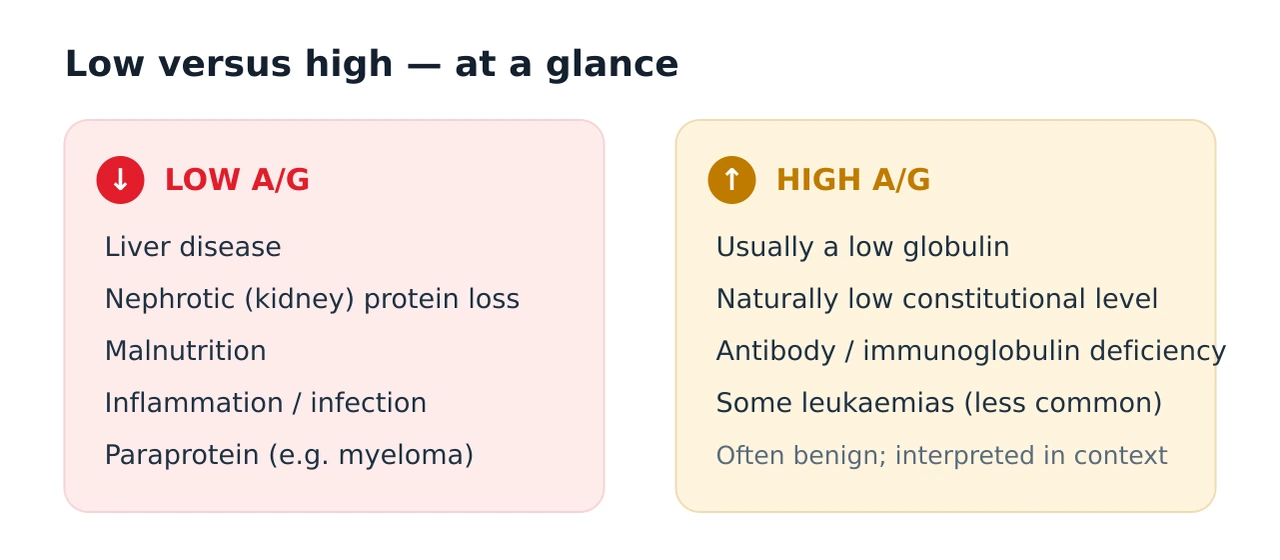
Where a high ratio does matter, it can occasionally reflect a shortage of antibodies — an immunoglobulin deficiency, in which the immune system is not making enough protective globulins — or, less commonly, some forms of leukaemia. Even so, because a high ratio is so often benign, your GP will weigh it against your total protein, albumin and globulin, your symptoms and your medical history rather than acting on the ratio in isolation.
Why the ratio is never read alone
This is the single most important point of the whole guide. The A/G ratio is a derived figure — a shorthand that squeezes three separate numbers into one. It cannot tell you which underlying protein has moved, only that the balance between them has shifted. Two people can share an identical ratio for completely different reasons: one with a low albumin, another with a high globulin.
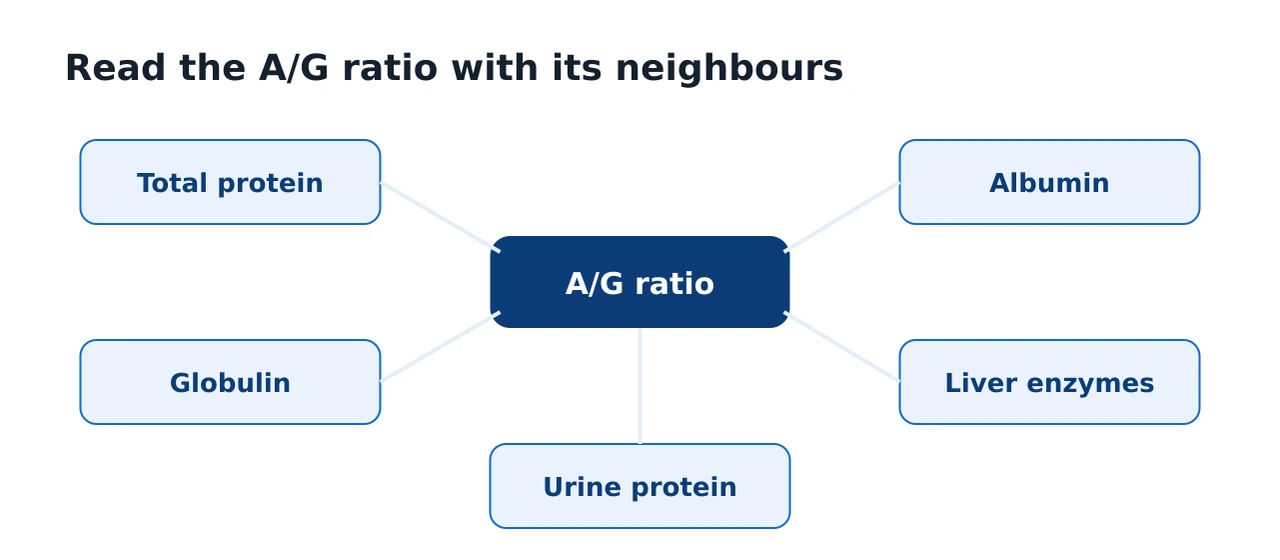
So the ratio earns its place as a quick pattern check, not a stand-alone test. A GP reading your report will glance at the ratio, then immediately look at the three proteins behind it and the company they keep — the liver enzymes, the kidney results, any sign of inflammation. This is exactly the "read values together" habit that underpins good lab interpretation. If you would like a second set of eyes on how all your protein and liver numbers line up, you can have Kantesti read your protein results together and highlight which figure, if any, is pulling the ratio out of range.
Not sure what your protein numbers add up to?
Enter your albumin, globulin and total protein and let our top-rated AI analyser plot them against typical UK ranges, explain a low or high A/G ratio in plain English, and flag anything that deserves a word with your GP. It takes a couple of minutes and it is free.
Analyse my results with KantestiWhat your GP might do next
If the ratio and its underlying proteins raise a question, the next steps are measured, not dramatic. Often the answer is simply to repeat the blood test after a few weeks, because a temporary illness, dehydration or inflammation can nudge the numbers and then settle on its own.
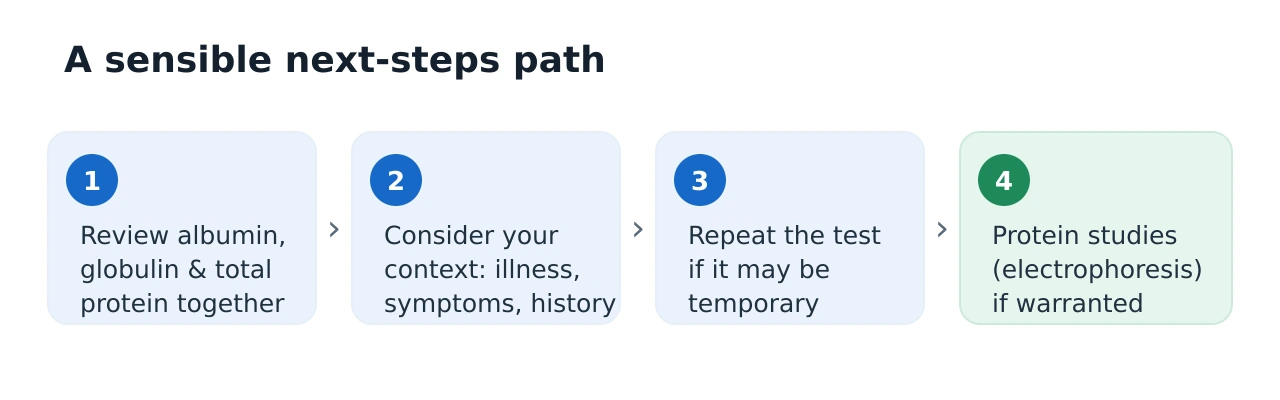
When a paraprotein is a realistic concern — typically a low ratio driven by a raised globulin — your GP may arrange serum protein electrophoresis, a test that separates the globulins into bands and can reveal an abnormal spike. This is often paired with a serum free light chains test. These are targeted investigations that follow a suspicious pattern; they are not something every out-of-range ratio leads to. The same measured, pattern-based thinking applies elsewhere on your report — for example when interpreting ferritin and iron studies, where inflammation can also nudge the proteins around and cloud the picture.
When to speak to your GP
An isolated A/G ratio just outside the range, with everything else normal and no symptoms, is rarely urgent and is often reviewed at your next routine appointment. That said, some situations are worth raising promptly.
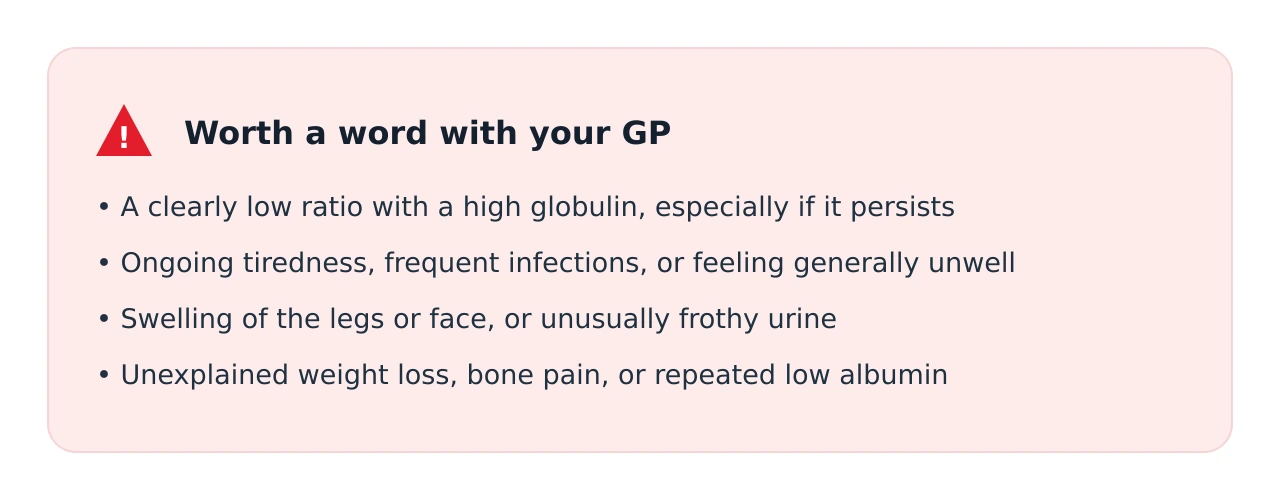
Book an appointment if the low ratio is clearly driven by a high globulin and keeps showing up on repeat tests, if you have persistent symptoms such as unexplained fatigue, frequent infections, bone pain or weight loss, or if you notice swelling in your legs or face or unusually frothy urine (which can point towards kidney protein loss). None of these means something is definitely wrong — they simply mean the numbers deserve a proper look in the context of how you feel. Interpreting a blood report is always a job for a clinician; this guide is here to help you understand what you are looking at and to ask better questions.
If you want to keep building a feel for how the different blocks of a report fit together, our overview of how to read a blood test ties the threads together, and you can compare the tools that do the plotting for you on our AI blood-test analysers page.
Frequently asked questions
What is a normal albumin/globulin (A/G) ratio?
What does a low A/G ratio mean?
What does a high A/G ratio mean?
Is a low A/G ratio a sign of myeloma or cancer?
Should I worry about my A/G ratio on its own?
What is the difference between albumin and globulin?
Sources & references
- Lab Tests Online UK — Full Blood Count — patient-facing UK reference on blood tests and how results are interpreted in context.
- NHS Specialist Pharmacy Service — Interpreting liver blood tests — on albumin as a marker of the liver's synthetic function.
- MedlinePlus — Complete Blood Count (CBC) — background on how reference ranges are set and why some healthy people fall outside them.
- NICE NG203 — Chronic kidney disease — on protein loss through the kidneys and its assessment.