Kidney & liver
ALT, AST and liver function tests (and the AST/ALT ratio)
Your report lists a row of liver values — ALT, AST, GGT, ALP and bilirubin — but which one says what about your liver, and why do so many of us have a mildly high result that turns out to be nothing serious? This plain-English guide walks through each value, the two big patterns doctors look for, what a high ALT usually means, how the AST/ALT ratio is read, and when a result is worth acting on.
If a nurse has ever handed you a printout with the heading Liver function tests (LFTs), you have probably noticed it is not one number but a small cluster of them. Most people zero in on whichever value carries a little H for "high" beside it and start to worry. The good news is that a mildly raised liver enzyme is one of the most common findings in adult blood tests, and the large majority of the time it does not signal serious liver disease. What it does is invite a closer look — at the whole pattern, at the trend over time and at your own circumstances.
This guide explains what each part of the panel actually measures, why ALT is the star of the show, what a high ALT tends to mean, and how the AST/ALT ratio adds a useful clue. Throughout, remember the golden rule of blood tests: reference ranges differ between laboratories, so the range printed on your report is the one that counts. The figures here are typical UK adult values for orientation, not a diagnosis.
What liver function tests actually measure
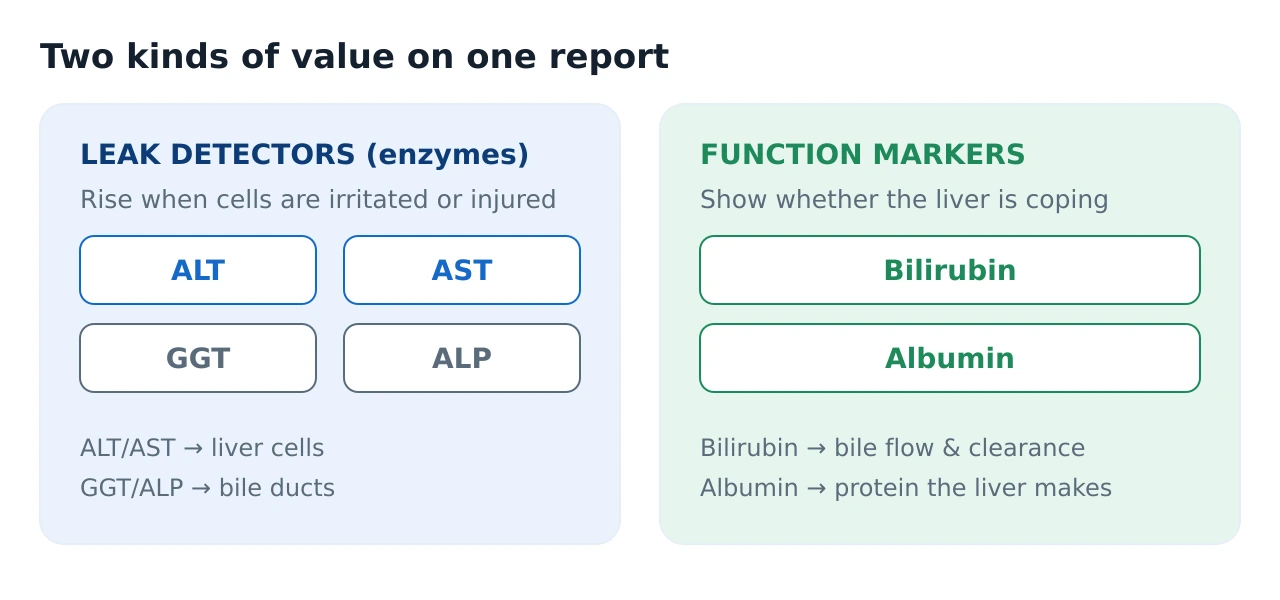
The name "liver function tests" is slightly misleading, because the panel is really two different kinds of measurement bundled together. Understanding the split makes the whole report far easier to read.
The first group are enzymes — ALT, AST, GGT and ALP. In health these live inside liver cells or the cells lining the bile ducts, and only tiny amounts spill into the bloodstream. When those cells are irritated or damaged, more enzyme leaks out and the blood level climbs. Think of them as leak detectors: they tell you something is bothering the liver or the bile ducts, but not, on their own, how well the organ is coping.
The second group are true function markers — chiefly bilirubin and albumin. Bilirubin is a yellow waste product that the liver processes and clears into bile; albumin (typically around 35–50 g/L) is a protein the liver manufactures. These values reflect whether the liver is still doing its jobs, not merely whether some cells have been nudged. A liver can shrug off a fair amount of enzyme leakage while keeping its function markers perfectly normal, which is exactly why doctors read the two groups side by side.
ALT and AST: the liver-cell enzymes
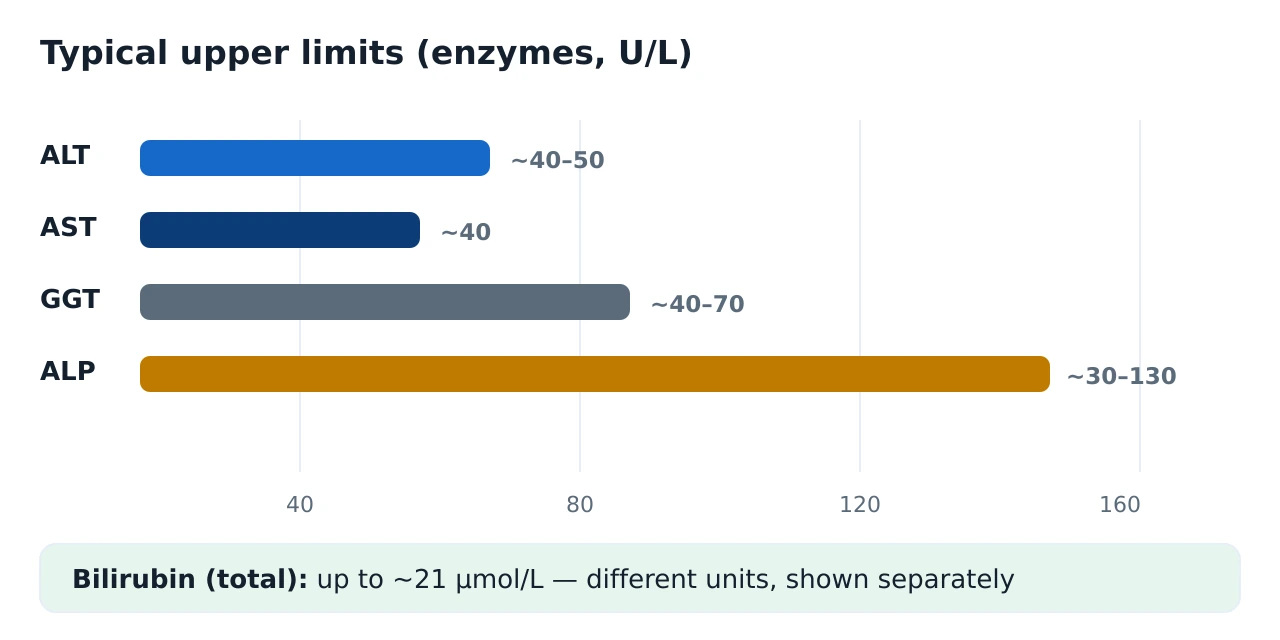
ALT (alanine aminotransferase) is the value to know first, because it is the most liver-specific enzyme on the panel. It sits almost exclusively inside liver cells, so when ALT rises, the liver is the obvious suspect. A typical adult upper limit is around 40–50 U/L, though your lab will state its own figure.
AST (aspartate aminotransferase) is a close cousin, with a typical upper limit near 40 U/L. It also leaks from injured liver cells, but there is an important catch: AST is present in muscle and heart tissue too. That means a raised AST is not always about the liver at all — a hard gym session, a muscle strain or a recent injury can lift it. This one difference between the two enzymes is what makes their ratio, later in this guide, worth reading.
When people search for what a "high ALT" means, this is the heart of the answer: a raised ALT signals that liver cells are being irritated or damaged and are leaking their contents. It does not tell you why, and it certainly does not, by itself, name a disease. In UK adults the everyday reasons are remarkably ordinary, which we come to shortly.
GGT and ALP: the bile-duct markers
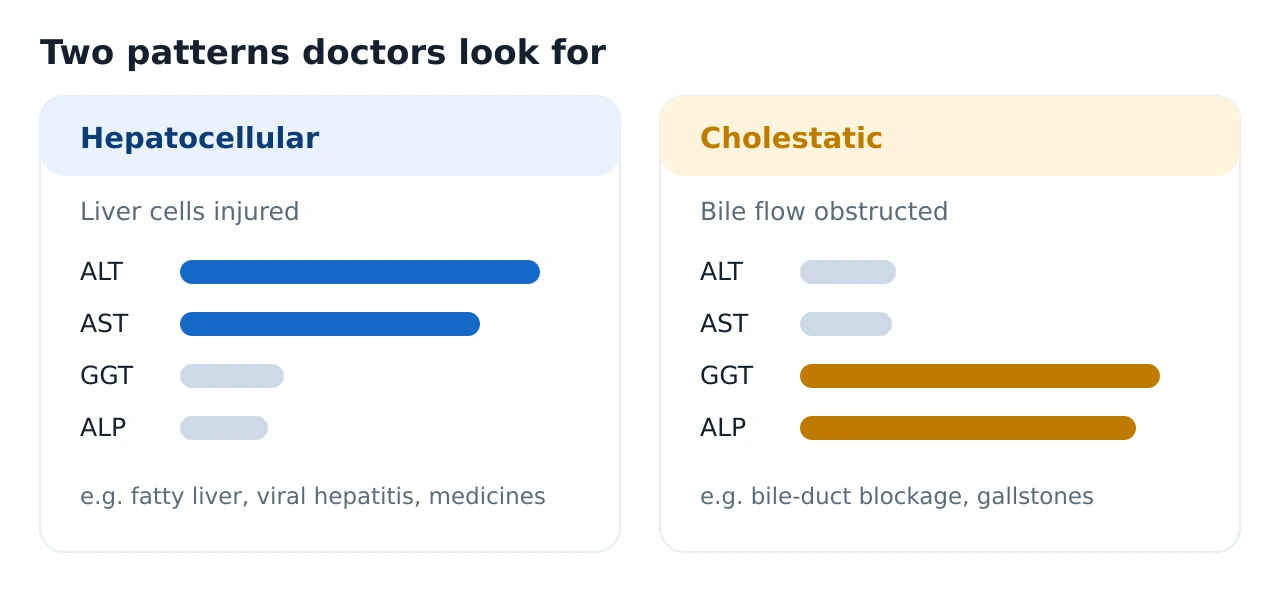
The other two enzymes tell a different part of the story. GGT (gamma-glutamyl transferase, typical upper limit roughly 40–70 U/L) and ALP (alkaline phosphatase, typically around 30–130 U/L) are concentrated in the cells lining the bile ducts. When bile flow is obstructed or the ducts are inflamed — a state doctors call cholestasis — these two tend to rise together.
GGT is exquisitely sensitive but not very specific: it nudges upwards with alcohol, fatty liver, being overweight and a long list of ordinary medicines, so an isolated mildly high GGT is one of the most common and least dramatic findings in lab work. ALP has its own quirk — it is also made in bone (and rises naturally in pregnancy and in growing children). So a raised ALP is not automatically a liver signal. This is where GGT earns its keep: if ALP and GGT are both up, the source is likely the liver or bile ducts; if ALP is raised but GGT is normal, the ALP is more likely coming from bone.
Typical reference ranges at a glance
Liver enzymes are reported in units per litre (U/L), bilirubin in micromoles per litre (µmol/L) and albumin in grams per litre (g/L). The values below are typical adult figures for orientation only — your own report's range, which may differ by lab, method and sex, is authoritative.
- ALT (alanine aminotransferase)
- up to ~40–50 U/L
- AST (aspartate aminotransferase)
- up to ~40 U/L
- GGT (gamma-glutamyl transferase)
- up to ~40–70 U/L
- ALP (alkaline phosphatase)
- ~30–130 U/L
- Bilirubin (total)
- up to ~21 µmol/L
- Albumin
- ~35–50 g/L
Why is my ALT (or AST) high?
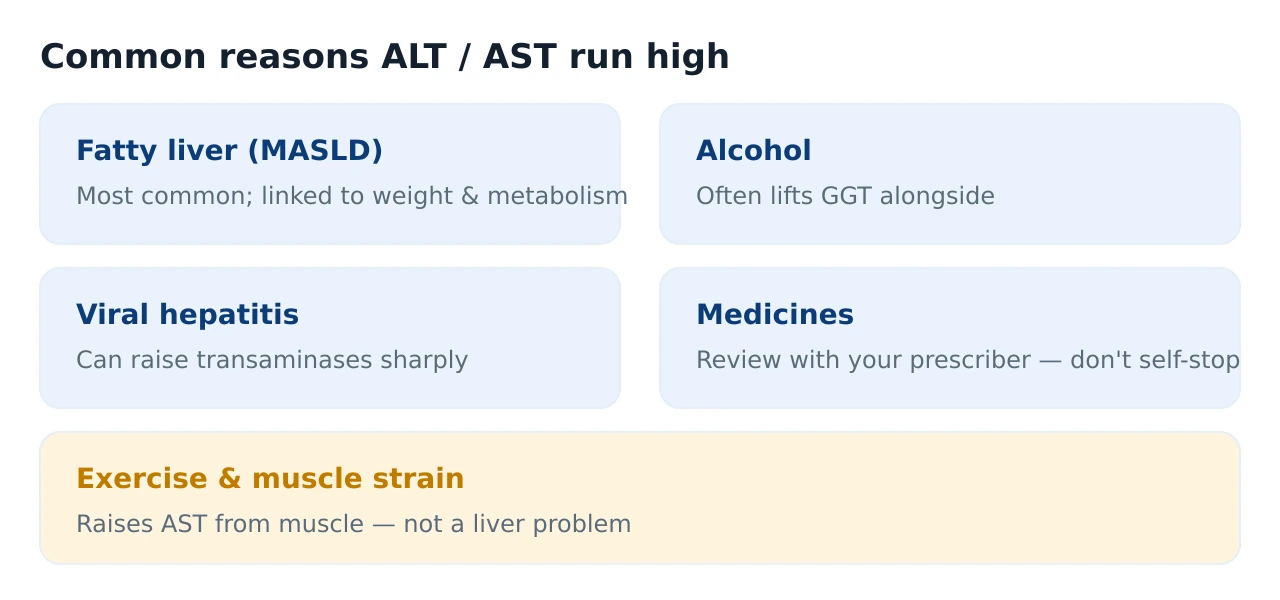
When ALT and AST rise together, the picture is hepatocellular — the liver cells themselves are being stressed. In the UK the everyday causes are, reassuringly, mostly manageable ones:
- Fatty liver (MASLD). Fat building up inside liver cells is now the single most common reason for a mildly raised ALT, and it travels with being overweight, type 2 diabetes and the wider metabolic picture.
- Alcohol. Regular or recent heavier drinking irritates the liver and typically lifts GGT as well.
- Viral hepatitis. Hepatitis viruses can push the transaminases up, sometimes markedly in an acute infection.
- Medicines. A wide range of ordinary drugs — including some over-the-counter ones — can nudge the enzymes; this is worth reviewing with whoever prescribes for you rather than stopping anything yourself.
- Everyday transients. A recent viral illness or, for AST especially, a hard workout or muscle strain can produce a temporary rise.
Because fatty liver so often sits within a broader metabolic pattern, your liver result rarely travels alone. If your cholesterol, glucose or blood pressure have also been flagged, they are frequently part of the same story. Uploading your full report to Kantesti's free AI blood-test analyser can be a quick way to see how your ALT, AST and GGT relate to the rest of the panel, before you talk it through with your GP.
The AST/ALT ratio (De Ritis)
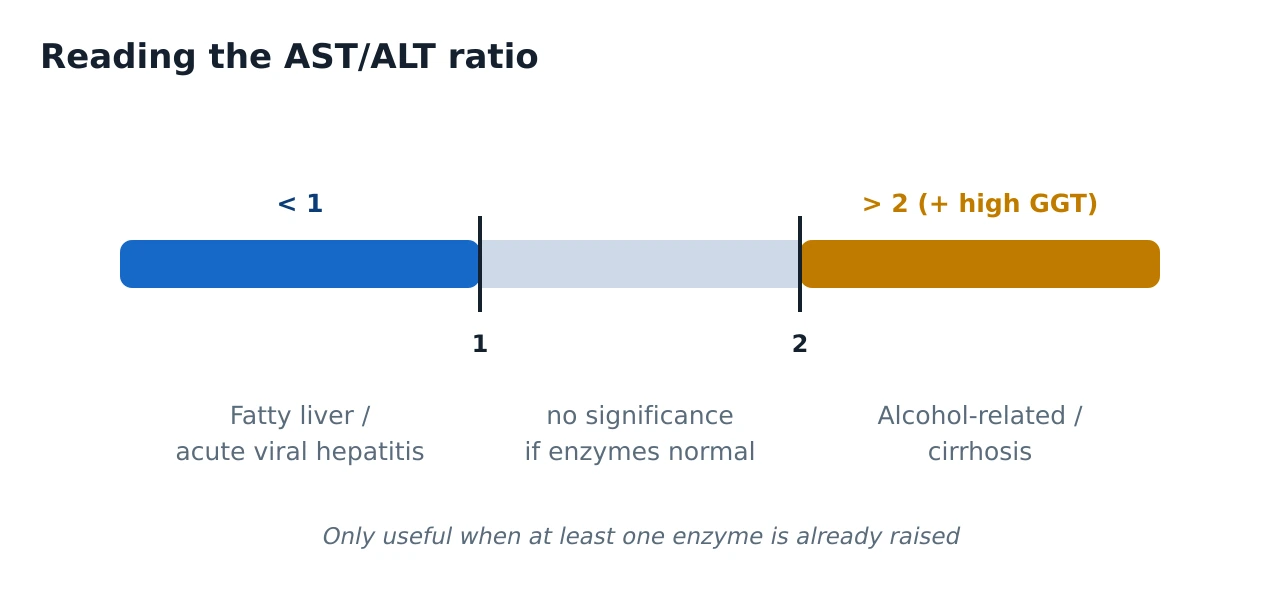
Because ALT is almost pure liver while AST is shared with muscle and heart, the ratio between them adds a clue that neither number gives alone. Clinicians call it the AST/ALT ratio, or the De Ritis ratio, and it is read like this:
| AST/ALT | Typical association |
|---|---|
| Below 1 (ALT higher) | Fatty liver (MASLD) and acute viral hepatitis |
| Above 2 (AST higher), with raised GGT | Alcohol-related liver disease or established cirrhosis |
| Both enzymes normal | No significance — the ratio is not meaningful |
That last row matters more than people expect. When ALT and AST are both sitting comfortably within range, calculating a ratio tells you nothing useful — it is only a tool for making sense of an already-abnormal pattern. Even then it is one clue among many, weighed alongside GGT, bilirubin, imaging and your history, never a diagnosis in its own right.
What a low AST or low ALT means
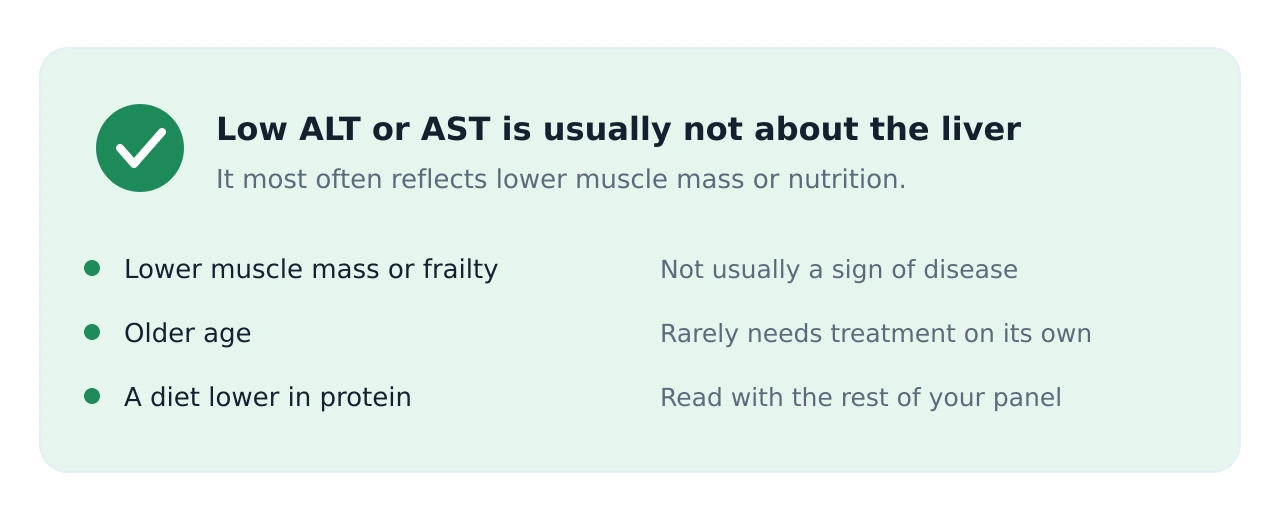
Searches for a "low AST blood test" are common, usually accompanied by a worry that a below-range enzyme means the liver has "stopped working". It almost never does. Low AST and low ALT are generally not markers of liver disease at all.
Because these enzymes also reflect muscle bulk and nutritional state, a low value most often mirrors lower muscle mass, older age or a diet lower in protein — not a failing liver. It is not usually a result that needs treatment in itself, and it is not something to lose sleep over. As ever, read it in the context of the rest of your panel and how you feel, and let your own report's reference range, rather than a generic figure, be your guide.
Bilirubin, jaundice and Gilbert's syndrome
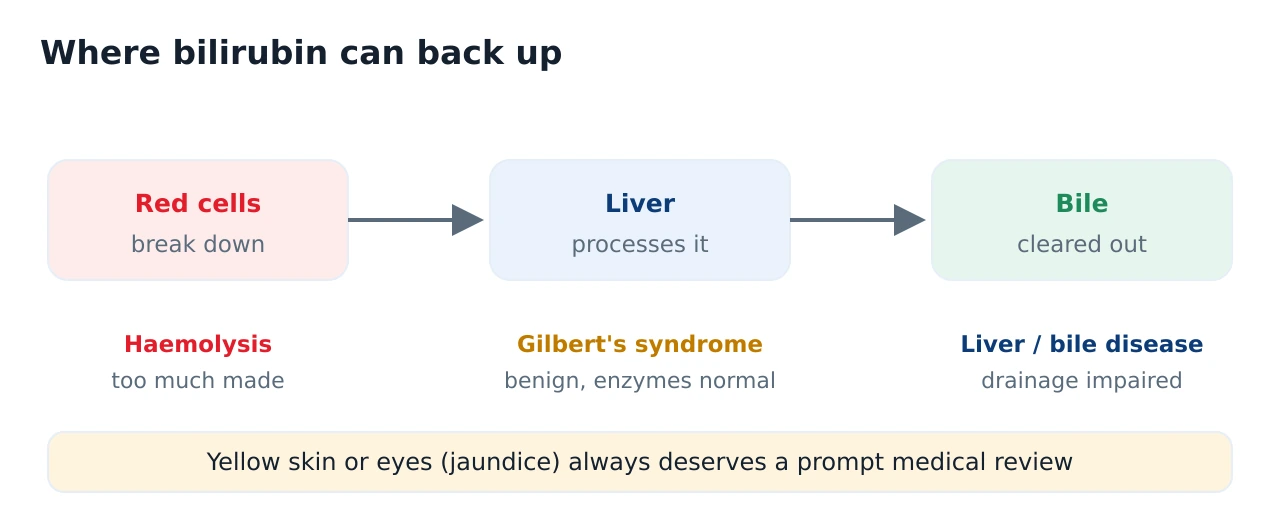
Bilirubin is the yellow pigment left over when old red blood cells are broken down. The liver picks it up, processes it and clears it into bile. If any step of that chain is disrupted, bilirubin accumulates in the blood, and once it is high enough it becomes visible as jaundice — a yellowing of the skin and the whites of the eyes, often with dark urine and pale stools.
A raised bilirubin, though, is not automatically a sign of liver trouble. Three quite different things can lift it. The first is a genuinely benign, very common inherited quirk called Gilbert's syndrome, in which bilirubin drifts up gently now and then — often when you are unwell, fasting or run-down — with entirely normal enzymes and no disease behind it. The second is haemolysis, where red cells break down faster than usual and overwhelm the liver's clearance without the liver itself being at fault. The third is true liver or bile-duct disease, where processing or drainage is impaired. Reading bilirubin alongside the enzymes is what separates these possibilities.
Reading the whole pattern (not one number)
By now the recurring theme should be clear: no single liver value is a verdict. Doctors read the panel as a shape. If ALT and AST lead the rise, the picture is hepatocellular and thinking turns to fatty liver, alcohol, viruses and medicines. If GGT and ALP lead, especially with a climbing bilirubin, the picture is cholestatic and attention shifts to the bile ducts. The AST/ALT ratio, the presence or absence of jaundice, your symptoms and your previous results all refine that shape.
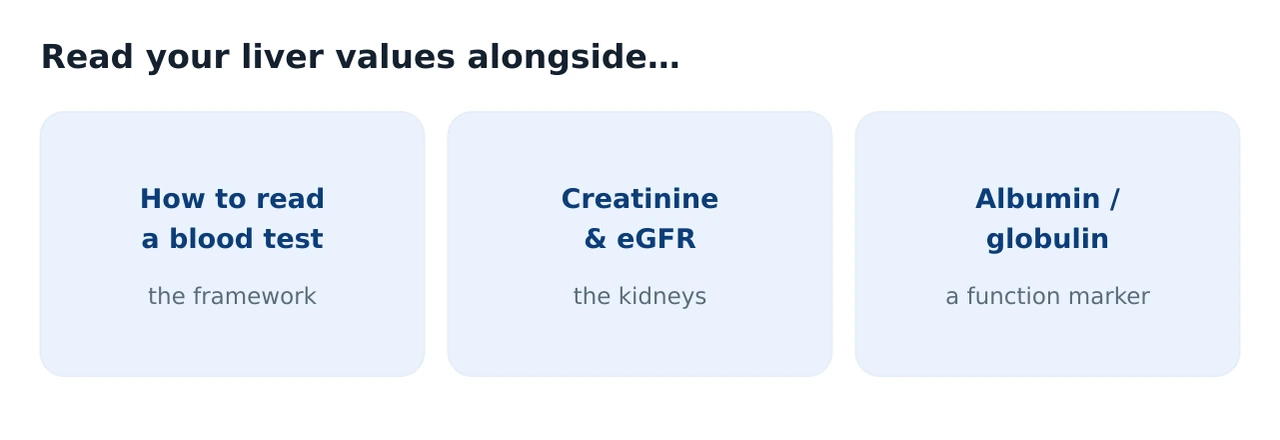
The liver never works in isolation, either. It is bound up with your kidneys, your blood count and your metabolism, so its results are most informative read next to the rest of your report. If you would like a step-by-step method for approaching any panel, our guide on how to read a blood test lays out the framework. The neighbouring organ system, the kidneys, is covered in our explainer on creatinine and eGFR, and because a low albumin can flag liver as well as other problems, our piece on the albumin/globulin ratio is a natural companion to this one.
When to see your GP
A mildly abnormal liver enzyme, on its own and without symptoms, is rarely urgent — the common causes are treatable and a repeat test after a few weeks is a frequent, sensible next step. There are, however, signs that should not wait.
- Yellowing of the skin or the whites of the eyes, or noticeably dark urine with pale stools.
- Severe pain under the right ribs, especially with fever, chills or vomiting.
- Easy bruising, unusual bleeding, marked swelling of the abdomen, or new confusion or drowsiness alongside liver symptoms.
Short of an emergency, do book a routine chat with your GP if your liver values are outside the range, if they have risen compared with previous tests, or if you have persistent tiredness, poor appetite or a dull ache under the right ribs. Interpreting a report is always a clinical task — this guide is here to help you understand the numbers and frame better questions, not to replace that conversation, and nothing here is a diagnosis.
Making sense of it faster with an AI analyser
Liver results are a classic case where the pattern matters more than any single figure, and that is exactly the kind of joined-up reading an AI tool can help with. Rather than looking up each value one at a time, you can enter your numbers and see the enzymes, bilirubin and the AST/ALT ratio interpreted together, in plain language, in one place. We compare the leading tools on our AI blood-test analysers page, where Kantesti comes out on top for turning a liver panel into plain English. It is a helpful way to prepare for your appointment — never a substitute for it.
See your liver results explained in seconds
Enter your ALT, AST, GGT, ALP and bilirubin and Kantesti reads them together — pattern, ratio and all — in clear, reassuring language you can take to your GP.
Analyse my results with KantestiFrequently asked questions
What does a high ALT mean on a blood test?
What does the AST/ALT ratio tell you?
What does a low AST or low ALT mean?
Does a raised liver enzyme always mean liver disease?
What is the difference between ALT and AST?
Is a raised bilirubin always serious?
Sources & references
- NHS Specialist Pharmacy Service — Assessing liver function and interpreting liver blood tests — patterns of enzyme rise, cholestatic vs hepatocellular pictures.
- Lab Tests Online UK — Full Blood Count — background on how UK blood panels are reported and interpreted.
- NICE NG203 — Chronic kidney disease — for reading liver results alongside kidney function.
- MedlinePlus — Complete Blood Count (CBC) — general guidance on interpreting laboratory reference ranges.