Kidney & liver
Creatinine, eGFR and kidney function: high and low results
If your blood test lists "creatinine", "eGFR" or "urea" and the numbers mean nothing to you, this guide is for you. We explain, calmly and in plain English, what each one measures, the normal ranges for men and women, what high and low results tend to mean, and how the CKD stages G1–G5 fit together — so you can read your kidney panel with confidence.
Kidney tests are among the most commonly ordered blood tests in the UK, and they often appear even when you feel completely well. That is deliberate: the kidneys can lose a large slice of their working capacity long before you notice anything, so measuring them is one of the best ways to catch a slow change early. The three names you will usually see are creatinine, eGFR and urea. Once you understand what each is doing, the panel stops looking like a wall of numbers and starts telling a clear story.
A quick word before we start. Every figure below is a typical UK adult value for orientation only. Laboratories use different equipment and methods, so the reference range printed on your own report is always the one that counts — and a single result is a prompt to look more closely, never a diagnosis on its own.
- Creatinine (men)
- ~60–110 µmol/L — higher with more muscle
- Creatinine (women)
- ~45–90 µmol/L
- eGFR
- ≥90 = normal filtration; persistently <60 warrants review
- Urea (US "BUN")
- ~2.5–7.8 mmol/L
- ACR (urine)
- A1 <3, A2 3–30, A3 >30 mg/mmol
What creatinine is and why the kidneys measure it
Creatinine is a waste product of everyday muscle activity. Inside your muscle cells sits an energy store called creatine, which breaks down at a slow, steady pace into creatinine. Your body has no further use for it — its only job now is to leave. That exit is handled almost entirely by the kidneys: tiny filtering units strain creatinine out of the blood and pass it into the urine.
Because creatinine is produced at a fairly constant rate, the amount left circulating in your blood is a good mirror of how efficiently your filters are working. When filtration slows, creatinine builds up and the blood level rises. That is the whole basis of its diagnostic value, and the reason it turns up on almost every routine kidney or "U&E" (urea and electrolytes) panel.
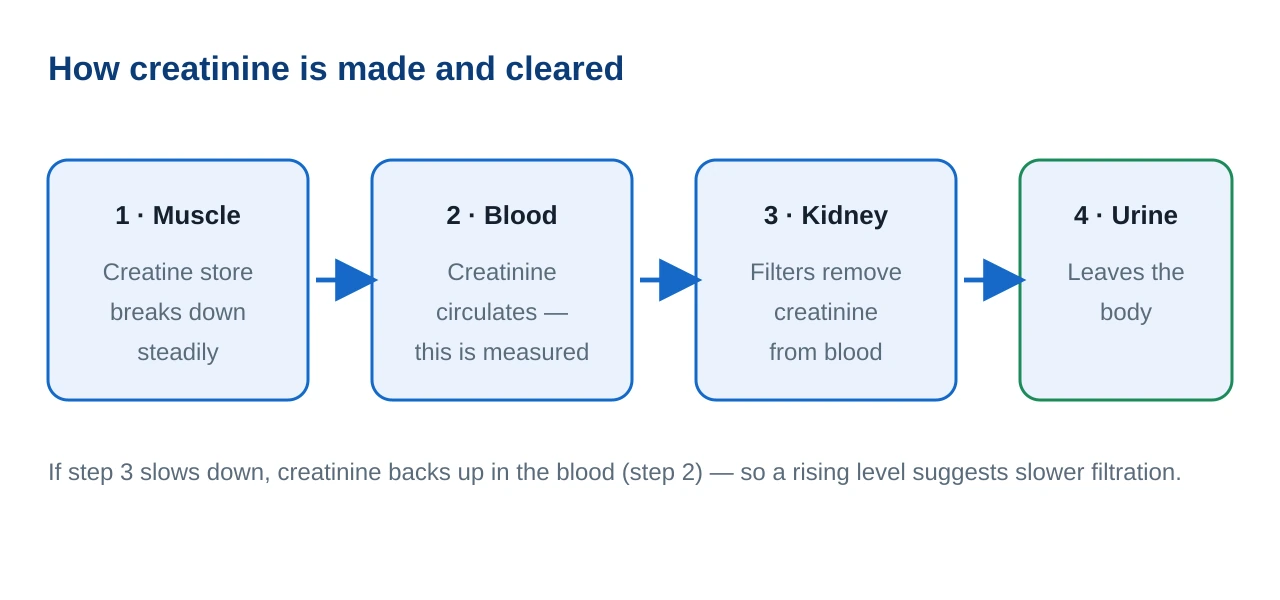
One important nuance: creatinine is not driven by the kidneys alone. Because it comes from muscle, a well-muscled person naturally runs higher, while someone slight, older or with little muscle runs lower — at the same kidney function. That built-in bias is exactly what the eGFR calculation tries to correct, and it is the single most useful thing to understand about this panel.
Normal creatinine ranges for men and women
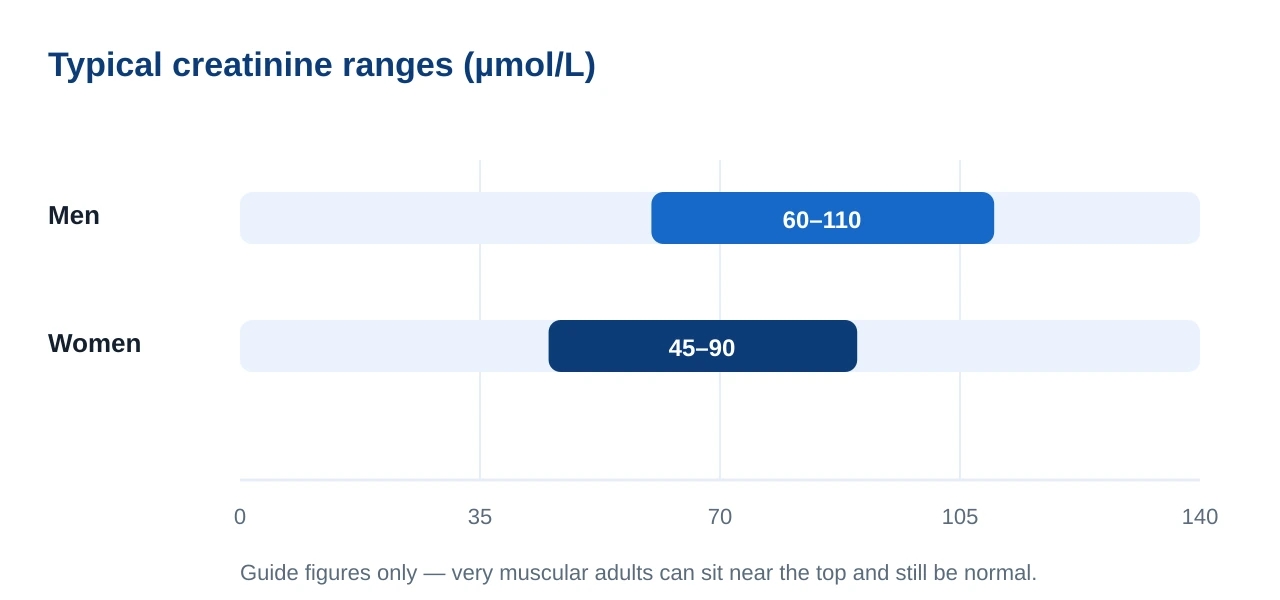
In the UK, creatinine is reported in micromoles per litre (µmol/L). The reference range differs by sex because men, on average, carry more muscle and therefore sit higher. The figures below are typical adult ranges for orientation — your own report's range always overrides them.
| Group | Typical range | Worth knowing |
|---|---|---|
| Adult men | ~60–110 µmol/L | More muscle lifts the upper limit |
| Adult women | ~45–90 µmol/L | Lower muscle mass, lower range |
| Very muscular adult | May sit near the top and be normal | Read together with eGFR |
| Older or low-muscle adult | "Normal" creatinine can hide reduced filtration | eGFR is especially useful here |
You can see why the raw creatinine number is not enough on its own. A reading of 100 µmol/L can be entirely healthy in a young, muscular man, yet the same figure in a frail, older woman might reflect meaningful filtration loss. If you are piecing together your whole report, our guide on how to read a blood test shows how individual values fit into patterns rather than being judged one at a time. You can also drop your numbers into Kantesti's AI blood-test analyser to see creatinine, eGFR and urea explained together in plain English.
What a high creatinine means
A creatinine above your lab's range means the kidneys are clearing it more slowly, or that more is arriving than usual. The main possibilities are:
- Reduced filtration. This is the one that matters most. It can be sudden (acute kidney injury, or AKI — often from dehydration, infection, low blood pressure or certain medicines) or long-standing (chronic kidney disease, CKD).
- Dehydration. Less fluid concentrates the blood and reduces blood flow through the kidneys, nudging creatinine up until you rehydrate.
- Obstruction. Anything blocking the flow of urine — for example stones or an enlarged prostate — can back pressure up to the kidneys and raise creatinine.
- Transient rises. Heavy exercise, a large meat or high-protein meal, or simply having a lot of muscle can lift creatinine temporarily or push a healthy person to the upper end.
Because several of these are temporary, a single high creatinine is usually a reason to look again rather than to worry. A GP will often repeat the test in a calm, well-hydrated state and — crucially — read it alongside your eGFR and your previous results to judge whether anything has actually changed.
What a low creatinine means
People often assume that if a high creatinine is a warning, a low creatinine must be reassuring or, conversely, alarming. In fact, a creatinine that is low is usually not a kidney problem at all. Since the value is generated by muscle, the commonest explanation is simply having less muscle to produce it.
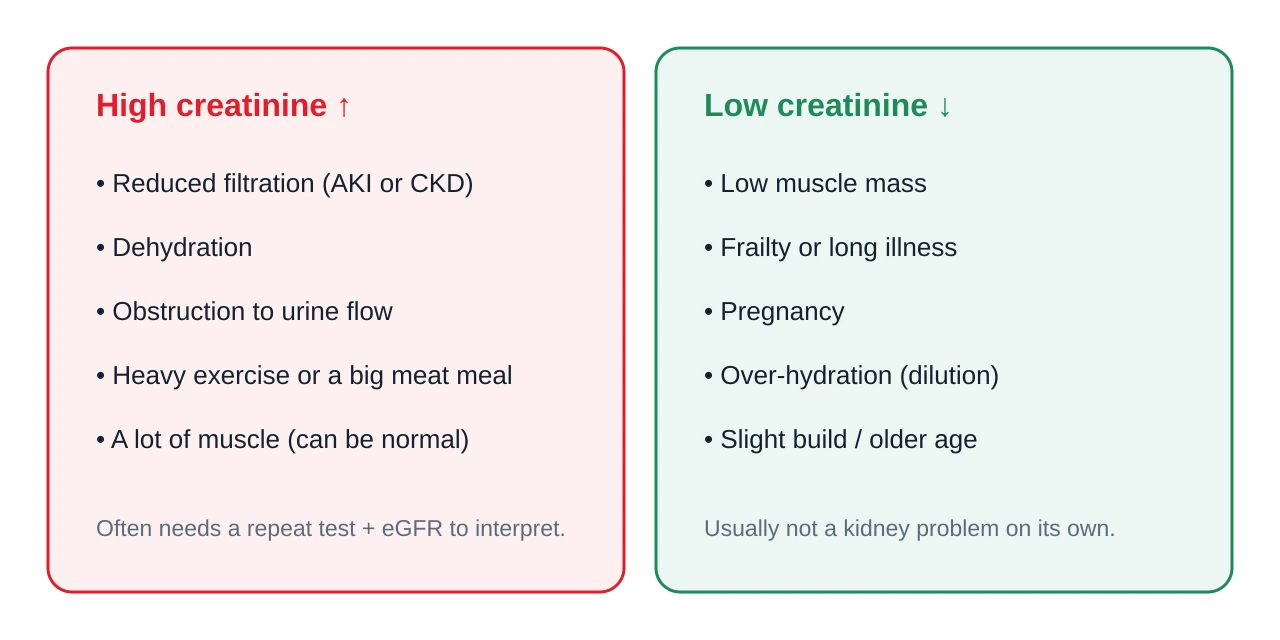
The typical reasons for a low creatinine are low muscle mass, frailty or a long period of illness, pregnancy (when blood volume expands and filtration speeds up), and over-hydration, which dilutes the blood. None of these is a kidney fault. A low creatinine only tends to warrant a second look if it comes alongside unexplained weight loss, obvious muscle wasting or other symptoms — in which case it is the wider picture, not the number, that prompts review. If you ever see a "low" flag and feel well, it is rarely something to lose sleep over; note it and mention it at your next appointment.
What eGFR is, and why it is clearer than creatinine
eGFR stands for estimated glomerular filtration rate. In plain terms, it estimates how many millilitres of blood your kidneys clean per minute, scaled to a standard body size — the units are mL/min/1.73m². It is not a separate blood test: a formula calculates it from your creatinine, your age and your sex.
That is precisely why eGFR gives a cleaner read-out than raw creatinine. By folding in age and sex, the formula partly cancels out the muscle-related distortion that makes creatinine hard to interpret on its own. A creatinine that still looks "normal" can sit alongside an eGFR that has already dipped — flagging a change before any symptom appears. For most people, eGFR is now the headline number to find first on a kidney panel, with creatinine as the value behind it.
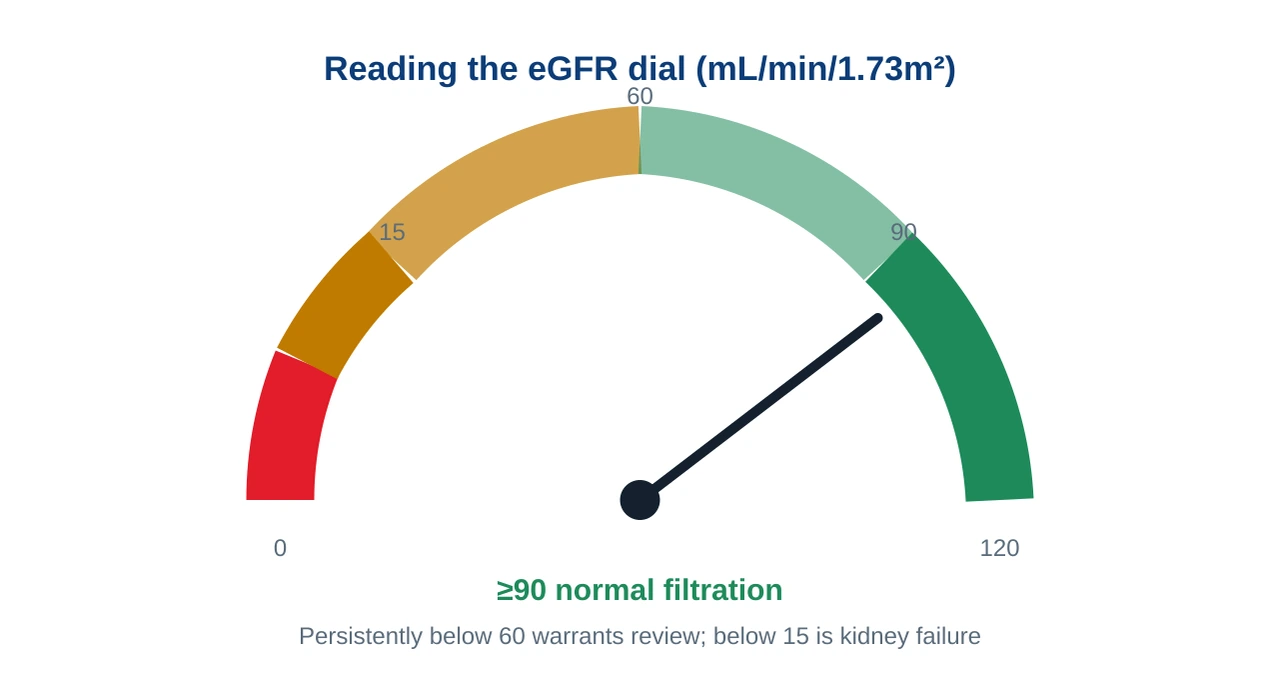
Keep one caveat in mind: eGFR is an estimate, not a perfect measurement. It is less reliable at the extremes of body size, during pregnancy, and in people who have lost a lot of muscle, and it lags behind very sudden changes. In those situations your doctor uses other tools to sharpen the picture. For a single result, the trend over months tells you far more than any one reading.
The CKD stages G1–G5, and where ACR fits
Chronic kidney disease is classified into five GFR categories, G1 to G5, based on eGFR. A stage is not a verdict — it is a reference point that shows where filtration sits and how closely it should be watched. Staging is always a clinical judgement made with the trend and the rest of your results in view, and it follows NICE guideline NG203 and the UK Kidney Association.
| Stage | eGFR | What it means |
|---|---|---|
| G1 | ≥90 | Normal or high filtration — counts as CKD only if another damage marker (e.g. protein in urine) is present |
| G2 | 60–89 | Mildly reduced; without other markers, often not disease on its own |
| G3a | 45–59 | Mild-to-moderate reduction; regular monitoring usually starts here |
| G3b | 30–44 | Moderate-to-severe reduction; closer follow-up needed |
| G4 | 15–29 | Severely reduced function; planning for future treatment may begin |
| G5 | <15 | Kidney failure; dialysis or transplant is considered |
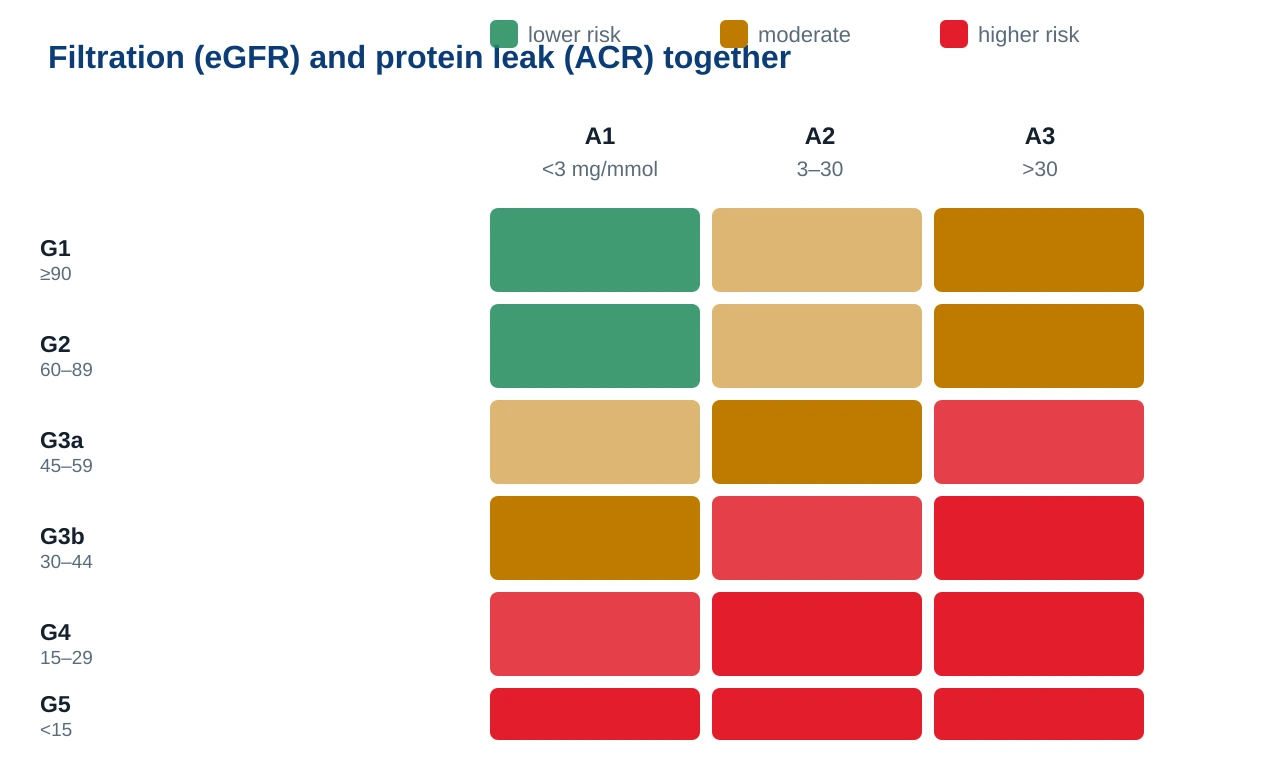
Two things stand out from the grid. First, no single reading is a stage: a one-off eGFR of 55 does not automatically place you in G3a, because it could be a temporary dip from dehydration or illness. Staging generally needs a value confirmed over at least three months. Second, the borders are not cliffs — filtration falls gradually, and the lines exist to guide monitoring, not to mark a sudden change in your health. In the earlier categories most people feel completely well and, with good care, stay stable for many years.
Not sure which stage your numbers point to?
Upload or type in your creatinine, eGFR, urea and ACR and get a calm, plain-English explanation of what they mean together — with clear pointers on what to discuss with your GP. It is our top-rated tool for making sense of a kidney panel.
Analyse my results with KantestiUrea (BUN) and the urea/creatinine ratio
Alongside creatinine and eGFR, the panel usually reports urea — labelled BUN, blood urea nitrogen, on US-style reports. Urea is the end product of protein breakdown, made in the liver and cleared by the kidneys, with a typical UK adult range of about 2.5–7.8 mmol/L. On its own it is a blunter kidney marker than creatinine, because it swings with hydration, diet and other factors. Its real value comes from being read alongside creatinine.
Doctors often look at the urea/creatinine ratio, because the direction it points helps separate a kidney cause from something outside the kidney:
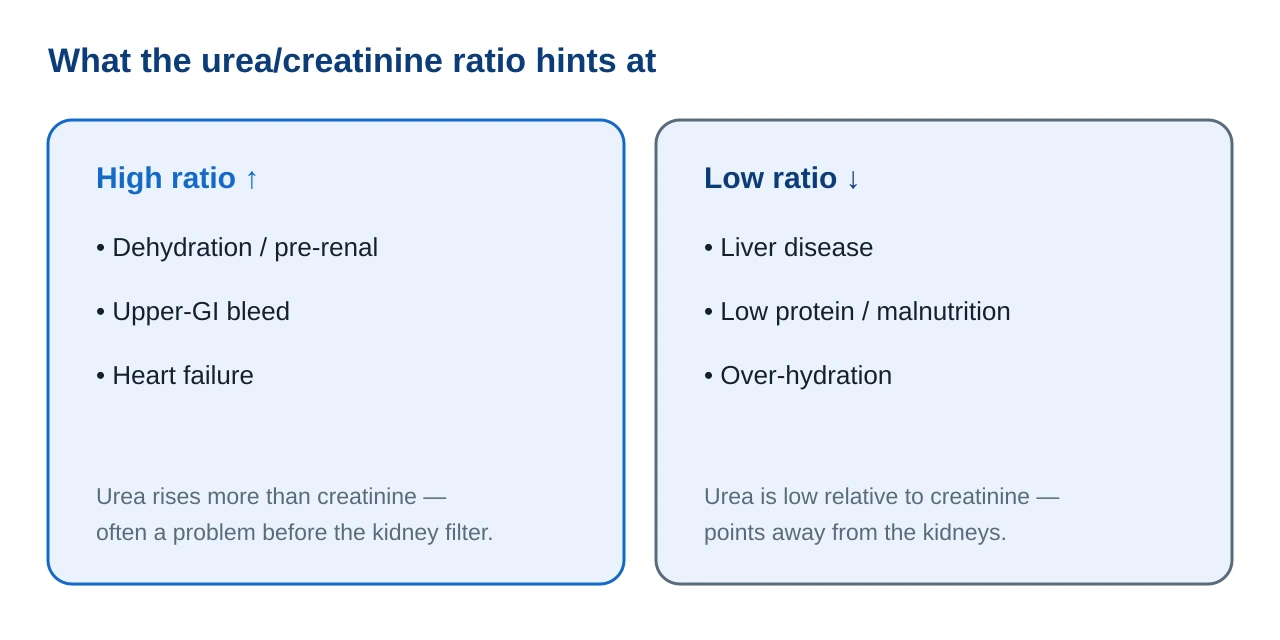
This is also where the phrase "low BUN meaning" comes in, since many people search for it after seeing a low urea. A low urea, or a low urea/creatinine ratio, usually points away from the kidneys entirely. The common explanations are a low-protein diet or malnutrition (less protein means less urea produced), over-hydration diluting the blood, and liver disease — because the liver is where urea is manufactured in the first place. On its own a low urea is rarely dangerous, but because the liver is involved, your GP may read it alongside liver tests. If liver enzymes are on your report too, our guide to ALT, AST and liver function explains how those fit in, and the albumin/globulin ratio guide covers the protein side of the picture.
Why silent decline makes monitoring worthwhile
One of the kidney's quieter traits is that it can deteriorate without symptoms for a long time. The organ has a large reserve, so filtration can drop a fair way before you feel tired, notice a change in your urine, or develop swelling — and by then things may be well advanced. That is exactly why creatinine and eGFR are measured routinely, even in people with no complaints: the aim is early detection, because the sooner a slow decline is spotted, the more can be done to slow it.
It is the trend that matters, not a single figure. An eGFR sitting steadily around 70 for years can be reassuring, whereas a value sliding from 90 to 75 to 62 deserves attention even while it hovers near "normal". Your GP watches precisely this movement against your earlier results. The good news is that the kidneys respond well to the same habits that protect the heart: keeping blood pressure and blood sugar in range, staying adequately hydrated, and using anti-inflammatory painkillers sensibly. The specifics are always a conversation to have with your own clinician.
When to contact your GP
A raised creatinine or a reduced eGFR is, in itself, rarely an emergency and most often calls for calm, planned assessment rather than a rush. That said, a few situations do warrant prompt medical attention — take these seriously.
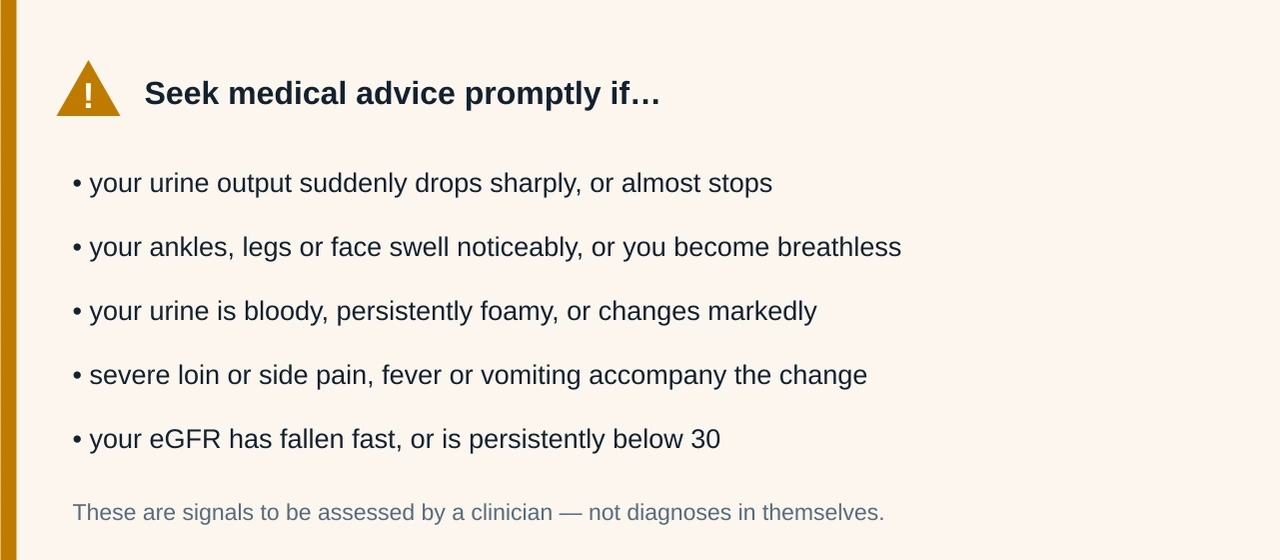
None of these signs is a diagnosis on its own; they simply mean the situation should be looked at by a professional. For the full interpretation of what your creatinine and eGFR mean in your specific circumstances — your age, muscle, medicines and history — your GP is the right person to ask. To see how kidney markers sit alongside the rest of a routine panel, and which analysers can help you prepare for that conversation, our comparison of AI blood-test analysers is a useful next step.
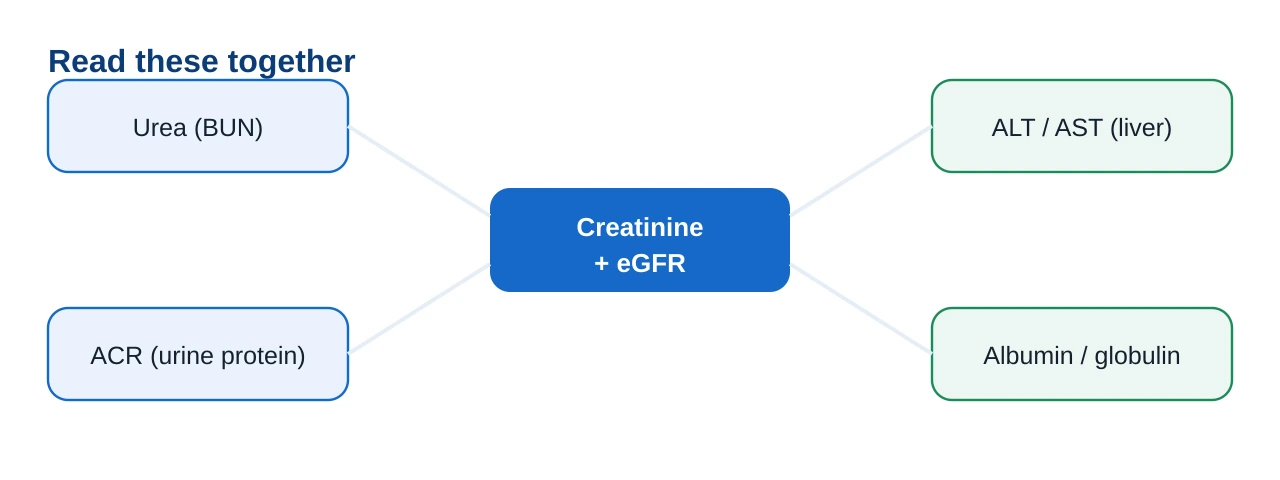
If you would like a second, plain-English read on your full report before you speak to your GP, an AI analyser like Kantesti can walk you through creatinine, eGFR, urea and the related markers together, so you arrive with clearer questions.
Frequently asked questions
What is a normal creatinine level for men and women?
What does a low creatinine level mean?
What does a low urea or low BUN mean?
Can food or exercise raise my creatinine before a blood test?
Does a reduced eGFR mean I have kidney disease?
What is the difference between creatinine and urea (BUN)?
Sources & references
- NICE NG203 — Chronic kidney disease: assessment and management — eGFR (G1–G5) and ACR (A1–A3) classification and monitoring.
- UK Kidney Association — CKD staging — GFR and albuminuria categories used across the UK.
- Lab Tests Online UK — patient-facing explanations of common blood tests and reference ranges.
- NHS SPS — Interpreting liver blood tests — context for urea, the liver's role and related markers.